
Diamond pricing is a complex process influenced by market factors, consumer trends, and certification from respected laboratories. The Diamond Price Guide evaluates each stone based on the 4Cs (carat, cut, colour, and clarity), providing a baseline valuation. Market factors, such as demand for fancy diamonds, loose diamonds, and different cuts like the emerald cut, drive variability in pricing. Consumer trends, including online retailers and choices like halo settings and pavé bands, also influence price premiums. Ethical concerns about conflict zones, blood diamonds, and traceability systems also play a role in pricing and sourcing decisions.
The closure of resources like the Argyle Mine has further impacted the supply of rare diamonds.
The diamond value education helps place this detail in context.
Technological advancements, such as lab-grown jewellery, offer sustainable alternatives, altering the dynamics for natural diamonds in both the sale market and overall diamond market. Industry reports, pricing indices, and data from initiatives like the Rapaport list help diamond dealers track trends, and buyers consider Mohs scale durability and specific diamond characteristics for investment confidence.
What is diamond value pricing?
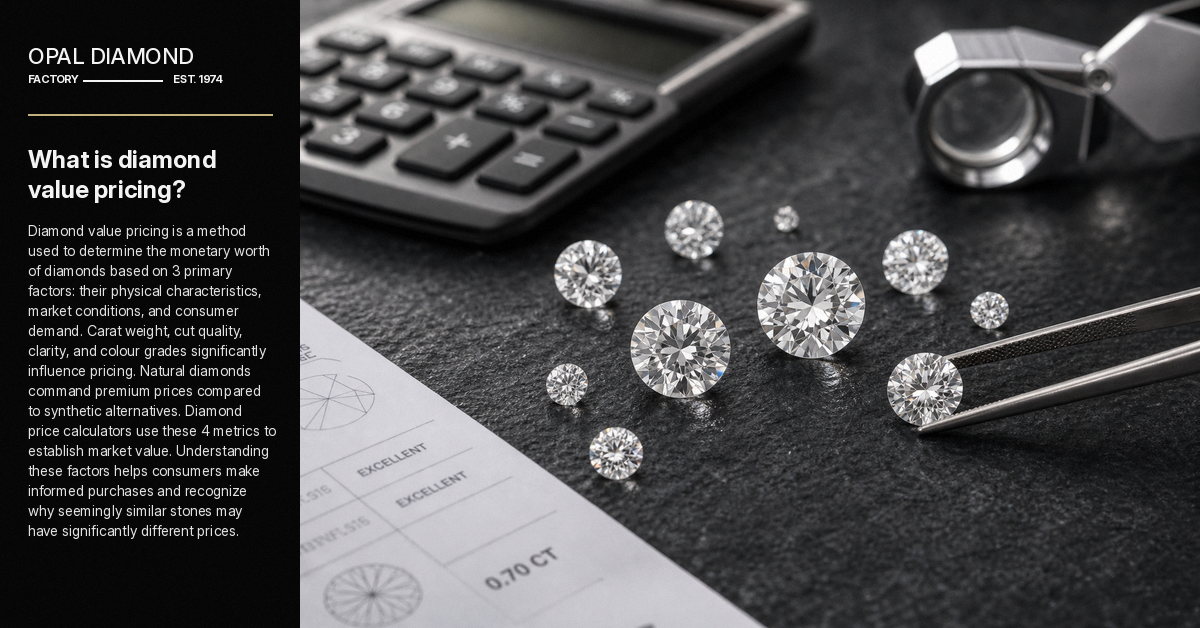
Diamond value pricing is a method used to determine the monetary worth of diamonds based on 3 primary factors: their physical characteristics, market conditions, and consumer demand. Carat weight, cut quality, clarity, and colour grades significantly influence pricing. Natural diamonds command premium prices compared to synthetic alternatives. Diamond price calculators use these 4 metrics to establish market value. Understanding these factors helps consumers make informed purchases and recognize why seemingly similar stones may have significantly different prices.
What factors affect diamond value pricing?
The value of a diamond is influenced by 8 factors that determine its rarity, quality, and overall appeal. These factors are often referred to as the “4Cs” along with 4 other important considerations. Here is a breakdown of the 8 aspects that affect diamond pricing:
- Carat Weight: Larger diamonds are rarer and typically more expensive than smaller ones, as the carat weight significantly impacts their value.
- Cut Quality: The precision of a diamond’s cut affects its brilliance and light performance. Well-cut diamonds generally command higher prices.
- Colour Grade: Diamonds are graded on a scale from colourless to light yellow or brown. Colourless diamonds are the most valued.
- Clarity Grade: The presence of inclusions or blemishes affects clarity. Flawless diamonds are more valuable than those with visible imperfections.
- Shape: Certain diamond shapes, such as round or oval, may be more popular and thus pricier than less common shapes like marquise or heart.
- Fluorescence: The presence of fluorescence under UV light can impact its value, either positively or negatively, depending on buyer preferences.
- Certification: Diamonds certified by reputable gemmological institutions, such as the GIA, tend to hold higher value due to guaranteed quality standards.
- Market Demand and Trends: Consumer preferences, current trends, and availability of specific diamond types influence pricing.
How is diamond value pricing calculated?
Diamond value pricing is calculated in the market using a specific formula that incorporates the 4Cs: carat weight, cut quality, colour grade, and clarity grade. A 1-carat diamond typically costs considerably more than smaller stones of identical quality. Well-cut diamonds command premium prices due to superior light performance. Natural diamond valuation also considers certification from reputable laboratories, which authenticates characteristics and quality. The diamond price chart and global rough diamond price index guide market valuations. When buying diamonds, consumers should understand that prices fluctuate based on supply-demand dynamics, with exceptional stones maintaining value more consistently.
Why is diamond quality important?
Quality is the fundamental determinant of a diamond’s value, with significant variations in price resulting from seemingly minor differences in characteristics. The Gemmological Institute of America (GIA) grading system evaluates diamonds on 4 key attributes: diamond cut, color, clarity, and carat size.
- Cut grades influence visual appeal, determining how light reflects through the stone.
- Colour diamonds range from colourless to yellow tints, with colourless commanding premium prices.
- Clarity refers to internal imperfections, with flawless diamond specimens being exceedingly rare. Clarity grades assess these inclusions’ visibility.
These factors create an all-encompassing assessment framework that establishes a diamond’s market position and worth.
What is the economic relevance of geology?
Geology plays a vital role in supporting the economy by contributing to various industries and providing essential resources. Its impact extends across 6 key areas:
- Resource Exploration and Extraction: Geology informs the discovery and mining of valuable minerals, metals, and gemstones critical for manufacturing and technology.
- Energy Production: It supports the exploration of fossil fuels like oil, gas, and coal, as well as renewable resources like geothermal energy.
- Construction Materials: Geological knowledge aids in sourcing materials like limestone, sand, and gravel used in building infrastructure.
- Water Resource Management: Hydrogeology plays a key role in locating and managing groundwater supplies for agriculture, industry, and domestic needs.
- Land Use and Urban Planning: Geology helps assess land stability, natural hazard risks, and soil quality, ensuring safe and sustainable development.
- Environmental Protection: Geologists study soil contamination, erosion, and geological hazards to support environmental conservation and disaster management.
Geology provides the foundation for numerous industries and promotes sustainable development by managing Earth’s resources effectively.
What is the link between resource scarcity and diamond pricing?
Resource scarcity directly influences the diamond market, with natural diamond prices reflecting finite global reserves. The diamond industry carefully monitors supply constraints, which historically drive price increases tracked through diamond price history charts and indices like the Rapaport List. Rough diamonds represent a diminishing resource, requiring billions of years to form and increasingly difficult extraction. This scarcity underpins wholesale market valuations, as diamond mines eventually deplete. Consequently, the economic principle of limited supply meeting consistent demand continues to support diamond pricing structures in global markets.
What role do diamond deposits play in economic markets?
Diamond deposits play a significant role in global economic markets by driving 5 industries and contributing to trade. Their impact includes the following:
- Wealth Generation and Trade: Diamonds are valuable commodities that contribute to export revenues and global trade.
- Industrial Applications: High-quality diamonds are used in cutting, grinding, and drilling, supporting manufacturing and construction industries.
- Employment Creation: Mining and processing of diamonds provide jobs in producing countries.
- Luxury Goods Industry: Diamonds fuel the luxury market, with demand influencing global pricing and economies.
- Local Economic Growth: Diamond-rich regions benefit from infrastructure development and economic stimulation.
Diamond deposits are vital resources that influence both local and global economies.
How does demand differ between natural and synthetic diamonds?
Demand for natural and synthetic diamonds differs significantly due to their unique market segments, consumer preferences, and distinct applications.
| Feature | Natural Diamonds | Synthetic Diamonds |
|---|---|---|
| Driving Factors | Exclusivity, emotional value, and heritage appeal as luxury items. | Sustainability, ethical considerations, and cost-effectiveness. |
| Primary Use | High-end jewellery, such as engagement rings and heirlooms, symbolizing tradition and luxury status. | Consumer jewellery for younger, eco-conscious buyers; industrial applications in semiconductors and advanced electronics. |
| Market Position | Positioned in the luxury market. | Rising as a versatile, affordable, and ethical option. |
| Cost | Higher prices due to rarity and natural formation. | Significantly lower prices (e.g., 30-40% less for comparable specifications) due to controlled manufacturing processes like CVD and HPHT. |
| Grading | Certified by gemmological institutions like GIA based on 4Cs. | Graded by major gemmological laboratories using the same standards as natural ones, legitimizing their presence in the consumer marketplace. |
| Cultural Impact | Maintain cultural significance for milestone celebrations, fostering enduring demand despite synthetic alternatives. | Offer an ethical and affordable alternative, influencing purchasing decisions of consumers prioritizing sustainability and value. |
This divergence highlights the natural diamond’s place in the luxury market and the synthetic diamond’s rise as a versatile, affordable, and ethical option.
What factors drive demand for natural diamonds?
The perceived value of natural diamonds stems from 3 primary factors: their rarity, tradition, and investment potential. The Gemmological Institute certified diamonds command premium prices based on the 4Cs: carat, cut, colour, and clarity. Diamond shape influences both aesthetics and price, with flawless diamonds representing the pinnacle of value. Larger carat diamonds typically yield higher per-carat diamond price points. Consumers often utilize diamond price calculator and simulator tools to assess potential purchases. Beyond technical specifications, natural diamonds maintain cultural significance for milestone celebrations, creating enduring demand despite synthetic alternatives.
Why are synthetic diamonds increasing in popularity?
Synthetic diamonds have experienced remarkable growth due to 3 primary reasons: technological advancements, changing consumer preferences, and significant cost advantages. Lab-grown diamonds, created through the CVD technique or HPHT technique, offer consumers identical chemical properties to natural stones at considerably lower prices. A well-cut diamond with identical specifications costs 30-40% less when lab-created. This price advantage, combined with environmental and ethical considerations, attracts younger buyers. Major gemmological laboratories now grade synthetic diamonds using the same standards as natural ones, further legitimizing lab-created diamonds in the consumer marketplace.
What are the premium metrics for round brilliant diamonds?
Premium metrics for round brilliant diamonds focus on maximizing their brilliance, fire, and overall appearance. These include 6 key areas:
- Cut Quality: The most critical metric, with Ideal or Excellent grades ensuring optimal proportions, angles, and symmetry for maximizing brilliance and light performance.
- Clarity Grade: Focus on eye-clean diamonds, such as VS1 or VS2, where inclusions are not visible to the naked eye, balancing beauty and value.
- Colour Grade: Opt for a near-colourless range, such as H or I, for the best visual appeal without overpaying, as these appear white in most settings.
- Carat Weight: Balance size with quality; a well-cut diamond may appear larger and more brilliant than a poorly cut diamond of greater weight.
- Certification: Look for reputable grading from organizations like GIA or AGS to ensure consistent and accurate quality standards.
- Symmetry and Polish: High symmetry and polish grades enhance diamond sparkle and brilliance by improving how the stone reflects and refracts light effectively.
These metrics collectively determine the aesthetic and economic value of round brilliant diamonds.
Why are round brilliant diamonds more expensive?
The round brilliant cut commands the highest prices in the market among all diamond shapes due to 3 key factors: consumer demand, production costs, and superior optical performance. Round brilliant diamonds sacrifice more rough diamond during cutting-typically losing 60% of the original stone compared to 50% for fancy shapes. The round brilliant cut’s superior fire and brilliance make it the most sought-after choice for diamond engagement rings. Its 57-58 facets maximize light performance, enhancing sparkle. Additionally, higher demand for round diamonds drives prices upward, with the cut grade profoundly influencing final valuation. These elements combine to justify the premium pricing of round brilliant diamonds.
What certifications prove round brilliant quality?
The quality and value of a round brilliant diamond are objectively established through professional certifications from internationally recognized gemmological laboratories. The GIA diamond grading report is considered the industry standard, providing thorough assessment of a brilliant cut diamond’s attributes. These certificates evaluate 4 critical metrics: cut shape, symmetry, polish, and proportions that determine a diamond’s brilliance. An excellent cut grade indicates ideal light performance in a round brilliant cut diamond. When diamond buying, consumers should prioritize gemmological certifications that detail these specifications. The diamond report serves as objective verification of quality, ensuring purchasers receive accurate information about their investment.
How do clarity and colour impact round brilliant value?
Clarity and colour represent two of the most significant value drivers for round brilliant diamonds, impacting their price beyond certification. Clarity grades affect diamond value dramatically, with flawless specimens commanding premium prices while included stones trade at substantial discounts. Colour grading similarly influences cost, with colourless diamonds (D-F) attracting higher valuations than stones with yellow or brown tints. These metrics interact with carat weight and cut quality when determining final diamond jewellery pricing. For engagement rings especially, the visual impact of high clarity and superior colour becomes most apparent in larger stones, where even subtle differences in grading can translate to thousands in value difference.
How do diamond attributes influence value?
Diamond value derives from 4 primary attributes known as the 4Cs: carat weight, clarity, cut, and color.
- Carat weight typically has the most dramatic impact on price, with larger stones commanding exponentially higher values due to their rarity.
- Cut quality determines how well a diamond handles light.
- Clarity measures the absence of internal inclusions.
- Colour grading assesses the presence of yellow tints.
Each attribute creates distinct value differentials in the marketplace.
How does carat weight affect value?
Diamond price is primarily determined by carat weight, which directly impacts pricing through exponential increases. Larger diamonds are rarer, and even small differences in size can significantly affect a diamond ring’s value. Price snapshots show that carat colour and carat round measurements must be considered together, as even small increments between carat weights can yield substantial price differences.
How does clarity impact pricing?
Diamond pricing is influenced by clarity, with internally flawless diamonds commanding premium prices due to rarity, while slightly included stones offer value. VS2 clarity balances affordability with aesthetics. Consumers should consider 3 factors when buying a diamond: inclusions, clarity grade, and fluorescence. Diamond value pricing models consider clarity as a critical variable in determining fair market value.
How does cut affect price?
Diamond pricing heavily relies on cut quality, surpassing even carat weight. Polished diamonds with excellent proportions command premium prices due to their light performance. Different shapes, such as round brilliant, princess, emerald, and asscher cuts, also impact pricing. A good cut can transform ordinary stones into exceptional gems, justifying price increases of 10-30% compared to poorly cut counterparts.
What role does colour play in diamond pricing?
Diamond colour is the second most important value factor after cut quality, with colourless diamonds commanding premium prices. White diamonds are common, but pink diamonds fetch extraordinary premiums. Colour grading involves examining diamonds in points and carats under controlled lighting. Colored diamonds vary in value based on hue intensity and rarity, with the most valuable specimens combining exceptional colour with excellent cut proportions.
How are diamonds graded?
To accurately determine a diamond’s worth, professional gemmologists employ a standardized grading system known as the 4Cs: cut, colour, clarity, and carat weight. Each diamond receives official certification from gemmological laboratories that document these qualities. When purchasing a diamond engagement ring, buyers can reference these reports. Lab diamonds undergo identical grading processes as natural stones.
Diamond retailers and dealers rely on these standardized assessments to price their inventory. The perfect diamond balances all 4Cs optimally. Even rough diamonds receive preliminary grading before cutting. This systematic approach guarantees consistent valuation across the diamond jewellery market, providing transparency for consumers looking to buy diamonds.
What is certification in pricing?
Diamond certification documents rarity factors that directly impact a stone’s market value. The scarcity of diamonds with exceptional colour, clarity, and carat weight enormously increases their price point. Certified diamonds with rare characteristics-such as D-colour, flawless clarity, or fancy colored diamonds-command premium prices in the marketplace.
How does rarity affect value?
Rarity affects value by increasing demand and exclusivity in 4 ways:
- Large Carat Sizes: Bigger diamonds are harder to find, making them more expensive.
- High Clarity: Flawless stones with no inclusions are rare and command premium prices.
- Perfect Cuts: Ideal cuts that maximize brilliance are less common and highly valued.
- Unique Colours: Fancy-colored diamonds, such as pink or blue, are extremely rare and costly.
The rarer the feature, the higher the diamond’s value.
What trends influence pricing?
5 key trends influence diamond pricing by shaping market dynamics, supply, and consumer preferences:
- Economic Conditions: Inflation, interest rates, and global economic stability directly affect luxury spending and diamond prices.
- Consumer Preferences: Shifts towards sustainable, ethical sourcing and the popularity of lab-grown diamonds impact natural diamond demand.
- Supply Chain Dynamics: Limited supply from major mining sources and geopolitical factors can drive price fluctuations.
- Technological Advancements: Innovations in lab-grown diamond production reduce costs, lowering prices for synthetic diamonds.
- Generational Buying Patterns: Younger consumers prioritize affordability, sustainability, and online purchasing, favouring lab-grown diamonds.
These trends collectively reshape the diamond industry’s pricing landscape.
What economic factors influence diamond value?
5 major economic factors drive diamond value fluctuations in the global market:
- Market demand remains the primary influence, with seasonal buying patterns affecting prices.
- Supply constraints related to diamond rarity create pricing pressure, particularly for larger carat weights.
- Global economic conditions impact consumer spending on luxury goods, including high-clarity stones.
- Industry disruption from lab-grown diamonds has created new pricing dynamics across all colour grades.
- Certification standards evolution also affects valuation, as stricter grading impacts perceived value.
Cut quality premiums fluctuate based on fashion trends and technical advancements in diamond cutting technology.
How does fashion impact diamond prices?
Fashion trends wield significant influence on diamond pricing across the market. When certain jewellery styles gain popularity, demand for specific diamond cuts and settings increases accordingly. The rise of rose gold has affected diamond value by creating premium pairings for certain stone colours. Wedding rings featuring larger diamond center stones command higher prices during periods when statement pieces are fashionable. Similarly, pendants, rings, and earring designs follow cyclical trends that impact diamond pricing. Recently, lab-grown diamonds have disrupted traditional valuation models, offering fashion-conscious consumers alternatives at different price points while still responding to the same trend influences.
How does demand set prices?
The fundamental law of supply and demand directly impacts diamond pricing, with low consumer interest inevitably driving down market values. Shifts in consumer preferences, such as the growing popularity of lab-grown alternatives or changing attitudes toward natural diamonds, create immediate ripple effects throughout the industry’s pricing structure. When demographic groups like millennials embrace different luxury symbols or prioritize experiences over traditional diamond purchases, retailers must adjust prices to maintain viable sales volumes.
Why does low demand lower market value?
When demand for a product falls, its market value typically decreases due to fundamental economic principles of supply and demand. This applies equally to diamonds, whether natural or lab-grown varieties. Market sectors including white gold settings, wedding rings, and diamond pendants experience price sensitivity when consumer interest wanes. Even prestigious pieces, like those comparable to queen’s crown jewels, face devaluation in low-demand periods. Retailers of diamond jewellery eyelet designs must adjust pricing downward when inventory exceeds buyer interest. This guarantees market equilibrium is maintained through price correction, preventing surplus accumulation and encouraging renewed purchasing activity through more attractive pricing.
How do shifts in consumer trends affect prices?
Consumer preferences for diamond jewellery undergo constant evolution, substantially impacting market prices across all segments of the industry. When trends shift toward specific cuts, colours, or sizes, prices for those attributes rise accordingly. Conversely, declining interest in certain styles causes value depreciation. Ethical sourcing, lab-grown alternatives, and vintage jewellery movements have created market segmentation affecting traditional diamond pricing structures. Millennial and Gen Z consumers increasingly prioritize sustainability and uniqueness over conventional status symbols, redirecting market demand. Social media and celebrity influences can rapidly accelerate trend cycles, creating temporary price spikes for featured styles while potentially devaluing previously popular designs almost overnight.
Why do diamond prices change?
Diamond prices change due to 6 various factors that impact supply, demand, and overall market dynamics. Key reasons include:
- Economic Factors: Global economic conditions, inflation, and currency fluctuations influence consumer spending and diamond pricing.
- Supply and Mining Output: Changes in diamond production, mine closures, or new discoveries affect availability and prices.
- Market Demand: Shifts in consumer preferences, such as increased demand for lab-grown diamonds, can impact natural diamond prices.
- Geopolitical Events: Conflicts, trade restrictions, and sanctions in diamond-producing regions can disrupt supply chains and raise prices.
- Seasonal Trends: Holidays, weddings, and proposals often boost demand, temporarily increasing prices.
- Technological Advancements: Improvements in synthetic diamond production reduce costs, creating competition and influencing pricing.
Diamond prices fluctuate as they react to a combination of economic, social, and industry-specific factors.
What are pricing strategies?
Pricing strategies in the diamond market reflect a complex interplay of supply, demand, and marketing psychology. Retailers employ 3 main approaches: keystone pricing (doubling wholesale cost), prestige pricing (high margins signaling exclusivity), and competitive pricing (market-based adjustments). Some sellers utilize dynamic pricing, where rates fluctuate based on market conditions and inventory levels.
Others implement price anchoring by displaying premium diamonds alongside more affordable options to influence perceived value. Promotional strategies, such as seasonal discounts and package deals, create urgency while maintaining value perception. Understanding these tactics helps consumers navigate diamond purchases with greater confidence and negotiate more effectively.
How does ethical sourcing affect value?
Ethically sourced diamonds typically command price premiums due to consumer preferences for conflict-free stones, maintaining stronger resale value compared to diamonds with questionable origins. Natural diamonds generally hold value better than synthetic alternatives, which have dramatically dropped in price as production technology improves. The expanding market for lab-grown diamonds has created a two-tiered pricing structure, with synthetics selling at 30-40% less than comparable natural stones despite identical physical properties.
Why do some items hold resale value better than others?
Commodities in the luxury market demonstrate varying abilities to retain their value over time, with some consistently outperforming others. Items with established brand recognition, limited availability, and historical prestige typically maintain stronger resale values. Diamonds with exceptional quality, certification, and rare characteristics preserve value better than mass-produced alternatives. Market perception of exclusivity and enduring demand considerably impacts an item’s long-term investment potential.
How does synthetic pricing compare?
Synthetic diamonds typically cost 30-40% less than their natural counterparts of equivalent size and quality. This price difference reflects manufacturing costs rather than geological rarity. Lab-grown diamonds have nearly identical physical properties but lack the investment potential of natural diamonds. As production technology improves, synthetic prices continue to decrease while natural diamond values remain more stable over time.
Related diamond guides: Diamond resale value: understanding a diamond's worth; What Are the 4Cs of Diamonds: the Ultimate Guide.