
Diamond shopping can be overwhelming, but understanding the 4Cs (cut, colour, clarity, and carat) is crucial for evaluating diamond quality and value. Diamond cut quality significantly affects a diamond’s brilliance and appearance, and a beautifully cut diamond can surpass larger ones in terms of sparkle. The GIA International Diamond Grading System provides an authoritative evaluation of these characteristics, helping buyers make informed decisions. Certified conflict-free diamonds are increasingly sought after, ensuring ethical sourcing.
When considering diamond rings, shoppers pay attention to diamond cut grades assigned by trained diamond graders, as these directly influence a diamond’s brilliance.
For broader context, compare this point with the diamond value comparison guide.
Heart-shaped diamonds, for example, require expert cutters to achieve perfect symmetry and angles. By understanding these key factors and using GIA’s diamond grading information, buyers can maximize the visual impact of their chosen stone and potentially save thousands on their diamond buying journey.
What do the 4Cs of diamonds represent?
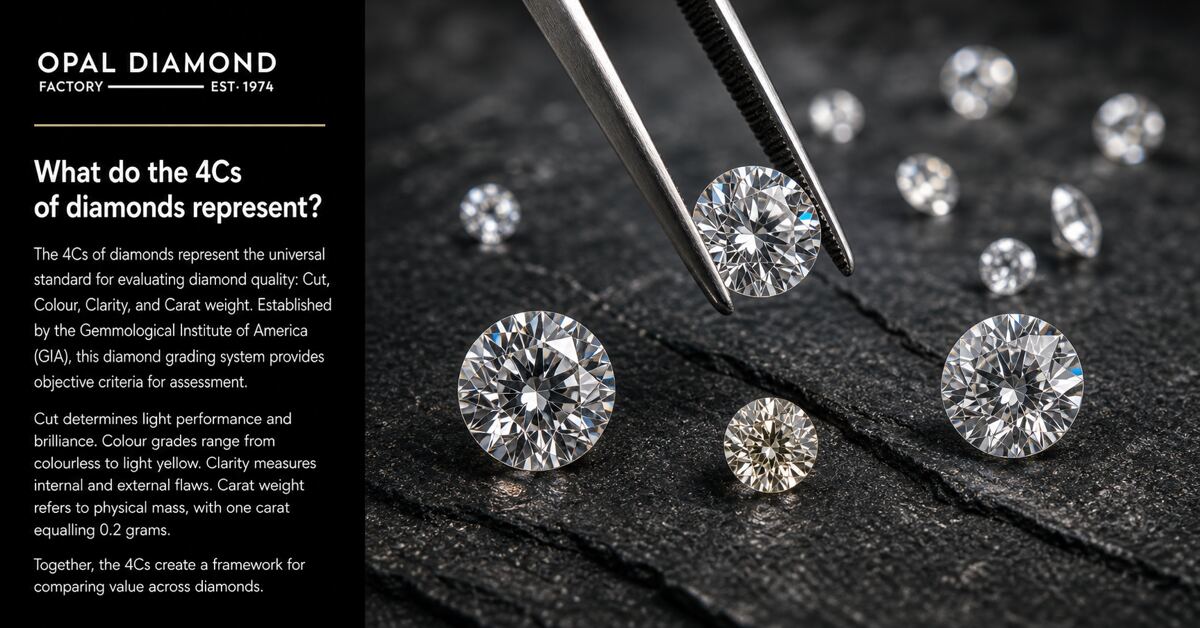
The 4Cs of diamonds represent the universal standard for evaluating diamond quality: Cut, Colour, Clarity, and Carat weight. Established by the Gemmological Institute of America (GIA), this diamond grading system provides objective criteria for assessment.
- Cut: determines light performance and brilliance-how effectively a diamond returns light to the eye.
- Colour: grades range from colourless to light yellow, with higher grades assigned to stones showing less colour.
- Clarity: measures internal and external flaws.
- Carat weight: refers to a diamond’s physical mass, with one carat equalling 0.2 grams.
Together, these 4Cs of diamonds create an exhaustive framework for comparing value across specimens.
What does carat measure?
Diamond carat weight directly affects price but works in conjunction with cut quality to determine a stone’s overall value. A well-cut diamond with ideal proportions appears more brilliant and potentially larger than a poorly cut stone of the same carat weight.
While diamond colour grades range from colourless to light yellow, affecting both appearance and cost, the true magic of a diamond’s sparkle lies primarily in how expertly its facets have been cut and polished.
What are carat calibration tools?
Carat calibration tools are specialized instruments designed to ensure the accuracy of scales used for weighing gemstones. These tools promote confidence in the measurements of gemstones, allowing for fair pricing and quality assessment, essential elements in the jewellery trade.
| Tool Type | Description |
|---|---|
| Calibration Weights | Standardized weights that allow users to verify and adjust the accuracy of their scales. |
| Digital Calibration | Advanced devices that connect to scales for automated calibration and adjustments. |
| Gemstone Calibration | Sets that contain various calibration stones of known weights and characteristics. |
| Reference Scales | Highly precise scales used as a benchmark to compare and calibrate other weighing devices. |
How does cut affect brilliance?
When examining a diamond’s sparkle, cut quality proves to be the most influential of the 4Cs. Unlike other characteristics, cut directly determines how light interacts with the stone.
A well-cut diamond exhibits maximum sparkle through precise angles that capture and reflect light upward through the crown. Cut grades range from Excellent to Poor, with excellent cut diamonds commanding premium prices due to their superior brilliance.
Ideal proportions allow for ideal light reflection, while poorly cut diamonds leak light through the bottom or sides, appearing dull despite potentially high clarity or colour grades. This makes cut quality essential for those prioritizing visual impact over size.
What defines diamond color grades?
Diamond colour grades refer to the classification of a diamond’s colour, particularly focusing on the absence of colour. The grading system assesses how colourless a diamond is, which ultimately affects its value.
- GIA Grading Scale: The Gemmological Institute of America (GIA) established a widely accepted grading scale that ranges from D (colourless) to Z (light yellow or brown).
- Colour Perception: The diamond’s colour is evaluated by comparing it against a set of master stones.
- Hue: Diamonds are graded based on how much yellow or brown is present.
- Fluorescence: Some diamonds exhibit fluorescence under ultraviolet light, which can influence how their colour is perceived.
- Lighting Conditions: The environment in which a diamond is viewed (natural light vs. artificial light) impacts colour perception.
What is clarity enhancement disclosure?
Clarity enhancement disclosure refers to the legal requirement for jewellers to inform consumers about any treatments applied to a diamond to improve its appearance. These treatments may include laser drilling, fracture filling, or other methods that minimize the visibility of inclusions and blemishes.
Full disclosure is essential for ethical business practices and helps consumers make informed decisions about diamond purchases, as enhanced diamonds typically sell for 30-50% less than natural diamonds of similar appearance. The GIA diamond certification explicitly states if a stone has undergone treatments to improve its clarity grades.
How do the 4Cs affect diamond value?
The interplay between the 4Cs creates a complex value matrix where buyers must balance priorities based on personal preferences and budget constraints. Savvy consumers often compare diamonds by prioritizing the C that matters most to them-whether seeking maximum sparkle through cut or size through carat-while making strategic compromises on less visible aspects.
These evaluations gain credibility through professional certification, where independent laboratories document each of the 4Cs, providing objective verification that greatly impacts a diamond’s market value.
How do buyers balance the 4Cs?
Balancing the 4Cs of diamonds requires understanding their relative impact on both value and visual appeal. The diamond grading system offers flexibility for buyers with different priorities and budgets.
Cut grade typically delivers the most visible impact on a diamond’s sparkle, making it worth prioritizing. Colour and clarity grades can often be compromised slightly without noticeable differences to the naked eye, especially in diamonds that are well-cut.
Experts recommend selecting the highest cut quality possible, then balancing carat weight against colour and clarity to maximize value. Quality diamonds do not necessarily need perfect grades in all categories.
How do buyers compare the 4Cs?
When buyers evaluate products, they often utilize the framework of the 4Cs: Customer, Cost, Convenience, and Communication. This model helps buyers compare and contrast different offerings by focusing on key aspects that affect their purchasing decisions.
| Aspect | Focus |
|---|---|
| Customer | Assess the needs and preferences of the target audience. |
| Cost | Evaluate the total cost of ownership, including purchase price and ongoing expenses. |
| Convenience | Consider the ease of obtaining the product or service, encompassing the purchasing process. |
| Communication | Analyse the effectiveness of marketing and customer service communications. |
How do the 4Cs influence certification?
Diamond certification stands as the official documentation of a stone’s 4C qualities, providing an objective assessment from respected gemmological laboratories. The Gemmological Institute of America Inc (GIA) established the definitive grading system that evaluates how diamonds are graded across all 4C diamond attributes.
A diamond grading report meticulously documents cut, colour, clarity, and carat weight using standardized scales.
The difference between a flawless diamond and one with minor inclusions becomes officially recognized through certification. This documentation guarantees transparency in pricing and quality, allowing consumers to use the report as a practical buying checklist when comparing stones of similar specifications but potentially different values.
What tools measure the 4Cs?
Measuring the 4Cs of diamonds-Carat weight, Cut, Colour, and Clarity-requires specific tools and instruments.
| 4C Aspect | Tools Used |
|---|---|
| Carat Weight | Jewellery Scale: A precise digital or mechanical scale. |
| Cut | Gemmological Microscope: Used to analyse proportions and symmetry. Aperture Gauge: Measures facet angles. |
| Colour | Master Colour Set: A collection of graded diamonds for reference. Colour Grading Light: Specific lighting. |
| Clarity | Gemmological Microscope: Essential for inspecting internal and external flaws. Loupe: A 10x magnifying glass. |
How have 4Cs standards changed?
The Gemmological Institute of America (GIA) has periodically updated 4Cs standards since their introduction in 1953 to reflect advances in gemmological research and technology. Advanced imaging systems and spectroscopy now enable more precise measurements of diamond characteristics, particularly in cut assessment and clarity detection.
These technological improvements have created more refined grading distinctions, allowing consumers to make increasingly informed decisions when selecting diamonds.
How do new technologies impact 4Cs standards?
Constantly evolving technologies have revolutionized how gemmologists evaluate diamonds according to the 4Cs standards. Advanced imaging systems now capture microscopic details invisible to the naked eye, providing unprecedented accuracy in grading excellent cut diamonds.
The diamond industry has embraced spectroscopy and AI-powered analysis to differentiate between natural and lab-grown diamonds. These new technologies have refined Liddicoat’s original standards, allowing for more precise evaluations of various diamond shapes.
3D mapping technologies measure facet symmetry with mathematical precision, resulting in more consistent cut grades. Lab diamonds particularly benefit from these advancements, as their production processes can now be optimized based on detailed 4Cs feedback.
Who initiated changes in 4Cs standards?
Industry pioneers at the Gemmological Institute of America (GIA) spearheaded the evolution of 4Cs standards since their introduction in 1953. Their ongoing research has refined how cut, colour, clarity, and carat are evaluated in natural diamonds.
The GIA revised cut standards for round brilliant diamonds in 2005, creating a more precise system that better reflected how diamonds interact with light. Similar refinements occurred for fancy cuts. Additionally, organizations like the International Gemmological Institute (IGI) contributed to standards for lab-grown diamonds.
As technology improved detection of treatments in diamonds mined worldwide, criteria evolved to distinguish natural gemstones from synthetic alternatives, particularly for larger diamonds.
How do retailers explain the 4Cs?
Retailers employ various methods to explain the 4Cs, from interactive displays and comparison tools to simplified grading charts and educational videos. Explanations often vary based on retailer type, with high-end jewellers typically providing more technical details while mass-market stores focus on simplified consumer-friendly explanations.
This variance in communication approach also stems from each retailer’s marketing strategy and customer demographic, with some emphasizing certain Cs over others to highlight their specific inventory strengths.
What methods do retailers use?
Retailers utilize a variety of methods for selling diamonds and gemstones effectively. These strategies encompass both traditional and modern approaches to reach a wider audience and enhance customer experiences.
| Method | Description |
|---|---|
| In-Store Sales | Traditional retail environments for physical examination and personalized service. |
| Online Marketplaces | E-commerce platforms to expand reach and provide convenient browsing. |
| Auction Houses | Partnerships for specialty sales of unique or high-value pieces. |
| Gem Shows and Trade Fairs | Participation to network, showcase offerings, and stimulate sales. |
| Social Media Marketing | Leveraging platforms to promote products, engage customers, and share educational content. |
| Email Marketing Campaigns | Targeted campaigns for new arrivals, promotions, and exclusive offers. |
| Subscription Services | Innovative models for curated gemstone selections. |
| Custom Design Services | Offering bespoke jewellery design to attract customers seeking personalized pieces. |
| Customer Education | Providing resources about the 4Cs and gemstone care to foster trust. |
Why do explanations vary among retailers?
Despite adhering to gemmological standards, explanations of the 4Cs differ markedly among retailers based on their business models and target demographics.
High-end fine jewellery merchants emphasize flawless diamonds and ideal proportions, while mass-market retailers might focus on carat weight to appeal to budget-conscious shoppers. A diamond shape guide varies between stores, with some highlighting classic engagement ring styles and others promoting fancy-shape diamonds as unique alternatives.
When comparing white diamonds of equal carat weight, customers often encounter different narratives about what matters most. Retailers selling direct from rough diamond sources may emphasize ethical sourcing, while others focus exclusively on optical performance. These varied approaches reflect each seller’s commercial priorities.
What are 4Cs misconceptions?
Many diamond shoppers mistakenly believe that all 4Cs contribute equally to a diamond’s beauty and value. In reality, cut quality impacts sparkle far more than the other characteristics, especially in round diamonds versus fancy shape diamond options like emerald cut styles.
Another misconception is that colourless diamonds are always superior. While D-grade diamonds command premium prices, many colored diamonds-particularly fancy vivid pink diamonds or light yellow varieties-are highly prized.
Consumers often assume white gold settings enhance a diamond’s colour, when metal choice is primarily aesthetic. Finally, many incorrectly believe lab-created diamonds are visually distinguishable from natural ones, when they are chemically identical.
Which 4C matters most?
Consumer preferences consistently show that cut has emerged as the most valued of the 4Cs because it directly impacts a diamond’s brilliance and visual appeal.
Market research indicates that while previous generations prioritized carat weight, today’s buyers often sacrifice size for superior sparkle and overall appearance. This shift reflects broader market trends toward valuing performance and visual impact over traditional metrics of diamond value.
What 4C is prioritized by consumers?
When surveying the diamond landscape, three out of four consumers prioritize cut above all other criteria. This preference aligns with industry expertise, as cut determines a diamond’s sparkle and overall brilliance-the qualities that make these gems mesmerizing.
While the 4Cs all influence a diamond’s value, most jewellery shoppers understand that a well-cut stone with minor colour imperfections will outshine a poorly cut diamond of higher colour grade. When selecting rings and other diamond pieces, consumers increasingly favour exceptional cut quality, willing to compromise slightly on carat size or clarity to maximize visual impact within their cost parameters.
How do market trends affect 4C importance?
Market trends continuously shift which diamond 4C receives premium valuation, with cut gaining prominence in recent years as consumers prioritize sparkle over size. Retailers and diamond marketers often emphasize whichever C aligns with their inventory strengths, potentially steering buyers toward characteristics where profit margins are highest.
Savvy diamond shoppers who understand these shifting priorities can capitalize on temporary market undervaluation of certain characteristics, such as buying excellent-cut diamonds during periods when carat weight dominates consumer attention.
Why is one 4C sometimes weighted more?
Many diamond experts acknowledge that not all 4Cs carry equal weight in determining a diamond’s value and desirability. Cut often dominates because it directly impacts sparkle, with round shapes commanding premium prices.
Clarity follows, though conflict-free and lab-grown diamonds like Liori diamonds have shifted priorities. Colour preferences vary by metal pairing-white gold enhances colourless stones while yellow or rose gold complements warmer tones, especially fancy colours like pink diamonds.
Who benefits from emphasizing a specific 4C?
Different stakeholders throughout the diamond industry strategically emphasize certain 4Cs to maximize their profits or align with their business models. Retailers selling wedding rings or eternity rings highlight cut for sparkle, while custom jewellers emphasize colour uniqueness like rare red diamonds.
Ethical suppliers avoid conflict diamonds by focusing on certification. Many times, marketing campaigns
Related diamond guides: How is diamond carat pricing calculated: the role of weight, clarity, and market dynamics; Diamond value pricing: understanding the factors that define value.