
Diamond brilliance is the reflection of light within a diamond, influenced by natural properties and the science behind diamond cuts. The difference between true brilliant-cut diamonds and fancy shape diamonds significantly impacts light performance. The diamond cut grade is crucial for optimal performance, affecting how light bounces and creates flashes. Elements like table percentage, diamond symmetry, and pavilion depth work together to achieve excellent brilliance.
Diamond polish and proper proportions ensure maximal light return, whether viewed in natural or incandescent light. Round-cut diamonds are considered the quintessential diamond shape for exceptional brilliance, but cushion-cut and Step cut diamond shapes offer different light performance characteristics.
For broader context, compare this point with the diamond characteristics guide.
The quality of brilliance is especially important for diamond engagement rings, and diamond experts use comprehensive diamond grading reports to evaluate these important aspects.
What causes diamond brilliance?
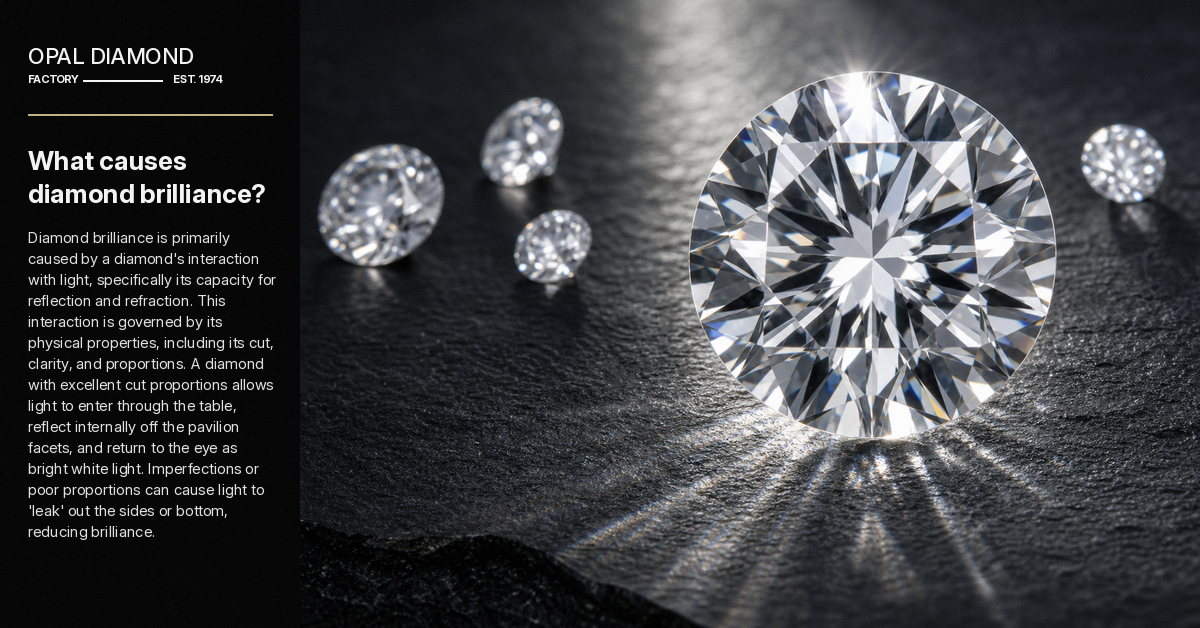
Diamond brilliance is primarily caused by a diamond’s interaction with light, specifically its capacity for reflection and refraction. This interaction is governed by its physical properties, including its cut, clarity, and proportions. A diamond with excellent cut proportions allows light to enter through the table, reflect internally off the pavilion facets, and return to the eye as bright white light. Imperfections or poor proportions can cause light to ‘leak’ out the sides or bottom, reducing brilliance.
How is diamond brilliance measured?
Diamond brilliance is measured against established diamond cut grading standards, which evaluate a diamond’s proportions, symmetry, and polish. Gemological laboratories, such as the Gemological Institute of America (GIA) and the American Gem Society (AGS), use specialised instruments and visual assessment to determine a diamond’s light performance. These standards minimise light leakage by requiring specific facet angles and alignment. Clarity also affects perceived brilliance; inclusions or blemishes can obstruct light pathways.
Why does diamond brilliance change?
Diamond brilliance can change due to several factors related to its physical condition or external environment. These include:
- Accumulated dirt or oils: Surface contaminants obstruct light entry and exit.
- Physical damage: Chips or abrasions on facets disrupt light reflection.
- Changes in lighting conditions: Different light sources (e.g., sunlight, incandescent, fluorescent) reveal different aspects of brilliance, fire, and scintillation.
- Wear over time: Micro-abrasions can develop, slightly dulling the surface polish.
Maintaining a diamond’s cleanliness is crucial for preserving its optimal brilliance.
What affects diamond brilliance most?
The cut of a diamond affects its brilliance most significantly. The cut is not the shape (like round or princess) but the quality of a diamond’s proportions, symmetry, and polish. These three elements dictate how light travels through the stone.
- Proportions: The relative sizes and angles of the facets.
- Symmetry: The precise alignment of facets.
- Polish: The smoothness of the facet surfaces.
An ideal cut maximises light return, fire (dispersion of white light into spectral colours), and scintillation (sparkle and flash created by movement).
What is light return in diamonds?
Diamond brilliance is a major aspect of diamond science, determining how natural light enters and reflects back to the viewer’s eye through the diamond table and crown facets. Excellent diamond brilliance depends on perfect diamond proportions, with careful diamond cutting ensuring light between facets reflects internally rather than escaping. The surface of diamonds, whether lab or natural, must have excellent polish to maximise flashing between light.
The depth range and crown measurement significantly influence how visible light transforms into rainbow light, making diamond features like these crucial for a sparkling appearance. The quality chart of diamonds, from EightStar-brand diamonds to SI2 diamond grades, shows how various factors affect the diamond gemstone’s ability to create flashes of light reflected. This understanding helps in choosing the best diamond for various settings, whether they are perfect stone specimens or special diamond cuts.
What is fire in diamond brilliance?
Fire in diamond brilliance is the dispersion of white light into spectral colours, seen as flashes of rainbow colours within the diamond. This occurs because the diamond material separates white light into its constituent colours, much like a prism. The amount of fire depends on the diamond’s cut proportions and the dispersion property of the diamond material itself. A diamond with high fire will exhibit strong, vibrant colour flashes.
What is scintillation in diamonds?
Scintillation in diamonds refers to the sparkle and flashes of light observed when the diamond, the light source, or the viewer moves. It is the interplay of light and dark areas (contrast) created by the reflections within the diamond.
Scintillation has two components:
- Flash scintillation: The flashes of light.
- Pattern scintillation: The pattern of light and dark areas.
A well-cut diamond exhibits a lively and attractive scintillation pattern, with balanced flashes of light and dark areas that are not too large or too small.
How does cut affect brilliance?
The cut of a diamond fundamentally affects its brilliance by controlling the path of light through the stone. A diamond cut with precise proportions, symmetry, and polish will exhibit superior light performance.
Consider the following cut characteristics and their impact:
|
Cut Characteristic |
Impact on Brilliance |
|---|---|
|
Table Size |
Too large or too small can reduce light return. |
|
Crown Angle |
Affects dispersion (fire) and how light enters. |
|
Pavilion Angle |
Most critical for light return; impacts internal reflection. |
|
Culet Size |
A large culet can cause light leakage. |
|
Symmetry |
Ensures light reflects evenly; poor symmetry causes uneven brilliance. |
|
Polish |
Smooth surfaces allow unobstructed light entry and exit. |
A cut that deviates from ideal proportions will result in diminished brilliance due to light leakage.
Which cut gives most brilliance?
The round brilliant cut is widely considered the diamond shape that provides the most brilliance. This is due to its specific structure, which typically features 57 or 58 facets meticulously arranged to maximise light reflection and dispersion. Professional diamond cutters have optimised the proportions and angles of the round brilliant cut over centuries to achieve exceptional light performance. Other shapes, like the princess cut or cushion cut, can also exhibit high brilliance when cut to excellent standards, but the round brilliant generally sets the benchmark.
How does symmetry affect brilliance?
Symmetry significantly affects a diamond’s brilliance because it ensures the precise alignment of facets. When facets are perfectly symmetrical, light enters and reflects within the diamond in a uniform and predictable manner, maximising light return and creating a balanced scintillation pattern. Poor symmetry, such as misaligned facets or an off-center culet, disrupts the path of light, causing uneven brilliance and reduced sparkle. Excellent symmetry is a key component of a high-quality cut grade.
How does clarity affect brilliance?
Clarity affects a diamond’s brilliance by influencing the unobstructed passage of light through the stone. Clarity refers to the absence of inclusions (internal flaws) and blemishes (external imperfections). Significant inclusions located in critical areas, particularly near the center of the diamond or in the pavilion, can block or scatter light, reducing light return and diminishing brilliance. For example, a large black inclusion under the table facet could create a noticeable dark spot and reduce brilliance. Diamonds with higher clarity grades generally exhibit better brilliance because they have fewer internal disruptions to light flow.
What is light return optimisation?
Light return optimisation is the process of cutting a diamond to maximise the amount of light that returns to the viewer’s eye, thereby enhancing its brilliance. This involves meticulously planning and executing the cut to achieve specific proportions, angles, and symmetry. Diamond cutters use advanced technology to map the rough diamond and determine the optimal way to cut it to achieve the highest possible light return, balancing brilliance with other factors like carat weight. The goal is to minimise light leakage and maximise the internal reflection and dispersion of light.
How does colour affect brilliance?
Colour affects the perception of brilliance, although it does not directly change the diamond’s ability to reflect white light. Diamonds are graded on a colour scale from D (colourless) to Z (light yellow or brown). A colourless diamond (D-F) allows white light to pass through and return unobstructed, showcasing the diamond’s inherent brilliance and fire, both of which influence value pricing. As the colour tint increases, the body colour of the diamond can become more apparent, which might influence how the white light return is perceived against that tint.
Fancy coloured diamonds, such as pink, blue, or yellow diamonds, are graded based on the intensity of their colour, and their brilliance is evaluated in the context of how well the cut displays that specific body colour.
Which shape has most brilliance?
As previously stated, the round brilliant shape typically exhibits the most brilliance due to its optimised facet arrangement designed for maximum light return. However, other shapes can also show significant brilliance.
Here are some popular diamond shapes and their general brilliance characteristics:
|
Diamond Shape |
Brilliance Characteristics |
|---|---|
|
Round Brilliant |
Highest potential for brilliance, fire, and scintillation. |
|
Princess Cut |
High brilliance, especially in the center, with sharp flashes. |
|
Cushion Cut |
High brilliance with a softer, warmer sparkle (“pillowy” look). |
|
Oval Cut |
Exhibits brilliance similar to round brilliants, with a bowtie effect potential. |
|
Pear Shape |
Combines brilliance with elegance, also susceptible to a bowtie effect. |
What is pavilion angle precision?
Pavilion angle precision is important in achieving optimal diamond performance, determining how light travels through natural and lab diamonds. Professional diamond cutters understand these angles are essential for creating diamond sparkle and preventing poor brilliance. In brilliant diamond shapes and cushion-cut diamonds, facet to facet angles below the girdle are critical. Insufficient pavilion angles cause light leaks, while steep crown angles create unwanted light deflection.
Diamond cutters target approximately 40.75 degrees for round brilliants to achieve excellent sparkle and colourful flashes. This element of diamond brilliance is documented in gemological diamond grading reports and affects everything from dazzling diamond scintillation to the sparkly appearance of the stone. These standards ensure that each diamond crystal achieves its full potential, regardless of colour grade or settings.
What is symmetry reflective scoring?
Symmetry reflective scoring is a component of a diamond’s overall symmetry grade that specifically evaluates how evenly and consistently light reflects off the facets. It assesses the precision of the facet shapes, sizes, and alignment. A diamond with perfect symmetry reflective scoring will have facets that are uniform and precisely angled relative to each other, ensuring that light behaves predictably and creates a harmonious pattern of brilliance and scintillation. This scoring contributes to the final symmetry grade provided by gemological laboratories.
What reduces diamond brilliance?
Several factors can reduce a diamond’s inherent brilliance.
These include:
- Poor Cut Quality: Angles and proportions that cause light leakage.
- Significant Inclusions or Blemishes: Internal or external flaws that obstruct light.
- Grease, Dirt, or Residue: Surface contamination prevents light from entering or exiting cleanly.
- Low Polish Grade: A rough surface diffuses light instead of reflecting it sharply.
- Incorrect Setting: A setting that covers too much of the diamond can impede light flow.
- Damage: Chips, scratches, or abrasions on facets.
Maintaining a diamond’s cleanliness and ensuring it was cut to high standards are the best ways to preserve its brilliance.
What improves diamond brilliance?
To improve a diamond’s brilliance, one must focus on the factors that enhance its interaction with light.
Here are several ways to improve or maximise diamond brilliance:
- Excellent Cut Quality: A diamond cut to ideal proportions, symmetry, and polish maximises light return.
- High Clarity Grade: Fewer inclusions mean less obstruction to light pathways.
- Regular Cleaning: Removing surface dirt and oils allows light to interact optimally.
- Choosing a Brilliant Cut: Shapes like the round brilliant, princess, and cushion cuts are designed for high brilliance.
- Appropriate Setting: A setting that exposes most of the diamond to light enhances sparkle.
- Ideal Proportions: Ensuring the table, crown, and pavilion angles are within optimal ranges for light return.
Focusing on the cut quality is the most impactful way to ensure high brilliance from the outset.
What tools measure brilliance?
Several specialised tools are used by gemologists and laboratories to measure diamond brilliance and other light performance aspects. These tools objectively quantify how a diamond interacts with light.
Tools include:
- Spectrophotometers: Measure how a diamond interacts with light across different wavelengths.
- Imaging Systems: Capture visual representations of light return, fire, and scintillation patterns. Examples include the ASET (Angular Spectrum Evaluation Tool) and Ideal-Scope.
- Proportion Scopes: Measure the angles and proportions of a diamond’s facets.
- Gemological Microscopes: Allow for detailed examination of facet arrangement, symmetry, and polish.
These tools, combined with expert visual assessment, contribute to a diamond’s light performance grading, helping buyers understand its potential brilliance.
How to compare diamond brilliance?
To accurately compare diamond brilliance, it is best to examine diamonds side-by-side under different lighting conditions.
Steps for comparing brilliance:
- Use consistent lighting: Evaluate diamonds under various light sources, including diffuse lighting (like fluorescent) and spotlighting (like halogen).
- Observe sparkle: Look for the intensity and pattern of white flashes (scintillation).
- Assess fire: Note the presence and vibrancy of coloured flashes.
- Check light return: Look for dark areas within the diamond, which may indicate light leakage due to poor proportions.
- Review grading reports: Consult reports from reputable laboratories (GIA, AGS) for objective assessments of cut, symmetry, and polish.
- Use light performance tools: If available, use tools like an ASET scope to visualise light return.
How to choose brilliance over size?
Choosing brilliance over size means prioritising the quality of a diamond’s cut and its light performance over a larger carat weight with inferior characteristics. A smaller diamond with an excellent cut will often appear more vibrant and beautiful than a larger diamond with a poor cut. This is because brilliance is the primary factor that makes a diamond visually appealing and lively.
When deciding, consider the following:
- A well-cut diamond maximises sparkle, making it appear lively.
- Light performance grading reports provide objective data on brilliance potential.
- Focusing on cut quality (excellent or ideal) ensures optimal light return.
- If budget is a constraint, a slightly smaller diamond with a superior cut offers more visual impact than a larger, poorly cut stone.
- Tools like the GIA cut grade for round brilliant diamonds provide a clear indication of potential brilliance.
Why does brilliance affect value?
Brilliance significantly affects a diamond’s value because it is a primary indicator of its beauty and desirability. A diamond that exhibits high brilliance is more visually appealing and captivating. Market demand for brilliant diamonds drives their value. A well-cut diamond that maximises brilliance requires greater skill and yields less from the rough stone, increasing its cost.
Laboratories evaluate cut quality and light performance, and diamonds with higher grades in these areas command higher prices due to their enhanced brilliance and overall visual appeal. The sparkle is what most people associate with a beautiful diamond, making brilliance a key component of its perceived and actual worth.
How to keep diamond brilliance?
Maintaining a diamond’s brilliance requires regular cleaning and care to prevent the buildup of substances that can hinder light performance.
Follow these steps to keep a diamond brilliant:
- Clean regularly: Use a soft brush and mild soap in warm water to gently scrub the diamond and setting.
- Use commercial jewellery cleaner: Follow product instructions for cleaning diamonds safely.
- Avoid harsh chemicals: Do not expose diamonds to chlorine bleach or other harsh chemicals, which can damage the setting.
- Rinse thoroughly: After cleaning, rinse the diamond under running water to remove all soap residue.
- Dry with a soft cloth: Use a lint-free cloth to dry the diamond and prevent water spots.
- Store separately: Store diamond jewellery in a fabric-lined box or separate pouch to prevent scratches from other jewellery.
- Professional cleaning: Have your diamond jewellery professionally cleaned and inspected periodically.
These practices remove surface barriers, allowing light to interact fully with the diamond and maintain its maximum sparkle.
Related diamond guides: What is diamond clarity: discover how grades, flaws, and sparkle affect what you see and pay; What is diamond fire: see what makes diamonds sparkle beyond brilliance.