
Diamond fire is a captivating optical phenomenon that manifests as vivid flashes of light and rainbow colours, particularly evident in brilliant-cut diamonds with ideal cut proportions and excellent symmetry. The interaction between light and a diamond’s physical and virtual facets creates this breathtaking display of scintillation, setting true diamonds apart from alternatives like cubic zirconia or moissanite gemstones.
The quality of diamond fire depends on several key factors, including the stone’s clarity, cut grade, and arrangement of facets, which diamond cutters have perfected over centuries. This distinctive characteristic is visible across various lighting conditions and contributes significantly to a diamond’s overall beauty, whether in loose stones or beautiful diamond engagement rings, creating a mesmerising pattern of brightness and coloured sparkle that makes each stone uniquely appealing.
This detail is part of the wider diamond characteristics quality guide.
What is diamond fire?
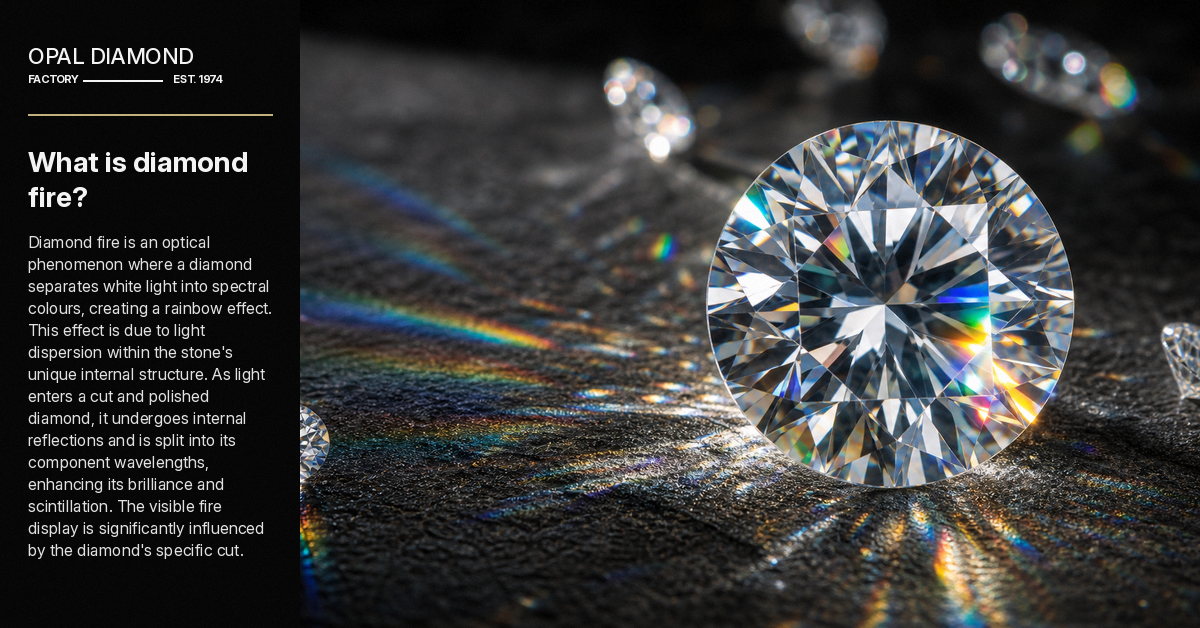
Diamond fire is an optical phenomenon where a diamond separates white light into spectral colours, creating a rainbow effect. This effect is due to light dispersion within the stone’s unique internal structure. As light enters a cut and polished diamond, it undergoes internal reflections and is split into its component wavelengths, enhancing its brilliance and scintillation. The visible fire display is significantly influenced by the diamond’s specific cut.
What does diamond fire look like?
Diamond fire appears as vivid, multi-coloured flashes that emanate from within the stone. This visual display occurs because the diamond refracts light into its spectrum of colours, similar to a prism. The specific appearance of diamond fire includes dazzling flashes of fire scintillation, where bright points of light are perceived as flashes of colour, such as red, blue, green, and yellow.
The arrangement and angles of each facet contribute to the intensity and visibility of these coloured flashes. The interplay between light entering the diamond, internal reflection, and dispersion results in a mesmerising diamond sparkle that captivates observers.
What causes diamond fire?
Diamond fire, a captivating attribute of brilliance in perfect diamonds, occurs when white light interacts with a stone’s physical facets, creating breathtaking displays of rainbow-coloured light. This optical phenomenon is particularly striking in brilliant diamonds with ideal proportions and outstanding symmetry, where light entering through the crown facets undergoes dispersion, creating radiant rainbow colours and coloured sparkle.
The intensity of these colourful flashes depends largely on the Diamond Cut grade and the precision of internal facets. Whether viewing loose diamonds in jewellery stores like James Allen or examining them under various types of light (natural light, LED, or fluorescent tube lighting), a well-cut diamond with proper facet-to-facet relationships will display plenty of diamond fire. This characteristic distinguishes real diamonds from alternatives and contributes significantly to their overall beauty, making it a key consideration in diamond selection, whether for Designer Diamonds or traditional brilliant-cut stones.
How is diamond fire measured?
Measuring diamond fire involves assessing the diamond’s ability to disperse light under controlled conditions. Gemological laboratories and grading professionals use specialised instruments to analyse the light performance of a diamond, including its fire. Metrics such as dispersion under specific lighting, often measured using instruments that analyse the spectral output from the diamond, quantify the amount and intensity of coloured flashes.
While there isn’t one universal scale purely for “fire,” it contributes to a diamond’s overall light performance grade, which is evaluated alongside brilliance (white light reflection) and scintillation (sparkle and pattern of light and dark areas). Accurate diamond grading reports often detail the quality of cut, which is the primary factor influencing fire.
What factors affect diamond fire?
Several critical factors affect the intensity and visibility of a diamond’s fire. These include:
- Cut Quality: The precision of the cut, including facet angles, proportions, and symmetry, is the most significant factor determining how effectively a diamond disperses light.
- Lighting Environment: The type and source of light (e.g., sunlight, LED lights) influence how light interacts with the diamond and reveals its fire.
- Clarity Grade: Inclusions or blemishes within the diamond can obstruct the path of light, reducing dispersion and diminishing fire.
- Carat Size: Larger diamonds generally have a greater surface area and depth for light to travel, potentially allowing for more pronounced dispersion, if cut well.
- Colour Grade: While not as direct an impact as cut, subtle body colour in the diamond can sometimes influence how certain wavelengths are dispersed or perceived.
These elements collectively determine the diamond’s overall light performance and the visible fire.
What cut gives the most diamond fire?
The ideal cut or cuts with specific proportions designed for maximum light return and dispersion typically give the most diamond fire. Cuts like the round brilliant cut, when executed with excellent precision and symmetry, are renowned for maximising fire, brilliance, and scintillation. Such cuts feature precise facet angles and proportions, while diamond structure shapes how light enters through the crown, reflects off the pavilion facets at critical angles, and disperses into vibrant spectral colours before exiting through the crown.
A high cut grade, often designated by grading bodies like the Gemological Institute of America (GIA) or the American Gem Society (AGS), indicates superior proportions and finish that optimise light performance, including fire.
How does light affect diamond fire?
The type and quality of light significantly affect how diamond fire is observed. Strong, focused light sources tend to showcase diamond fire most effectively. Natural sunlight is particularly effective due to its broad spectrum and intensity, allowing the diamond to fully separate the wavelengths. Point sources of light, such as spotlights or certain types of LED lights, also enhance the visibility of fire, creating distinct flashes of colour as the diamond moves.
Diffuse lighting, such as overcast conditions or soft indoor ambient light, generally makes fire less noticeable, while brilliance and scintillation may still be apparent. Observing a diamond under varied lighting conditions is essential to fully appreciate its light performance attributes.
How does clarity affect diamond fire?
Clarity directly affects diamond fire by impacting the unobstructed path of light through the stone. Inclusions (internal characteristics) and blemishes (external characteristics), especially those positioned near the center or critical facets of the diamond, can block or redirect light. This interruption prevents the light from following the optimal path for reflection and dispersion.
A diamond with a high clarity grade (e.g., Internally Flawless or VVS) allows light to travel freely, maximising its potential for dispersion and vivid fire. Conversely, diamonds with lower clarity grades and significant inclusions may exhibit reduced fire because less light is effectively dispersed into spectral colours. The location, size, and nature of inclusions are detailed in a diamond clarity grade report, indicating their potential impact on light performance.
How does colour affect diamond fire?
Diamond colour has a subtle but discernible impact on how fire is perceived. Colourless diamonds (those in the D-F colour range on the GIA scale) tend to display the most prominent fire because white light enters the stone unimpeded by body colour. As diamonds move down the colour scale towards light yellow or brown (G-Z), the presence of body colour can slightly absorb or alter certain wavelengths of light before they are dispersed.
While coloured diamonds (fancy colours like pink, blue, or yellow) exhibit their inherent hue, their primary appeal is colour saturation, and they may show less distinct white light fire compared to colourless stones, although some can still exhibit impressive dispersion depending on their cut. The type of light source can also interact with the diamond’s body colour to influence the appearance of fire.
How does carat size affect diamond fire?
Carat size influences diamond fire primarily by providing a larger canvas for light interaction. Larger diamonds, assuming a proportional cut, have larger facets and greater depth. This allows light to travel a longer path within the stone, potentially providing more opportunity for dispersion into spectral colours.
For example, a well-cut 2-carat diamond generally exhibits more visible fire than a similarly cut 0.50-carat diamond simply due to its increased size facilitating light dispersion. Carat size alone does not guarantee significant fire; the cut quality remains paramount. An improperly cut large diamond may show less fire than a well-cut smaller one. The interplay between size, cut precision, and proportion determines the visible fire.
What reduces diamond fire?
Several factors reduce the amount or visibility of diamond fire:
- Poor Cut Proportions: Facet angles and proportions that deviate significantly from ideal standards (e.g., overly shallow or deep pavilion, incorrect crown angles) cause light leakage rather than internal reflection and dispersion.
- Low Clarity Grade: Significant inclusions or blemishes block or disrupt the passage of light within the diamond, minimising dispersion.
- Heavy Soiling or Grime: Dirt, oils, and residues on the surface of the diamond, particularly on the pavilion facets, prevent light from entering and exiting cleanly, drastically reducing fire and brilliance.
- Certain Lighting Conditions: Diffuse or low-intensity lighting sources do not facilitate the clear separation and visibility of spectral colours compared to focused or point sources.
- Damage: Chips or abrasions on the facets can distort light reflection and dispersion.
Maintaining a diamond’s cleanliness through regular cleaning using methods like a steam cleaner or ultrasonic jewellery cleaner is one of the most effective ways to preserve its optimal light performance, including fire.
Diamond fire vs. Diamond brilliance: What’s the difference?
Diamond fire and diamond brilliance are two distinct optical phenomena contributing to a diamond’s overall beauty, though they are related aspects of light performance.
|
Feature |
Diamond Fire |
Diamond Brilliance |
|---|---|---|
|
Description |
Coloured flashes (spectral colours) |
White light reflection (overall brightness) |
|
Cause |
Dispersion of light into its component colours |
Reflection of light from the surface and internally |
|
Visuals |
Rainbow flashes (red, blue, green, etc.) |
Bright, white sparkle and internal luminosity |
|
Focus |
The separation and display of different wavelengths |
The intensity of returned white light |
Both fire and brilliance are maximised by an excellent cut, but they describe different visual effects. Fire refers specifically to the display of colour, while brilliance refers to the overall brightness of the diamond caused by white light return. Scintillation encompasses both the flashes of white light (brilliance) and flashes of colour (fire) as the diamond moves.
Why does diamond fire matter?
Diamond fire matters because it’s both a key visual indicator of a diamond’s quality and a major factor in its overall beauty and value. From the breathtaking display of rainbow colours in perfectly cut stones to the way light interacts with fancy colour diamonds, fire helps distinguish high-quality diamonds from average ones and authentic stones from imitations.
It serves as a practical guide for consumers making purchase decisions, whether in traditional jewellery stores or through online retailers, reflecting the stone’s cut quality, clarity, and overall craftsmanship. This makes fire not just an aesthetic feature, but an essential characteristic in determining a diamond’s true worth and authenticity.
How to get more diamond fire?
To maximise diamond fire and achieve those coveted bright flashes and radiant rainbow colours, the most crucial factor is selecting ideal cut diamonds with excellent proportions and symmetry. High-grade diamonds from reputable laboratories like GIA demonstrate superior light interaction and dispersion, creating breathtaking displays of diamond scintillation whether viewed in jewellery stores or under various lighting conditions.
The beauty of these fiery diamonds depends on several key contributors: proper cut geometry that optimises the interaction with light, high clarity that prevents light leakage, and proper maintenance. Whether dealing with fancy colour diamonds or traditional colourless stones, keeping them clean is essential for maintaining their captivating gemstone characteristics and ensuring optimal dispersion under LED lighting or natural light. This combination of factors helps create the perfect conditions for diamond fire, resulting in those desirable flashes of colour that make diamonds truly unique among gemstones.
How is diamond fire tested?
Testing diamond fire involves assessing the stone’s light dispersion and prismatic colour intensity. Gemological laboratories, such as the GIA, use specialized instruments and standardized lighting conditions to evaluate a diamond’s light performance, including how effectively it disperses light to create fire. These tests often involve observing the diamond under precise angles and light sources to quantify the coloured flashes produced.
While a separate numerical grade for “fire” isn’t always provided independently on standard reports, the quality of fire is a significant factor contributing to the overall cut grade or light performance score. Angular spectrum measurement can quantify the range and intensity of colours dispersed. Both natural diamonds and lab-grown diamonds undergo similar testing protocols to assess their optical properties, including fire. The results help determine the diamond’s overall quality and visual appeal.
What lighting shows most diamond fire?
Direct, focused lighting typically shows the most diamond fire. Natural sunlight, especially when direct, is highly effective at revealing a diamond’s fire due to its full spectrum and intensity. Spotlights, halogen lights, and certain types of LED lights also tend to enhance diamond fire by providing a concentrated light source that allows the stone to act as a prism, separating the light into visible colours.
Diffuse lighting, such as soft ambient light or fluorescent lighting, generally emphasises brilliance more than fire. To see a diamond’s fire potential, observing it under multiple light sources is recommended to understand how it performs in different environments.
Do lab diamonds have fire?
Yes, lab-grown diamonds do exhibit fire, just like natural diamonds. Fire is a physical property of the diamond material itself, related to its high refractive index and dispersion capabilities. Since lab-grown diamonds possess the exact same chemical and physical properties as natural diamonds (both are crystalline carbon), they also disperse light into spectral colours when cut and polished.
The amount of fire in a lab-grown diamond is determined by the same factors as in a natural diamond: primarily its cut quality, followed by clarity and the lighting conditions. A well-cut lab-grown diamond will show significant fire, comparable to a natural diamond of similar cut quality.
How to pick diamonds for fire?
To pick diamonds for maximum fire, prioritise the cut quality. Look for diamonds with high cut grades from reputable grading laboratories, such as GIA Excellent or AGS Ideal. These grades indicate that the diamond’s proportions, symmetry, and polish are optimised for light performance, including dispersion. Consider a round brilliant cut, which is specifically designed to maximise fire, brilliance, and scintillation.
Examine the diamond under various lighting conditions, particularly point sources, to observe how it handles light and the intensity of the coloured flashes. Ensure the diamond has a high clarity grade, as inclusions can impede light dispersion. While colour is less critical, colourless or near-colourless diamonds (D-J on the GIA scale) tend to display fire most purely. Be cautious of poor proportions or significant inclusions, as these can detract from fire regardless of other factors.
Can diamond fire fade?
Diamond fire itself does not fade as a chemical or physical property of the diamond material. However, the visibility of diamond fire can diminish over time due due to external factors. The most common reason for reduced fire is surface contamination from dirt, oils, lotions, and everyday grime. This buildup on the facets, especially the pavilion, obstructs light from entering and exiting the stone cleanly, severely dampening dispersion and making the fire appear dull or absent.
Damage to the facets, such as abrasions or chips, can also distort light performance. Therefore, while the inherent property of dispersion doesn’t change, maintaining the diamond’s cleanliness and condition is essential to ensure its fire remains visible and vibrant. Regular cleaning with a mild soap and water solution or professional cleaning will restore the stone’s sparkle.
Is diamond fire linked to quality?
Yes, diamond fire is strongly linked to a diamond’s overall quality, particularly its cut quality. A diamond’s ability to exhibit vibrant fire is a direct indicator of how well it has been cut according to optimal proportions and angles. High-quality diamonds, especially those with top cut grades like GIA Excellent or AGS Ideal, are specifically engineered to maximize light return and dispersion, resulting in pronounced fire, brilliance, and scintillation.
While colour and clarity also play roles in light performance, the precision of the cut is the most influential factor in determining the intensity of fire. Gemological institutions like the GIA evaluate fire as part of their comprehensive cut grading system, recognising its importance in assessing a diamond’s beauty and quality.
How do experts rate diamond fire?
Experts rate diamond fire as part of a diamond’s overall light performance evaluation, primarily contributing to the cut grade. While there isn’t a single, universal numerical scale solely dedicated to fire across all grading labs, gemologists assess its presence, intensity, and pattern. Tools and methods like observing the diamond under controlled lighting, using specialised scopes, and sometimes utilising light performance imaging systems help evaluate how effectively the diamond disperses light into spectral colours.
The quality of fire, alongside brilliance and scintillation, informs the final cut grade provided by institutions such as the Gemological Institute of America or the American Gem Society. A higher cut grade indicates superior light performance, which includes excellent fire.
What diamond fire is best for rings?
The best diamond fire for engagement rings and other ring styles combines several key elements that maximise the stone’s light performance and visual appeal. Here’s what to look for:
• Cut Characteristics – Round brilliant cuts typically show the most fire. These stones should have ideal cut proportions, excellent symmetry grade, and high polish grade, as these elements work together to create optimal light dispersion.
• Clarity Factors – VS2 or better clarity ensures minimal interference with light performance. The stone should have minimal inclusions, a clean table facet, and good overall transparency to maximize fire potential.
• Setting Considerations – Raised settings allow maximum light interaction, while minimal metal coverage and an open gallery design ensure light can enter from multiple angles. Proper prong placement helps showcase the stone’s fire without obstruction.
• Light Performance – Look for strong scintillation with a good balance of fire and brilliance. The stone should display even light distribution with minimal light leakage, creating those desirable rainbow flashes.
• Practical Aspects – Choose a stone that’s easy to maintain clean, durable enough for daily wear, compatible with your chosen ring style, and displays fire visible from multiple viewing angles.
Can other gems show fire like diamonds?
Yes, certain other gemstones can show fire, a phenomenon also known as dispersion, although typically not to the same degree or intensity as diamonds. Dispersion is a property inherent to many transparent materials, but the amount of dispersion varies. Examples of gemstones that exhibit noticeable fire include:
- Moissanite: Has a higher dispersion rate than diamond, often resulting in even more intense spectral flashes.
- Zircon (specifically colourless or blue): Exhibits high dispersion.
- Demantoid Garnet: Known for its high dispersion relative to other garnets.
- Rutile (synthetic): Possesses extremely high dispersion, historically used as a diamond simulant.
- Sphalerite: Has very high dispersion, though it is a softer gemstone.
While these gems display dispersion, diamonds remain renowned for their unique combination of high dispersion, exceptional brilliance (due to high refractive index), and hardness, which allows for precise faceting that maximises these optical effects.
Related diamond guides: What is diamond luster: how cut, clarity, and polish shape the way a diamond catches the eye; What is diamond scintillation: learn what shapes sparkle, what light reveals, and why it matters to buyers.