
Diamond scintillation is a fascinating phenomenon that combines flash scintillation and magical sparkle. Professional diamond cutters create precise facet angles and symmetrical patterns to maximise a stone’s natural properties, whether in Earth-mined or lab diamonds. The white light-reflective aspects of a well-cut diamond create multi-coloured sparkles and colourful flashes, while the passage of light through the carbon-based stone contributes to its overall dazzling display.
Understanding diamond grading components, including the 4Cs (Cut, Colour, Clarity, and Carat weight), is crucial for making informed choices. Clarity and colour grades significantly impact a diamond’s performance, while Diamond Ateliers’ craftsmanship plays a central role in creating excellent sparkle.
This detail is part of the wider diamond characteristics selection guide.
Choosing loose diamonds, antique diamonds, or modern cuts should consider the stone’s ability to create a captivating gemstone display.
What is Diamond Scintillation?
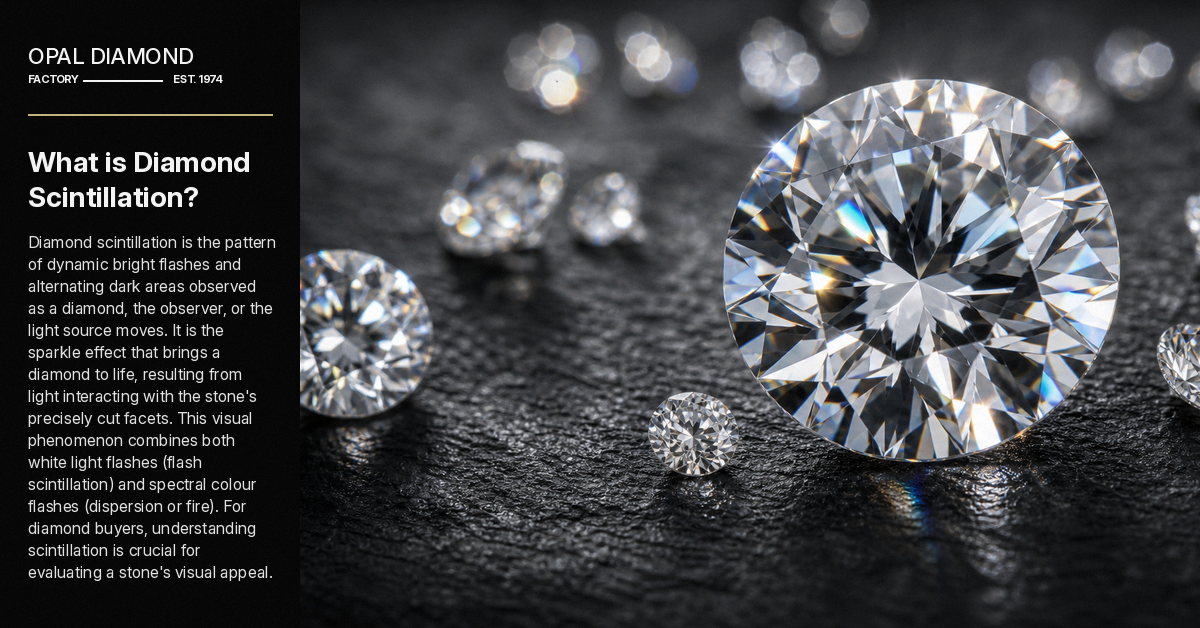
Diamond scintillation is the pattern of dynamic bright flashes and alternating dark areas observed as a diamond, the observer, or the light source moves. It is the sparkle effect that brings a diamond to life, resulting from light interacting with the stone’s precisely cut facets. This visual phenomenon combines both white light flashes (flash scintillation) and spectral colour flashes (dispersion or fire).
For diamond buyers, understanding scintillation is crucial for evaluating a stone’s visual appeal. It works in tandem with brilliance (white light return) and fire (colour flashes) to determine a diamond’s overall light performance. A diamond’s ability to display captivating sparkle is a key factor in its beauty and perceived value.
What Causes Diamond Scintillation?
Diamond scintillation occurs due to the precise interaction of light with a diamond’s physical structure, governed by several critical factors. The quality of the diamond’s cut is the primary driver of this dynamic light play. These factors include facet angles, facet arrangement, crown height, pavilion depth, polish grade, and clarity level.
The environment also plays a role; surrounding light conditions and movement between the diamond, the light source, or the viewer’s eye are necessary for scintillation to be visible. A well-cut diamond expertly manages light entry, internal reflection, and exit to create striking sparkle patterns.
What Features Increase Diamond Scintillation?
Several key features in a diamond’s cut enhance its scintillation. Optimal cut proportions, including well-balanced crown and pavilion angles, maximize light return and create vivid sparkle. Excellent symmetry ensures that facets are perfectly aligned and uniform, improving light reflection patterns and creating balanced light distribution.
Additional features that contribute to high scintillation include a high polish grade for smooth light interaction, a balanced table size (typically between 53-58%), clean facet junctions, and an optimal total depth percentage (around 59-62.5%). Minimal inclusions and a proper girdle thickness prevent light leakage, further enhancing the stone’s dynamic sparkle.
How Do Diamond Facets Change Scintillation?
Diamond facets fundamentally change scintillation by controlling how light enters, travels through, and exits the stone. The precise angles, size, and arrangement of each facet dictate the paths light takes internally. This geometric design determines the specific patterns of bright flashes and contrasting dark areas observed as the diamond moves.
Well-aligned and precisely cut facets ensure optimal light reflection and refraction, leading to intense, balanced sparkle. Conversely, poorly cut or misaligned facets can cause light to leak out of the pavilion instead of returning to the viewer’s eye, resulting in reduced and uneven scintillation. The interaction between crown facets on the top, pavilion facets on the bottom, and the accuracy of their meeting points directly shapes the diamond’s final scintillation pattern.
What Lighting Affects Diamond Scintillation?
The type and quality of lighting significantly affect a diamond’s scintillation. Dynamic lighting conditions, where the light source, diamond, or viewer is in motion, are crucial for observing scintillation’s bright flashes and dark patterns. Both ambient and focused light sources play roles in revealing a diamond’s sparkle.
Optimal light environments, such as spotlights or natural sunlight with movement, highlight the dynamic interplay of light and shadow. Mixed lighting conditions can also enhance the diamond’s visual appeal by creating a spectrum of colour flashes (fire) alongside the white sparkle (scintillation). Different light types, like incandescent or LED, can emphasise different aspects of the diamond’s light performance.
How Does Cut Quality Affect Scintillation?
Cut quality is the single most important factor affecting a diamond’s scintillation. Diamonds with higher cut grades, particularly those graded ‘Excellent’ or ‘Ideal’, display superior scintillation. This is because their facet angles, proportions, symmetry, and polish are optimised for maximum light interaction.
Precise facet angles ensure total internal reflection and optimal light return, creating strong, dynamic flashes. Poorly cut diamonds, such as those with overly deep or shallow proportions, leak light instead of reflecting it back to the viewer, resulting in significantly diminished or lifeless scintillation. The skill of the diamond cutter directly translates into the stone’s ability to sparkle vibrantly.
Why Does Diamond Grading Include Scintillation?
Diamond grading includes scintillation because it is a fundamental visual characteristic that significantly contributes to a diamond’s beauty and perceived quality. This dynamic play of light, producing sparkle and colour flashes when the stone moves, differentiates lively diamonds from dull ones. Scintillation is a key component of a diamond’s overall light performance, alongside brilliance and fire.
Grading systems evaluate how well a diamond’s cut maximises this effect, recognising the centuries of refinement by professional diamond cutters to achieve optimal sparkle. Including scintillation in grading, as part of the comprehensive assessment of the diamond's 4Cs (Cut, Colour, Clarity, Carat), ensures that a stone’s ability to create a captivating display remains a central focus, impacting its value and desirability.
What is Dynamic Sparkle Distribution in Diamond Scintillation?
Dynamic sparkle distribution refers to how the bright flashes and contrasting dark areas are spread across the diamond’s surface as it moves. It describes the pattern created by the changing interplay of light and shadow. In a well-cut diamond, this distribution should be balanced and consistent, creating an even, lively pattern of sparkle across the entire stone.
Proper dynamic sparkle distribution results in a harmonious blend of numerous small, intense flashes and well-defined contrasting areas. This creates the appealing visual effect that makes the diamond seem alive. Poor distribution, often caused by uneven or asymmetrical facet arrangements, can lead to large dull areas, distracting patterns, or a lack of visual balance, diminishing the stone’s overall appeal.
What is Flash Frequency in Diamond Scintillation?
Flash frequency in diamond scintillation refers to how often bright flashes appear and disappear as a diamond moves relative to a light source. It measures the rate at which these distinct bursts of light occur. A high flash frequency with regular, consistent flashes contributes to a lively, dynamic sparkle.
A well-cut diamond is designed to create a rhythm of flashes that is both frequent and balanced, enhancing the stone’s visual excitement. Conversely, a poorly cut diamond may exhibit irregular or infrequent flashes, leading to a less dynamic and less appealing sparkle effect. This metric helps evaluate the responsiveness and dynamism of a diamond’s interaction with light during motion.
How Does Light Interaction Affect Diamond Scintillation?
Light interaction with a diamond creates scintillation through a precise sequence of optical behaviors. Scintillation occurs as light enters the diamond through its top facets (crown and table), travels internally, reflects off the pavilion facets, and exits back to the viewer’s eye. This process relies heavily on total internal reflection, where light bounces within the diamond’s interior due to the critical angle of the facets.
Dispersion causes white light to split into spectral colours as it passes through the diamond, contributing to the coloured flashes (fire). The precise angles of the facets determine the reflection patterns and the percentage of light that successfully returns to the viewer (light return). Areas where light escapes (light leakage) or is blocked create the necessary dark contrast that makes the bright flashes visible, forming the dynamic sparkle pattern.
How is Scintillation Measured in Diamonds?
Scintillation in diamonds is measured using a combination of advanced technology and skilled visual assessment. Specialised digital scanning equipment captures and analyses the complex patterns of light behaviour within the diamond during motion. Tools like the Angular Spectrum Evaluation Tool (ASET) and the Ideal-Scope provide detailed maps of light return and areas of light leakage under controlled conditions.
Trained gemologists perform visual assessments in standardised lighting environments, observing the patterns of bright flashes, dark contrast, and colour dispersion. High-speed cameras may be used to record the dynamic sparkle patterns as the diamond is moved. Computer modelling software also analyses cut parameters to predict their impact on scintillation, combining with contrast mapping techniques to provide a comprehensive evaluation.
How Do Labs Test Diamond Scintillation?
Diamond grading laboratories test scintillation using a multi-faceted approach that combines precise technology and expert evaluation. Labs employ digital scanning systems that capture detailed images of how light interacts with the diamond’s facets as it is rotated. Tools such as ASET and Ideal-Scope are used to analyse the distribution and intensity of light return.
Controlled lighting environments ensure consistent testing conditions, allowing technicians to accurately measure bright-to-dark contrast ratios across the diamond’s surface. High-speed video imaging documents the dynamic sparkle patterns created by movement. Gemologists, drawing on their experience, conduct visual assessments to complement the technical data, ensuring a comprehensive evaluation of the diamond’s scintillation quality.
What Tools Measure Diamond Scintillation?
Several specialised tools are used to measure and evaluate diamond scintillation and overall light performance. Primary instruments include digital scanners and light performance meters that quantify the intensity and distribution of returned light. Tools like the ASET (Angular Spectrum Evaluation Tool) and Ideal-Scope use coloured light to map light return, leakage, and obstruction within the diamond.
Other tools, such as proportion scopes and computer modeling software, analyze the diamond’s physical dimensions and cut parameters to predict their effect on scintillation. High-speed cameras capture the rapid changes in sparkle patterns during motion. These tools provide objective data that complements visual assessments performed by trained gemologists under standardised lighting conditions.
Here are main tools used:
- ASET (Angular Spectrum Evaluation Tool) – Uses coloured light to map light return based on angle.
- Ideal-Scope – Shows light leakage and reflection patterns with red illumination.
- Digital Scanners – Capture detailed images of light behaviour and patterns.
- Light Performance Meters – Quantify the intensity of light returned by the diamond.
- Proportion Scopes – Measure and analyse a diamond’s precise cut parameters.
- High-Speed Cameras – Record dynamic sparkle patterns during movement.
What is the Difference Between Diamond Scintillation and Diamond Brilliance?
|
Feature |
Diamond Scintillation |
Diamond Brilliance |
|---|---|---|
|
Nature |
Dynamic interplay of light and shadow during motion. |
Static white light return when stationary. |
|
Visual |
Flashes of light and dark areas; “sparkle” effect. |
Overall brightness and white light reflection. |
|
Movement |
Requires movement (diamond, viewer, or light) to be seen. |
Visible when the diamond is still. |
|
Focus |
Patterns of bright/dark flashes, flicker. |
Total intensity of white light returned. |
|
Key Driver |
Facet arrangement and symmetry (creates patterns). |
Facet angles and proportions (maximise light return). |
Scintillation refers to the dynamic flashes and patterns of bright and dark areas that occur as a diamond moves. It is the visible sparkle effect. Brilliance, conversely, is the overall white light reflected from the diamond when it is stationary, representing its total brightness. Both qualities depend heavily on cut quality, but scintillation focuses on the changing light patterns, while brilliance focuses on the amount of light returned.
What Diamond Cuts Show the Most Scintillation?
The amount of scintillation varies significantly between different diamond cuts, with certain shapes designed to maximise this effect. The Round Brilliant cut consistently shows the highest level of scintillation due to its meticulously designed 57 or 58 facets, which are optimised for maximum light return and dynamic sparkle patterns.
Other cuts known for strong scintillation include the Princess, Oval, Cushion, and Radiant cuts. These modified brilliant cuts feature numerous facets that create vibrant flash patterns. Step cuts like the Emerald and Asscher cuts display a different type of scintillation, often described as a distinct “hall of mirrors” effect with broader, more dramatic flashes rather than the pinfire sparkle of brilliant cuts.
Here are cuts showing high scintillation:
- Round Brilliant – Exhibits the highest level of dynamic sparkle.
- Princess Cut – Displays strong, symmetrical flashes.
- Oval Cut – Creates excellent flash patterns across its elongated shape.
- Cushion Cut – Blends vintage appeal with vibrant modern sparkle.
- Radiant Cut – Known for intense sparkle due to its mixed-cut facet arrangement.
- Pear Cut – Shows dynamic scintillation, particularly near the pointed end.
- Marquise Cut – Creates lively sparkle patterns along its length.
What Settings Show Diamond Scintillation Best?
The setting chosen for a diamond can significantly impact how well its scintillation is displayed by maximising light interaction. Settings that allow the most light to enter the diamond from various angles best showcase its sparkle. Solitaire settings, particularly those with raised prongs, are ideal as they lift the stone away from the metal, permitting light entry from the sides and bottom.
Open gallery settings and designs with minimal metal contact around the pavilion also enhance light exposure. White metal settings, such as platinum or white gold, can reflect more light back into the diamond compared to yellow or rose gold. Settings with simple, clean lines avoid obstructing light, further maximising the diamond’s potential for dynamic sparkle.
Here are the best settings for displaying scintillation:
- Solitaire Settings – Allow maximum 360-degree light entry.
- Raised Prong Settings – Elevate the diamond for enhanced light access.
- Open Gallery Settings – Permit light to enter through the pavilion.
- White Metal Settings – Reflect ambient light back into the stone.
- Cathedral Settings – Lift the diamond high for increased light exposure.
- Four-Prong Designs – Minimise metal coverage, exposing more surface area.
What is the Difference Between Diamond Scintillation and Diamond Fire?
|
Feature |
Diamond Scintillation |
Diamond Fire (Dispersion) |
|---|---|---|
|
Nature |
Dynamic flashes of white light and dark contrast. |
Static or Dynamic flashes of spectral colours. |
|
Visual |
Sparkle, flicker, bright/dark patterns. |
Rainbow-like flashes of colour. |
|
Origin |
Reflection and refraction of light creating patterns. |
White light splitting into spectral colours upon exiting. |
|
Movement |
Most visible with movement (diamond, viewer, light). |
Can be seen with movement, but also from static light splitting. |
|
Focus |
Intensity and pattern of light/dark flashes. |
Intensity and range of spectral colours. |
Scintillation refers specifically to the dynamic flashes of white light and alternating bright and dark patterns seen as a diamond moves. It is the sparkle. Diamond fire, also known as dispersion, refers to the flashes of spectral colours (like a rainbow) that occur when white light is split as it passes through the diamond and exits. While both contribute to a diamond’s overall visual appeal and light performance, scintillation focuses on the white sparkle and dark contrast due to reflection/refraction patterns during motion, whereas fire focuses on the separation of white light into colours.
Can Diamond Scintillation Improve After Buying?
No, diamond scintillation cannot fundamentally improve after the diamond has been cut and purchased. Scintillation is determined by the permanent physical properties of the diamond, including its cut quality, facet angles, proportions, and internal characteristics like clarity. These factors are established during the diamond cutting process.
However, a diamond’s apparent scintillation can be temporarily diminished by dirt, oils, or lotions on its surface. Regular cleaning using appropriate methods and solutions can restore the diamond’s optimal light performance by removing these surface contaminants, allowing light to enter and exit the stone properly and restoring its intended sparkle.
Why Do Some Diamonds Have Low Scintillation?
Diamonds exhibit low scintillation primarily due to suboptimal cutting. Poor cut quality, including incorrect facet angles, improper proportions (such as overly deep or shallow pavilions), or asymmetrical facet arrangements, prevents light from reflecting efficiently within the stone. Instead of returning to the viewer’s eye as dynamic flashes, light leaks out of the diamond, resulting in a dull, lifeless appearance with minimal sparkle.
Other contributing factors include a poor polish grade, which can cause surface imperfections that hinder light entry, and significant inclusions or blemishes that obstruct the path of light travelling through the diamond. These issues reduce the stone’s ability to create the necessary bright flashes and contrasting dark areas that constitute scintillation.
How Do People See Diamond Scintillation?
People see diamond scintillation through three primary visual effects that manifest as the diamond moves. The most recognizable is the “flash effect,” characterised by bright, distinct bursts of white light appearing and disappearing. Simultaneously, observers perceive a constantly changing pattern of light and dark areas across the diamond’s surface, which creates the sense of dynamic movement and life within the stone.
Additionally, people see “colour flashes,” which are the brief, vibrant bursts of spectral colours caused by dispersion (fire). This complex interplay of white flashes, moving light and dark patterns, and colour flashes, all occurring simultaneously as the diamond or its lighting changes, constitutes the visual phenomenon perceived as diamond scintillation. The clarity and intensity of these effects depend heavily on the diamond’s cut quality and the surrounding lighting conditions.
Why Do Buyers Like Diamond Scintillation?
Buyers value diamond scintillation highly because it is the captivating visual quality that makes a diamond appear lively, dynamic, and beautiful. The rapid flashes of light and sparkle bring the stone to life, making it far more engaging and visually interesting than a stone that lacks strong scintillation. This dynamic play of light is often what people first notice and admire about a diamond.
Strong scintillation indicates a well-cut diamond, which is perceived as higher quality and more desirable. It directly contributes to a diamond’s aesthetic appeal, making it stand out as jewellery and enhancing its overall attractiveness and perceived value for the buyer.
Related diamond guides: What is diamond brilliance: learn how cut, symmetry, and angles affect the sparkle; What is diamond clarity: discover how grades, flaws, and sparkle affect what you see and pay.
TOPICS COVERED
facet to facet, Diamond Sparkle, dispersion of light, coloured light, Maximum brilliance, girdle facets, dynamic patterns, flashes of colour, types of scintillation, brighter sparkle, optical effects, beautiful diamonds, brilliant diamond, brilliant-cut diamonds, diamond jewellery, diamond science, Eye-clean diamonds, lifeless diamond, motionless diamonds, perfect diamond, quality diamonds, shallow diamonds, lots of facets, crucial factors, balanced pattern, on-off or checkered pattern, component colours, ice stones, Step-cut stones, aspect of scintillation, external reflection, flashes of light seen, flat surface, clarity grades, colour grades, crucial roles, Fast-moving scintillation, slow-moving scintillation, white paper, multi-coloured sparkles, dazzling sparkle, lots of sparkle, light visible, coloured flashes, colourful flashes, poor brilliance, steep crown angles, broader range, deep diamonds, diamond comparisons, diamond cut anatomy, larger diamond, smaller, well-cut diamond, 4Cs of diamonds, appeal of diamonds, attribute of diamonds, attributes of diamonds, beautiful diamond sparkle, Bright diamonds, centuries diamond cutters, certified diamonds, clarity diamonds, clarity of diamonds, collection of diamonds, colourless diamonds, components of diamond, components of diamond grading, consensus about diamond scintillation, conversations about diamond performance, Deep or shallow-cut diamonds, definition of diamond scintillation, diamond affect scintillation, diamond bends, diamond black, diamond buying consumers, diamond clarity, diamond colours, diamond counter, diamond craftsmanship, diamond crystal, diamond cut grad, diamond dazzle, diamond engagement, diamond enthusiast, diamond features, diamond flashes, diamond form, diamond in motion, diamond in relation, diamond industry diamond cut, diamond journey, diamond knowledge, diamond leaks light, diamond life, Diamond light, diamond material, diamond performance combo-platter, diamond price calculator, Diamond Price Guide, diamond search, diamond shape, diamond shine, diamond unforgettable, Diana Rafael Diamond, dirty diamond, lowest facets, additional facets, dark facet, distinct facets, additional factors, array of factors, beauty factor, biggest factors, central factor, on-off pattern, pattern of brightness, asymmetrical contrast patterns, additional component, component of scintillation, component rainbow colours, component to brilliance, dramatic component, central stone, deep cut stones, captivating aspects, critical aspect, dynamic aspects, beautiful gemstones, brightest gemstones, dazzling gemstone, animated appearance, dazzling appearance, dead appearance, dull appearance, Partial leakage, Blatant leakage, Dispersion Fire, dispersion potential, lighting effects, diffuse lighting, additional carat weight, angled surfaces.