
Diamond Luster represents far more than just a mesmerising display of light. Unlike common surface issues such as water spots on shower glass or oxidation from sprinkler overspray, a diamond’s unique atomic structure creates something extraordinary. At its core, atoms form tetrahedra in precise proportions, creating a crystal lattice structure that determines how both natural and artificial light interact with the stone, resulting in its characteristic adamantine luster.
The role of clarity extends beyond simple descriptors, encompassing everything from invisible long-wave ultraviolet light interaction to the stone’s behaviour under various lighting conditions.
The diamond characteristics education helps place this detail in context.
While some might confuse diamond brilliance with the greasy luster of soap scum or water stains on stainless steel, the atomic structure of diamonds creates intermediate types of light interaction that result in their characteristic allure. This complex interplay of light at the atomic level makes each diamond unique, distinguishing them from other natural materials and cementing their status as nature’s most brilliant gem.
What is diamond luster?
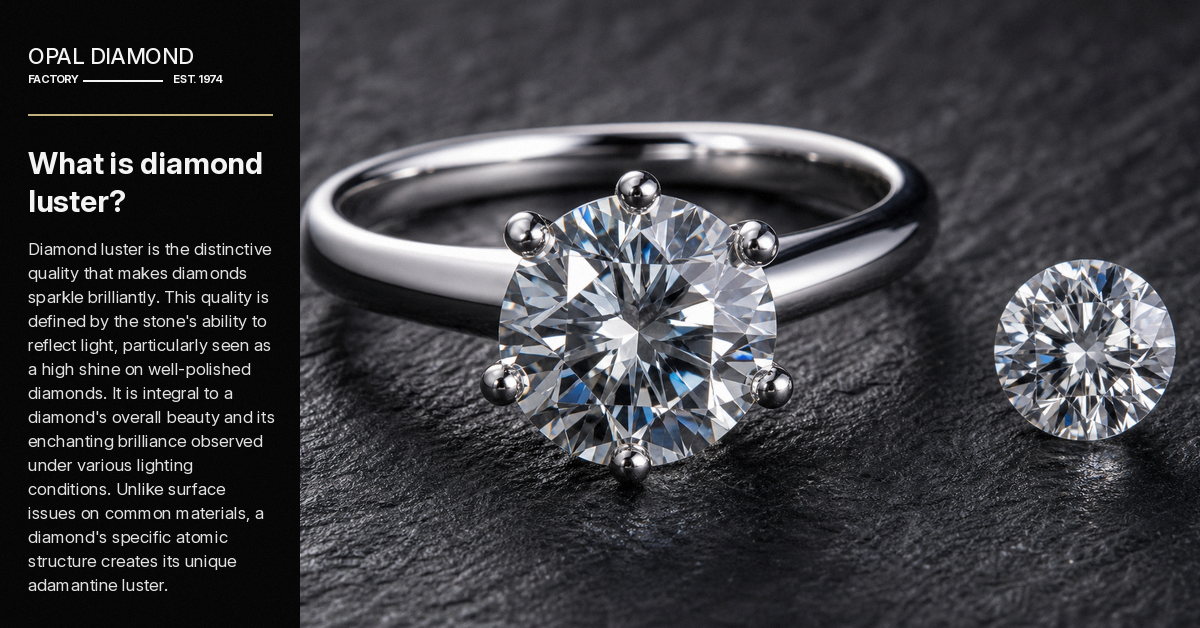
Diamond luster is the distinctive quality that makes diamonds sparkle brilliantly. This quality is defined by the stone’s ability to reflect light, particularly seen as a high shine on well-polished diamonds. It is integral to a diamond’s overall beauty and its enchanting brilliance observed under various lighting conditions. Unlike surface issues on common materials, a diamond’s specific atomic structure creates its unique adamantine luster.
What causes diamond luster?
Diamond luster results from a complex interplay of specific physical and structural characteristics. The primary cause is the diamond’s unique crystal lattice structure where carbon atoms form in precise tetrahedral proportions.
Several specific factors contribute to this phenomenon:
- Atomic Structure: The unique arrangement of carbon atoms in a dense crystal lattice with strong atomic bonds.
- Light Interaction Properties: How the diamond handles and disperses both natural and artificial light, including its high Refractive Index and critical angle.
- Physical Characteristics: The diamond’s cut quality, precise facet arrangement, superior surface polish, and overall clarity contribute significantly.
- Structural Elements: Specific planes formed by carbon atoms within the crystal structure enhance light reflection.
- Quality Factors: Minimal internal inclusions and blemishes, optimal proportions from cutting, and a superior polish finish are essential for maximising luster.
What makes light reflect off a diamond?
The reflection of light off a diamond, creating its legendary brilliance and sparkle, is due to several key properties working together.
- High Refractive Index: Diamonds have an exceptionally high Refractive Index (2.417), causing light to bend significantly upon entering the stone (Internal Refraction).
- Critical Angle: Light striking internal facets at an angle greater than the critical angle (approximately 24.4 degrees) undergoes total internal reflection, bouncing light back towards the viewer.
- Optimal Facet Arrangement: Strategic cutting and positioning of 57 or 58 facets in a standard round brilliant cut maximise light return and minimise light leakage.
- Crystal Structure and Density: The tightly packed carbon atoms in the tetrahedral crystal structure create an extremely dense material that interacts effectively with light waves.
- Polished Surfaces: Highly polished surfaces and clean facet junctions allow for smooth, uninterrupted light reflection.
- Material Purity: The absence of internal inclusions or external flaws ensures unobstructed light paths within the stone.
What is surface reflectivity grading?
Surface reflectivity grading is a key aspect in assessing a diamond’s potential brilliance, providing a quantitative measure of how effectively the stone’s surface reflects light. This grading examines the precise way light interacts with the outermost layer of the diamond, distinguishing its characteristic adamantine luster from the duller reflections seen on other materials. It involves sophisticated methods that analyse the stone’s carbon structure and surface properties to determine the quality and intensity of its surface shine, which is crucial for evaluating both colourless and fancy colour diamonds.
What types of diamond luster exist?
Diamond luster presents in several specific forms, each contributing to the stone’s unique optical characteristics. The primary classification describes the intensity and appearance of the surface reflection.
| Type of Luster | Description | Key Characteristics |
|---|---|---|
| Adamantine Luster | The highest possible degree of surface reflection
in natural materials, characteristic of high-quality diamonds. |
Intense, mirror-like brilliance; sharp, bright reflections; indicates superior polish and surface integrity. |
| Metalloid Luster | A sub-category appearing as a bright, metal-like reflection. | Often seen in darker-coloured diamonds; can have a slightly less sharp edge than pure adamantine. |
| Vitreous Sub-luster | A glass-like quality that can complement the primary luster. | Appears in certain cuts or angles; less intense than adamantine but contributes to the overall light display. |
| Sub-adamantine Luster | A slightly less intense version of adamantine luster. | Common in diamonds with minor surface imperfections or less-than-ideal polish quality. |
Other specific descriptions of luster related to light interaction include:
- External Luster: The immediate surface reflection visible without considering internal light behaviour.
- Internal Luster: The brilliance generated by light reflections within the diamond’s structure due to its high Refractive Index.
- Fire Luster: The display of spectral colours (like those in a rainbow) created by light dispersion within the diamond.
- Scintillation Luster: The pattern of bright flashes and dark areas that become visible as the diamond moves.
- Brilliance Luster: The total light return from both internal and external reflections, contributing to the diamond’s overall brightness.
- White Light Luster: The pure, colourless reflection of light that gives diamonds their characteristic “icy” appearance.
What is adamantine luster?
Adamantine luster is a unique quality characteristic of diamonds, signifying exceptional brilliance and luminous allure. This specific type of luster is the highest degree of surface reflection naturally possible in minerals. Its shine is significantly enhanced by a diamond’s cut, clarity, and polish, creating a visually captivating and intense interplay of light that showcases the stone’s intrinsic beauty. Gem-quality diamonds with adamantine luster are highly prized for their radiance.
How is diamond luster measured?
Professional gemologists measure diamond luster using several specific methods and criteria to ensure accurate evaluation.
Measurement techniques include:
- Visual Assessment: Experienced graders examine the diamond’s surface reflection under controlled lighting to evaluate its immediate visual impact and brilliance.
- Optical Testing: Specialised equipment measures the exact percentage of light return and analyzes reflection patterns from various angles.
- Reflectometer Analysis: Scientific instruments quantify the precise amount of light reflected directly off the diamond’s surface.
- Surface Quality Evaluation: Microscopic examination assesses polish quality, surface consistency, and detects any polishing artifacts.
- Light Performance Testing: Advanced imaging systems measure how effectively the diamond handles and returns light, including brilliance, fire, and scintillation.
- Brilliance Mapping: Digital tools create detailed maps illustrating light behaviour patterns on and within the diamond.
- Angular Spectrum Measurement: Assessment of how light reflects at different angles determines the optimal light return profile.
- Polish Grade Assessment: Evaluation of the surface smoothness and its direct impact on the quality of light reflection.
- Symmetry Analysis: Measurement of facet alignment and its influence on consistent light reflection patterns across the stone.
- Comparative Analysis: Direct comparison with master stones of known luster quality establishes a relative grade for the diamond being examined.
What luster do other gemstones have?
While diamonds possess the distinct adamantine luster, other gemstones exhibit a variety of different luster types that contribute to their unique appeal.
Here is a comparison of luster types in several gemstones:
| Gemstone/Material | Primary Luster Type(s) | Description | Examples |
|---|---|---|---|
| Diamond | Adamantine | Intense, mirror-like surface reflection. | High-quality diamonds |
| Garnet, Spinel | Vitreous | Glassy, bright surface reflection. | Red garnets, blue spinels |
| Gold, Pyrite | Metallic | Opaque with a high, reflective, metal-like shine. | Gold nuggets, pyrite cubes |
| Opal, Pearl | Pearly, Iridescent | Soft, shimmering, sometimes showing rainbow colors. | Precious opals, natural pearls |
| Serpentine | Greasy | Appears as if coated with a thin layer of oil. | Green serpentine stones |
| Talc | Pearly, Dull | Soft sheen or lacks significant reflection. | Talc powder |
How can true diamond luster be tested?
True diamond luster can be tested and verified through a combination of professional gemological observation and precise scientific measurement. Expert gemologists examine the distinctive sharp, intense adamantine reflection under controlled lighting conditions to assess its quality. Simultaneously, specialised laboratory equipment provides quantitative data.
Tools such as reflectometers measure the exact percentage of surface light reflection, while optical measurement devices analyze detailed light return patterns and surface brilliance across the stone. Advanced testing may also involve comparing the diamond’s properties to established master stones and analysing polishing artifacts.
Why does luster matter in diamonds?
Luster is a critical quality indicator that directly impacts a diamond’s beauty, value, and desirability. The specific adamantine luster is a key identifying characteristic of a genuine diamond, distinguishing it from imitations. It also provides important information about the stone’s durability over time, cut quality, and clarity.
Beyond aesthetics, proper luster signifies optimal light interaction within the stone, which directly affects its brilliance (total light return), fire (colour dispersion), and scintillation (sparkle) – these are fundamental properties determining a diamond’s overall value and authenticity in the market.
How does cut affect diamond luster?
The cut of a diamond plays an essential role in influencing its luster, specifically how light interacts with and reflects off the stone’s surface and through its structure.
A well-executed cut, such as a round brilliant cut with precise angles and proportions, maximises the diamond’s ability to reflect light and achieve intense luster.
The precise arrangement of facets ensures light enters the stone efficiently and is returned to the viewer. Conversely, an inferior or poorly executed cut can compromise a diamond’s potential luster by allowing light to escape or by creating poor surface angles for reflection.
How does clarity affect luster?
Diamond clarity significantly affects a diamond’s luster by impacting its ability to transmit and reflect light effectively. Clarity is graded based on the number, size, position, and nature of internal inclusions and external blemishes. Internal flaws can obstruct the path of light as it travels through the diamond, reducing internal reflections and diminishing overall brilliance, which in turn affects the perception of luster. Diamonds with higher clarity grades (fewer inclusions), such as Internally Flawless or VVS grades, allow light to pass through unimpeded, contributing to superior luster and brilliance.
What role does polish have in luster?
Polish plays a major role in achieving a diamond’s characteristic dazzling sparkle and maximising its adamantine luster. It refers to the smoothness and condition of the diamond’s surface, particularly the facets. A superior, high-quality polish creates a perfectly smooth surface that allows light to reflect cleanly and without distortion.
Any imperfections left by the polishing process, such as polish lines or abrasions, can disrupt the smooth reflection of light, reducing the stone’s luster and dulling its appearance. Achieving an excellent or very good polish grade is essential for unlocking a diamond’s maximum light performance and luster.
What is polish artifact analysis?
Polish artifact analysis in diamond luster is a specialised technique used to evaluate the quality and characteristics of a diamond’s surface finish. This analysis involves examining microscopic features left on the diamond’s facets during the polishing process. It helps identify specific patterns, such as polish lines, abrasion marks, and surface textures, which can indicate the quality of workmanship, the tools used, and even distinguish between natural and synthetic diamonds or reveal past treatments. Analyzing these artifacts provides detailed insights into how well the surface is prepared to interact with light, directly impacting the diamond’s visible luster.
How can diamond luster be improved?
Diamond luster can be improved through professional treatments and diligent maintenance. Professional repolishing by a skilled diamond cutter is the most effective method to restore or enhance luster; this process removes minor surface scratches or abrasions that dull the shine. Regular cleaning is also essential, as accumulated oils, dirt, and debris from daily wear can significantly diminish a diamond’s brilliance and luster.
Using appropriate cleaning methods and products, such as a soft brush with mild soap and water or professional ultrasonic cleaning, helps maintain the diamond’s optimal light-reflecting surface. In some cases, very deep damage might require recutting, which also includes repolishing.
What is the difference between diamond luster and brilliance?
The difference between diamond luster and brilliance lies in the specific type of light interaction they describe. Luster refers specifically to the quality of light reflected off the diamond’s surface – its external reflection and the intensity of its surface shine, often described as adamantine in diamonds. Brilliance, conversely, encompasses the total light return from both internal and external reflections, including how light enters, travels through, reflects within the diamond’s structure, and returns to the viewer’s eye. Brilliance is influenced heavily by cut quality, while luster is primarily determined by the surface polish.
How does luster appear in fake diamonds?
Fake diamonds, or diamond simulants, typically lack the characteristic sharp, intense adamantine luster of genuine diamonds. Instead, they often display a luster that is vitreous (glassy), overly reflective, or plastic-like. Materials like cubic zirconia might exhibit a high shine, but the quality and appearance of the surface reflection differ from a real diamond’s unique white, distinct luster. This difference is often noticeable under varying light conditions, and experienced gemologists can readily distinguish the luster of genuine diamonds from that of simulants.
What luster do lab grown diamonds show?
Lab-grown diamonds exhibit the identical adamantine luster to natural diamonds because they possess the same chemical composition (pure carbon) and crystal structure (tetrahedral lattice). Since their physical and optical properties are the same as natural diamonds – differing only in their origin – they produce the same characteristic adamantine luster, high Refractive Index, and light-handling capabilities. Professional gemologists cannot distinguish between natural and lab-grown diamonds based solely on luster; specialised testing methods are required to determine their origin.
What is Refractive Index topography?
Refractive Index topography in diamond luster is a sophisticated analytical technique that creates a detailed map of how light bends and reflects across different areas on a diamond’s surface and within its structure. Using advanced optical instruments, this method measures subtle variations in refractive properties across the stone. This mapping helps identify inconsistencies in the crystal structure, verify the authenticity of the diamond, and precisely evaluate overall quality by revealing how these subtle variations might impact the stone’s light performance and visible luster. It is a valuable tool for scientific study and commercial grading.
Why is luster used in diamond grading?
Luster is used as an important indicator in diamond grading because it provides key information about a stone’s optical properties, surface quality, and overall craftsmanship. Assessing luster helps gemologists evaluate the quality of the diamond’s polish, identify any surface defects or treatments, and gain insights into its potential light performance (brilliance and sparkle). In professional grading laboratories, luster assessment contributes to the final quality grade and valuation of the diamond, helping to confirm its authenticity and differentiate high-quality examples from those with inferior surface characteristics.
What tools measure diamond luster?
Professional gemologists and laboratories use several specialised tools and instruments to accurately measure and evaluate diamond luster quantitatively and qualitatively.
Key tools include:
| Tool Type | Primary Function | Application in Luster Measurement |
|---|---|---|
| Reflectometer | Measures the intensity and percentage of light reflected off a surface. | Quantifies the exact surface reflectivity
and quality of the diamond’s luster. |
| Optical Light Performance Analyser | Analyses how light interacts with the stone (internal and external). | Creates detailed maps showing light return patterns and surface brilliance distribution. |
| Digital Imaging Systems | Captures high-resolution images of the diamond. | Allows detailed analysis of surface reflectivity patterns and polish quality. |
| Spectrophotometer | Measures wavelengths of light absorbed or reflected. | Can analyse the specific spectral characteristics of reflected light contributing to luster. |
| Surface Mapping Equipment | Creates topographical maps of the surface. | Provides a detailed analysis of surface polish smoothness and texture influencing reflection. |
| Polariscope | Analyses optical properties related to light polarisation. | Helps evaluate internal stress and symmetry that can indirectly affect how luster is perceived. |
| Microscope with Fiber Optic Lighting | Provides high magnification and controlled lighting for detailed examination. | Allows close inspection of surface polish quality, polish lines, and minor surface imperfections. |
| Angular Spectrum Measurement Device | Measures light reflection at various angles. | Analyses how consistently light reflects across different parts of the surface. |
| Brilliance Scope (or similar devices) | Measures overall light return and sparkle patterns. | Provides a composite analysis of brilliance which includes the contribution of surface luster. |
| Photometric Analysis Tools | Quantifies light intensity and distribution. | Provides data on the brightness and evenness of the diamond’s surface reflection. |
How does luster affect diamond value?
Luster significantly impacts a diamond’s value because it directly contributes to the stone’s visual appeal and confirms its intrinsic quality. A diamond with excellent adamantine luster appears brilliant, lively, and visually captivating, which increases its desirability and market price. Poor luster, often caused by suboptimal polish or surface imperfections, makes a diamond appear dull or lifeless, significantly reducing its value. Professional grading assesses luster as a key component of overall quality, and diamonds with superior luster command higher prices due to their enhanced beauty and light performance.
What industries use diamond luster?
Several industries utilise diamond luster properties for various applications, ranging from authentication to manufacturing.
Industries include:
- Jewelry Industry: The primary industry using diamond luster for grading, valuation, display, and authentication of gemstones.
- Gemological Laboratories: Relies heavily on luster analysis for diamond certification, quality assessment, and identification.
- Scientific Research: Studies luster properties for material science research, crystallography, and optical physics investigations.
- Manufacturing: Applies luster standards in the production and finishing of synthetic diamonds and diamond coatings for industrial use.
- Mining Industry: Uses luster characteristics for preliminary sorting and evaluation of rough diamonds after extraction.
- Technology Sector: Applies diamond luster principles in developing high-precision optical components, sensors, and specialised coatings.
- Security Industry: Utilises unique luster properties in creating authentication tools and methods for verifying diamonds.
- Medical Equipment: Incorporates standards related to diamond surface properties and luster in specialised cutting and imaging tools.
- Aerospace: Employs diamond luster properties in precision instruments and wear-resistant coatings for critical components.
- Education: Uses luster analysis as a fundamental component in gemological training programs and professional certification.
What research studies diamond luster?
Research into diamond luster is conducted across multiple scientific and industrial fields to deepen our understanding of its properties and applications.
Key areas of research include:
- Materials Science: Studies the atomic structure of carbon and its crystal lattice formation and how these properties influence light interaction and surface reflection.
- Optical Physics: Investigates the precise ways light interacts with diamond surfaces and internal structures, focusing on refraction, reflection, and dispersion phenomena.
- Gemological Laboratories: Conducts research to refine standardised grading criteria, develop more accurate measurement tools, and improve methods for detecting treatments or simulants based on luster.
- Universities: Academic research in crystallography, surface chemistry, and mineralogy explores the fundamental causes and characteristics of adamantine luster.
- Industrial and Engineering Centers: Focuses on applied research for manufacturing synthetic diamonds with optimal luster, developing new polishing techniques, and creating advanced luster measurement instruments.
Can diamond luster fade?
Diamond luster cannot permanently fade due to the stone’s inherent, stable molecular structure, which is composed of tightly bonded carbon atoms. However, the visible appearance of a diamond’s luster can temporarily diminish or appear reduced if the surface becomes contaminated with oils, dirt, lotion, or other substances from daily wear. Physical damage, such as scratches, chips, or abrasions on the facets, will also negatively impact surface quality and consequently reduce the diamond’s luster.
Regular professional cleaning effectively restores the surface cleanliness, bringing back the diamond’s optimal brilliance and luster, while more serious surface damage requires professional repolishing to correct. Any perceived “fading” is a surface issue that can be addressed through maintenance or restoration.
Related diamond guides: What is diamond scintillation: learn what shapes sparkle, what light reveals, and why it matters to buyers; What is diamond brilliance: learn how cut, symmetry, and angles affect the sparkle.