
Diamonds, known as the hardest natural mineral and gemstone, have remarkable durability making them the perfect choice for engagement rings and statement pieces. As discovered by Friedrich Mohs, diamonds rank supreme in terms of hardness, being many times harder than other precious stones, such as sapphires or quartz. Despite their reputation as the hardest material on earth, diamonds are not invincible. Their perfect cleavage planes make them vulnerable to chipping or breaking under intense heat or stress, particularly during cutting.
The science behind diamonds involves their formation through volcanic eruptions, resulting in a cubic crystal structure.
For broader context, compare this point with the diamond care guide.
Modern technology enables the creation of lab-grown alternatives that share identical optical properties and chemical composition with natural diamonds. Diamond cutters consider these properties when working with diamond crystals to create various jewellery shapes, including Round, Princess, and Emerald cuts. Both natural and lab-created diamonds require a certificate of authenticity. Factors like heat treatment, cutting processes, and impurities like nitrogen atoms influence their overall durability and appeal.
What is diamond durability?
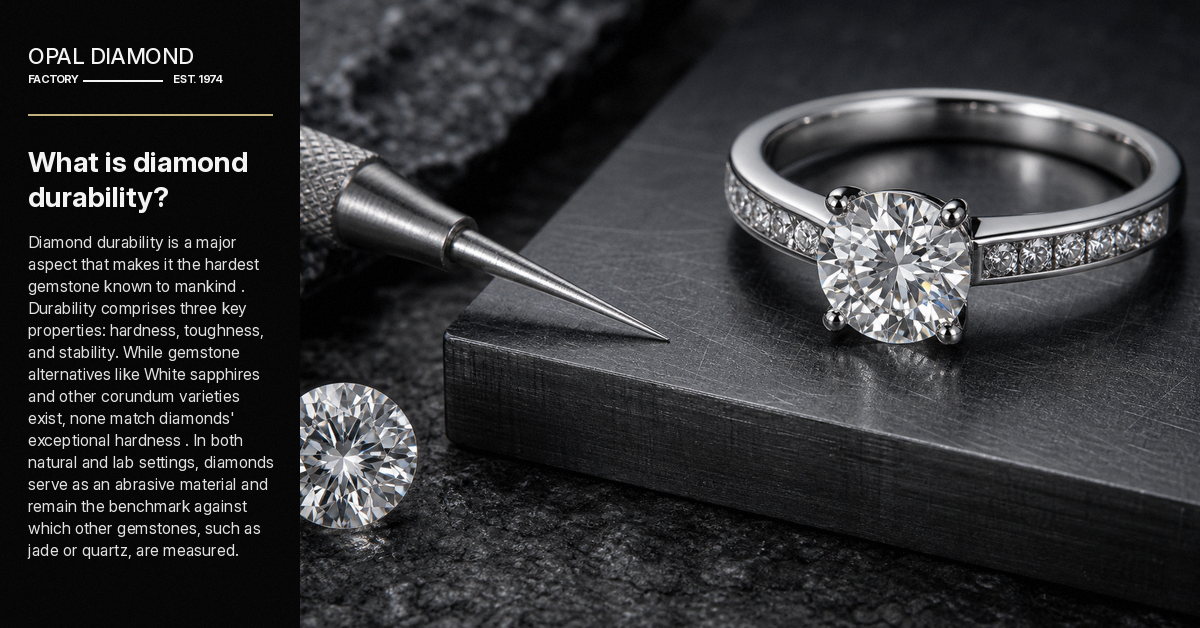
Diamond durability is a major aspect that makes it the hardest gemstone known to mankind. Durability comprises three key properties: hardness, toughness, and stability. While gemstone alternatives like White sapphires and other corundum varieties exist, none match diamonds’ exceptional hardness. In both natural and lab settings, diamonds serve as an abrasive material and remain the benchmark against which other gemstones, such as jade or quartz, are measured.
Diamonds are appealing not just for their variety of colours, including rare blue diamonds, but for their remarkable durability. Vulnerable areas exist along cleavage planes, making loose stones susceptible to breaking if struck precisely. This gemstone cleavage characteristic, along with their electrical properties, helps distinguish real gems from fake diamonds.
High-quality sapphires and other harder gemstones offer alternatives, but the absence of inclusions and superior durability of gem diamonds continue to drive their social impact and value. Understanding these factors helps distinguish authentic diamonds from imitations grown from a diamond seed. Their exceptional hardness, particularly in blue color varieties, remains unmatched in nature.
How hard is a diamond?
Diamonds are the hardest natural substance known, ranking 10 on the Mohs Hardness Scale. Their exceptional hardness comes from their unique crystal structure where each carbon atom bonds with four others in a tetrahedral formation.
While sapphires and rubies rank 9 on the scale, diamonds are actually four times harder than these gems despite being only one number higher. The Vickers Scale shows that diamonds are 300% harder than corundum (sapphires and rubies).
Due to their superior hardness, diamonds can scratch any other material, while only another diamond can scratch a diamond. This remarkable resistance makes them ideal for jewelry and industrial applications where extreme durability is required.
What makes a diamond tough?
Diamonds are renowned for their exceptional toughness, making them the most durable natural material on Earth. Their strength comes from several key features developed during formation deep within the Earth. These features include:
- Crystal Structure: Carbon atoms lock together in a perfect pattern, creating an incredibly stable formation.
- Strong Bonds: Each carbon atom links to four others, forming an unbreakable network.
- Pure Composition: Made entirely of carbon with very few impurities.
- Natural Formation: Created under intense pressure and heat over billions of years.
- High Resistance: Cannot be scratched by most materials (except other diamonds), withstands extreme temperatures, and resists most chemicals.
What scratches a diamond?
Diamonds, with a Mohs hardness of 10, are highly durable and resistant to scratches, making them ideal for everyday wear. They can still be scratched by materials with equal or greater hardness. Accidental damage can occur if not properly housed during cleaning or other activities. Understanding these factors helps maintain diamonds’ durability and ensures lasting beauty.
Can a diamond chip or break?
Yes, diamonds can chip under stress. While known for their hardness, they can be susceptible to damage due to their moderate toughness. Chipping risk increases when diamonds are set alongside softer materials. Daily wear also increases the risk of damage, making regular maintenance important in ensuring longevity. Understanding these factors is essential for preserving a diamond’s resilience and enhancing its resistance to wear and tear over time.
Are diamonds unbreakable?
Diamonds are not unbreakable. Known for their hardness, their chemical composition provides resistance to splitting. They can chip or fracture under significant impact. Understanding gemstone durability is important, as toughness varies among durable gemstones. Diamonds are incredibly strong but susceptible to wear and breakage, making proper care essential for their longevity and beauty.
How long does a diamond last?
Diamonds are incredibly long-lasting, with a lifespan extending millions to billions of years under normal conditions. They remain stable at room temperature and normal pressure for timeframes far beyond human lifespans. Natural diamonds formed between 1 to 3.3 billion years ago. This exceptional longevity makes them perfect for family heirlooms and legacy pieces.
Only a few conditions can degrade diamonds:
- Extremely high temperatures (above 1500°C), such as those found in industrial furnaces.
- Intense pressure, far exceeding daily wear.
- Exposure to oxygen at high temperatures, which can cause them to burn.
For practical purposes, both natural and lab-grown diamonds maintain their brilliance and structure for generations with proper care.
Do diamonds wear down?
While diamonds are the hardest natural substance, they can wear down over time, though extremely slowly. During normal wear as jewellery, diamonds experience minimal degradation through daily friction and micro-abrasions. This wear is so slight that it’s practically imperceptible during a person’s lifetime.
The main risks to diamonds come not from gradual wear, but from sudden impact damage. With proper care and regular maintenance, a diamond will maintain its brilliance and structure for generations.
Do diamonds erode?
Yes, diamonds can erode, but the process is extremely slow under normal conditions. Natural erosion occurs through chemical dissolution in magma, mechanical weathering, and exposure to extreme temperatures and pressures.
In everyday wearing conditions, diamond erosion is practically non-existent. Erosion that might occur through normal jewellery wear is so minimal it would take many human lifetimes to become noticeable. The main risks to diamonds come from accidental damage rather than natural erosion processes.
Can chemicals damage a diamond?
Diamonds, known for their hardness, are not immune to chemical damage. Certain harsh chemicals can affect their structural integrity, especially in synthetic diamonds or those with visible inclusions. Proper care involves avoiding exposure to strong acids or harsh cleaning agents, as well as avoiding thermal shock from extreme temperature changes. Diamonds are tough, but proper care is crucial to maintain their brilliance, especially in engagement rings and other cherished pieces.
Does cut affect diamond durability?
Yes, the cut of a diamond significantly affects its durability. A diamond’s cut influences how well it withstands everyday wear and potential damage.
Sharp corners, thin edges, and extremely thin girdles are more vulnerable to chipping and cracking. Well-cut diamonds distribute force more evenly across the stone, making them less likely to break. Professional cutters carefully consider the diamond’s natural cleavage planes when shaping the stone, balancing durability with aesthetic appeal to ensure the diamond remains beautiful and intact.
Does clarity affect diamond strength?
Yes, diamond strength is influenced by internal and external clarity characteristics, including inclusions and imperfections. Large or numerous inclusions can create weak points, making the stone more vulnerable to damage. The location of inclusions is important; those near the surface or under tension areas make diamonds more susceptible to chipping or cracking. Deep inclusions can also create breaking points. Most small inclusions in commercial-quality diamonds don’t significantly affect durability for everyday wear.
Does colour affect diamond durability?
While clarity, toughness, and cut significantly influence durability, a diamond’s colour itself does not directly impact its hardness or toughness. Diamonds’ hardness comes from their atomic structure and crystal lattice.
Colour can indicate impurities or structural defects, but these typically don’t weaken the stone unless associated with significant inclusions or created through treatments that compromise the diamond’s integrity. Longevity is influenced more by wear, proper maintenance, and the setting decisions covered in a diamond jewellery buying guide.
Do settings affect diamond strength?
Yes, diamond settings significantly influence its strength and durability. A setting provides major protection while showcasing the diamond. Prong settings expose more surface area, potentially making stones vulnerable to damage, while bezel settings provide more comprehensive protection. The choice of setting affects diamond strength, as the right setting enhances hardness and ensures longevity, maintaining the gem’s beauty and integrity.
What is cleavage plane vulnerability in diamonds?
Cleavage plane vulnerability in diamonds presents a contrast to their extraordinary hardness. Despite being the hardest mineral with superior scratch resistance, diamonds have natural planes of weakness in their crystal structure that can make them susceptible to splitting if struck with sufficient force.
These planes are crystal directions where atomic bonds are slightly weaker. Professional cutters and jewellers consider these planes during cutting and setting to ensure maximum durability and protection. Understanding these structural vulnerabilities is crucial for proper care and longevity of diamond jewellery, especially for protective settings in engagement rings.
What is microfracture stress tolerance in diamonds?
Diamonds’ hardness is due to their complex physical properties, allowing them to withstand microfractures under certain external forces and accidental impact. The durability of diamonds depends on their ability to handle these microfractures, important in diamond jewellery, especially engagement rings. Natural inclusions and clarity grade play a significant role in how a stone tolerates stress, making proper jewellery settings essential for protection.
Diamonds’ complex crystal structure allows them to withstand considerable stress before showing signs of wear. Even durable stones need regular cleaning and authenticity verification. Diamond cuts must consider these stress points to minimise vulnerability to microfractures and maintain the stone’s integrity despite external forces.
What is thermal shock resistance in diamonds?
Thermal shock resistance in diamonds is their ability to withstand rapid temperature changes without fracturing. Diamonds are exceptional thermal conductors, dissipating heat quickly and minimising stress. Their hardness is due to strong covalent bonds within the cubic structure. Understanding thermal shock resistance helps ensure the longevity of a diamond ring in temperature-sensitive environments.
Can a diamond handle daily wear?
Yes, diamonds can handle daily wear exceptionally well due to their superior hardness and durability. They resist scratching and maintain their polish during everyday activities. They aren’t indestructible and can be damaged by hard impacts, especially along their cleavage planes.
With proper settings and reasonable care, such as avoiding harsh chemicals and removing jewellery during high-risk activities, a diamond maintains its beauty through generations of daily wear.
Are diamonds durable in rings?
Yes, diamonds are extremely durable for diamond engagement rings and other daily-wear jewellery. Their unparalleled hardness and crystal lattice structure create stronger resistance to scratches than alternatives like quartz. This explains their popularity in rings.
While their cubic formation provides resistance to breakage, they are not immune to damage. Environmental factors and impact can affect longevity, making frequent cleaning and proper care a must for maintaining brilliance.
Are lab diamonds as strong?
Yes, lab diamonds are just as strong as natural diamonds because they have identical physical and chemical properties. Created under controlled conditions that mirror nature’s process, they share the same crystal structure and carbon composition as their natural counterparts.
Both types have identical durability characteristics, including the same 10/10 hardness rating and resistance to scratching. The only difference is their origin. In terms of strength and wearability, they are indistinguishable because they are atomically identical.
Are treated diamonds durable?
Treated diamonds can be durable, but their strength may be compromised depending on the treatment type. While they maintain the basic diamond structure, treatments like fracture-filling can make stones more vulnerable to heat and chemical damage. Colour treatments through irradiation or HPHT generally don’t affect durability, but these diamonds may need special care instructions.
Do diamonds resist heat?
Yes, diamonds have excellent heat resistance, but they’re not indestructible at high temperatures. In oxygen, diamonds burn around 1,500°F (800°C). In an oxygen-free environment, they withstand temperatures up to about 3,550°F (1,955°C) before transforming into graphite.
For practical jewellery wear, diamonds safely withstand typical heat exposure from daily activities. Common household temperatures won’t affect structure or appearance. Still, remove diamond jewellery during activities involving significant heat exposure to protect both the diamond and its setting.
Do diamonds resist pressure?
Yes, diamonds resist pressure extremely well, having formed under intense pressure deep within the Earth. They maintain their structure under most common circumstances, making them ideal for daily-wear jewellery.
While diamonds handle steady, evenly distributed pressure, they can crack or chip when sudden, sharp impacts or extreme pressure is applied along their cleavage planes. For practical purposes, diamonds easily handle normal pressure encountered daily but should be protected from extreme impacts.
How does diamond durability compare to moissanite?
Diamond and moissanite have similar durability characteristics. Diamonds rank 10 on the Mohs scale, while moissanite ranks 9.25-9.5, making it the second hardest gemstone for jewellery. While diamonds are slightly more scratch-resistant, moissanite is actually more resistant to breaking and chipping because it lacks the cleavage planes found in diamonds.
|
Property |
Diamond |
Moissanite |
|---|---|---|
|
Hardness (Mohs) |
10 |
9.25-9.5 |
|
Scratch Resist. |
Superior |
Excellent |
|
Breakage Resist. |
Good (has cleavage planes) |
Better (no cleavage planes) |
|
Heat Resist. |
Burns ~ 800°C (in O₂) |
Stable to ~ 980°C |
For practical everyday wear, both stones are highly durable. The average wearer won’t notice significant durability differences with normal use and proper care.
What is the Mohs scale for diamonds?
The Mohs scale rates diamonds at 10, making them the hardest natural substance known. While sapphires and rubies rank 9, the scale isn’t linear; diamonds are about four times harder than sapphires. Nothing in nature can scratch a diamond except another diamond, making them exceptionally resistant to scratching.
Key facts about diamonds on the Mohs scale:
- Diamonds are the hardest natural mineral.
- They rank 10/10 on the scale.
- The scale is non-linear, with diamonds significantly harder than rank 9 minerals.
- Only another diamond can scratch a diamond under normal conditions.
Can a damaged diamond be reshaped?
Yes, a damaged diamond can be reshaped by a skilled diamond cutter through recutting or repolishing. This process removes chips, scratches, or worn edges. The process results in a loss of carat weight since material must be removed.
Not all damaged diamonds are candidates for reshaping. Some damage may be too severe or would require removing too much material. Consult with a certified diamond expert to assess if recutting is beneficial and cost-effective.
What tools are used to reshape diamonds?
Diamond reshaping requires highly specialised tools and equipment operated by expert diamond cutters. Main tools include:
- Diamond Saw: Ultra-thin blade coated with diamond dust for initial cutting.
- Polishing Wheel: Diamond-charged spinning disc for creating smooth facets.
- Dop: Metal holder that secures the diamond during cutting.
- Laser Equipment: Used for precise cutting and shape planning.
- Microscopes: Provide detailed views for precision work.
How does reshaping affect diamond value?
Reshaping significantly affects diamond value through multiple factors. The process typically results in a loss of carat weight, which decreases value. A well-executed reshape can enhance symmetry grade and overall appearance, potentially increasing value. Market trends and preferred shapes also influence the final value.
Success depends on balancing improved appearance with minimal carat loss to maintain or enhance market value.
Related diamond guide: How to repair diamonds: fixing chips, cracks, and settings.
TOPICS COVERED
Scale of hardness, scale of mineral hardness, jewelry settings, piece of jewelry, precious gemstone, alternative to diamonds, appeal of diamonds, brilliant cut diamonds, Diamond Earrings, diamond shapes, Diamond Wedding Bands, remarkable hardness, harder material, resistance to chemicals, natural stones, dozen pieces, piece of jade, piece of quartz, excellent choice, layers of atoms, extreme heat, essential factors, crucial factors, environmental impact, cutting process, formation process, Professional Cleaning, gemstone bind, advanced technology, common misconception, soft toothbrush, terms of durability, types of jewelry, diamond cubic, cushion cut diamonds, diamond vulnerable, natural diamond crystal, real diamond, single-crystal diamond, soft stones, engagement ring gemstones, traditional choice, sapphire jewelry, substitutional nitrogen atoms, variety of colors.