
The diamond structure is a marvel of natural engineering, formed as a giant covalent structure with an interlocking network of carbon atoms from the periodic table. This precise crystal arrangement, known as its crystal habit, makes diamond the hardest known natural material. The unique atomic architecture determines its unparalleled strength, optical properties, and wide range of potential applications. Understanding this intricate structure is essential to avoid costly mistakes in both diamond selection and industrial utilization.
What is a diamond’s atomic structure?
A diamond possesses a distinct crystalline structure defined by carbon atoms arranged in a face-centered cubic lattice.
For broader context, compare this point with the diamond science guide.
This structure features carbon atoms bonded to 4 neighboring atoms, forming tetrahedral configurations throughout the crystal. Each carbon atom shares electrons with its neighbors through strong covalent bonds, creating a giant covalent structure that extends in 3 dimensions. This arrangement, with atoms connected at precise 109.5° angles, generates exceptional stability, explaining diamond’s unparalleled hardness and thermal conductivity.
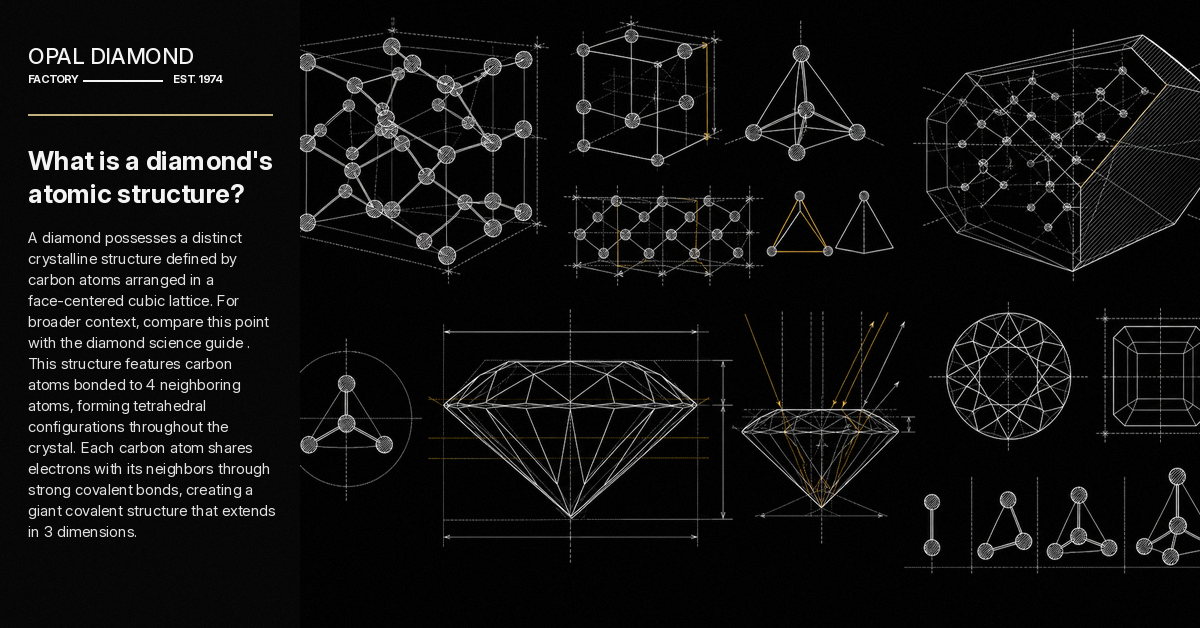
What does diamond structure look like?
Despite its complexity, diamond structure resembles a 3-dimensional network of interconnected tetrahedra. Each carbon atom forms 4 carbon-carbon covalent bonds in a tetrahedral arrangement with 109.5° bond angles. This creates a diamond cubic structure where carbon atoms lock together in a rigid covalent lattice that extends uniformly in all directions, producing its exceptional hardness. A diamond 3D model reveals how each carbon atom shares electrons with 4 neighbors through sp³ carbon bonding. This forms a highly symmetric lattice structure that efficiently distributes force throughout the entire network.
How is diamond structure formed?
Diamonds are formed deep within the Earth’s mantle under extreme heat and pressure. The formation process involves 4 key steps:
- Carbon Source: Diamonds are composed of carbon atoms, which originate from deep within the Earth’s mantle.
- High Pressure and Temperature: Intense pressure (approximately 725,000 psi) and temperatures (2000-2200°F) force carbon atoms into a compact, crystalline structure.
- Crystal Formation: The carbon atoms bond in a tetrahedral arrangement, resulting in an extremely strong lattice.
- Transport to Surface: Volcanic eruptions bring diamonds to the surface via kimberlite and lamproite pipes.
This unique formation process gives diamonds their remarkable hardness and brilliance.
What is the chemical makeup of diamond structure?
Carbon atoms, arranged in a 3-dimensional crystalline lattice, form the chemical foundation of diamond structure. Each carbon atom covalently bonds to 4 neighboring atoms in a tetrahedral arrangement, creating one of nature’s most stable carbon allotropes. This giant covalent structure exhibits a face-centered cubic lattice with 2 carbon atoms per primitive cell. The crystal arrangement guarantees exceptional chemical properties, including unparalleled hardness and thermal conductivity.
Diamond’s carbon structure differs fundamentally from graphite despite identical chemical composition. The tetrahedral bonding pattern creates a rigid 3-dimensional network where each atom shares electrons equally, distributing forces throughout the entire diamond crystal structure.
What is the carbon allotrope lattice?
The carbon allotrope lattice refers to the specific arrangement of carbon atoms in different forms of carbon. In diamond, carbon atoms form a rigid 3-dimensional tetrahedral lattice, making it extremely hard. In contrast, graphite’s lattice consists of 2-dimensional hexagonal layers, making it softer. Each allotrope’s lattice structure determines its unique properties.
What is the atomic symmetry index?
Every diamond’s fundamental property lies in its atomic symmetry index, which quantifies the degree of order in the crystal structure. This index characterizes the diamond cubic crystal, a variant of the face-centered cubic Bravais lattice with specific crystallographic structure. The diamond space group Fd3m represents this highly ordered 3D lattice, where carbon atoms occupy precise lattice points. Each atom forms 4 covalent bonds in a tetrahedral arrangement, creating the rigid diamond structure.
Scientists measure atomic symmetry through diffraction techniques, yielding values that indicate structural perfection. Higher indices correlate with greater hardness, transparency, and thermal conductivity-properties that define diamond’s exceptional mechanical and optical characteristics.
What makes the diamond crystal lattice unique?
The diamond crystal lattice is unique due to its remarkable structural and physical properties, such as:
- Tetrahedral Structure: Each carbon atom is covalently bonded to 4 others in a 3-dimensional tetrahedral arrangement.
- Extreme Strength: The lattice creates an incredibly strong bond network, making diamond one of the hardest materials known.
- High Thermal Conductivity: The rigid lattice allows efficient heat transfer, giving diamond exceptional thermal conductivity.
- Optical Transparency: The lattice structure refracts light, giving diamonds their brilliance and sparkle.
These features result from the diamond’s unique atomic bonding and arrangement.
How is crystalline density analysed?
Crystalline density analysis typically examines the spatial arrangement of atoms and their packing efficiency within a crystal structure. Diamond crystalline density reflects its lattice configuration where carbon atoms form a giant structure through tetrahedral structural bonding. Scientists determine density by measuring the lattice constant within diamond cubic crystals, which reveals the characteristic face-centered cubic lattices with interpenetrating frameworks. This yields a relatively low atomic packing factor compared to other crystal structures.
The diamond structure crystal drawing reveals substantial void spaces between carbon atoms, explaining why diamond’s density (3.5 g/cm³) is lower than other carbon allotropes despite its extreme hardness.
What types of diamond structures exist?
There are several types of diamond structures, categorized based on variations in atomic arrangement and composition:
| Diamond Type | Description |
|---|---|
| Natural Diamond | Formed under Earth’s mantle, it has a perfect tetrahedral carbon lattice. |
| Synthetic Diamond | Created in labs via methods like HPHT (High Pressure High Temperature) or CVD (Chemical Vapor Deposition), mimicking the natural tetrahedral structure. |
| Polymorphs | A rare diamond form with a hexagonal lattice instead of cubic, offering slightly different properties (e.g., Lonsdaleite). |
| Impure Diamond | The structure includes trace impurities (e.g., nitrogen or boron), resulting in distinct colours like yellow, blue, or pink. |
These variations show the diversity in diamond structures, each with specific properties and uses.
What are diamond properties?
Diamonds possess unique properties that make them highly valued, such as:
- Hardness: Diamond is the hardest naturally occurring material, resistant to scratching and wear.
- Thermal Conductivity: It has exceptional heat transfer capabilities, making it an excellent thermal conductor.
- Refractive Index: Its ability to bend and reflect light gives diamonds their brilliance and sparkle.
- Electrical Insulation: Despite high thermal conductivity, it is an excellent electrical insulator.
- Chemical Stability: Diamonds are highly resistant to chemical reactions at room temperature.
These properties result from its strong covalent bonds in the tetrahedral crystal lattice structure.
What is facet-specific refractivity?
Facet-specific refractivity describes how light behaves differently when striking various cut surfaces. Diamond structure influences this phenomenon fundamentally. Each facet possesses unique refraction angles determined by the diamond’s crystalline arrangement. Light entering these precisely cut surfaces creates diamond optical effects through controlled reflection and dispersion.
Physical properties of diamond crystals enable facets to ACT as light-managing tools. When precisely angled according to diamond model specifications, these facets maximize brilliance by directing light back to the viewer’s eye. Diamond characteristics like high Refractive Index (2.42) guarantee that different facets exhibit varying refractivity, creating the stone’s signature fire and sparkle.
What are thermal conductivity dynamics?
Diamond, as a covalent network solid, boasts the highest thermal conductivity of any natural material due to its rigid carbon lattice, where efficient phonon vibrations transfer heat. It conducts heat 5 times better than copper, surpassing materials like graphite. The strength of its giant covalent structure, with minimal atomic vibrations, ensures exceptional heat transfer, even at elevated temperatures.
While defect structures can reduce conductivity, CVD diamond and polycrystalline diamond are precisely engineered to optimize performance, particularly as diamond substrate components in electronics. Modern nanocrystalline diamond is pivotal in tribological properties and heat dissipation in nanotech systems, outperforming conventional materials. Beyond natural diamond mines, these properties make diamond invaluable in diamond tools and advanced technologies.
What is gem material physics?
Gem material physics examines the distinct physical properties that make diamonds exceptional among crystalline solids.
The diamond structure features carbon atoms in sp³ hybridization, creating tetrahedral bonding patterns that contrast sharply with graphite’s layered structure. This unique carbon chemistry yields remarkable characteristics, such as: extreme hardness, high thermal conductivity, optical transparency, and the dispersion that contributes to diamond fire. Diamond’s wide band gap (5.5 eV) explains its electrical insulation properties and optical behaviour.
As an allotrope of carbon, diamond material structure represents carbon’s densest crystalline form. Understanding diamond structure reveals why it maintains stability under extreme pressure while exhibiting extraordinary physical and chemical resistance.
How are atoms arranged in diamond structure?
The electronic structure of diamond derives from the sp³ hybridization of carbon’s valence electrons. Each atom shares electrons with 4 neighbors to form strong covalent bonds. This tetrahedral arrangement creates a band gap of approximately 5.5 eV, making diamond an excellent electrical insulator under normal conditions. The wide band gap also explains diamond’s transparency to visible light while absorbing in the ultraviolet region, contributing to its distinctive optical properties.
What are the electronic traits of diamond structure?
The electronic traits of the diamond structure are unique and important for certain applications, including:
- Wide Band Gap: Diamond has a large band gap (5.5 eV), making it an excellent electrical insulator.
- High Dielectric Strength: It can withstand high electric fields without breaking down, useful in specialized electronics.
- Semiconductor Potential: When doped (e.g., with boron or phosphorus), diamond can exhibit semiconducting properties suitable for power electronics.
- High Carrier Mobility: Electrons and holes move efficiently within the crystal lattice when doped, enhancing performance.
- Thermal Stability in Electronics: Its ability to maintain electronic properties at high temperatures and power densities makes it ideal for high-performance applications.
These traits, alongside its physical durability, position diamond as a key material in advanced electronic technologies.
How does diamond structure conduct heat?
The diamond structure’s rigid covalent network allows for efficient thermal vibration transfer between carbon atoms. These strong carbon-carbon bonds create a lattice that transmits phonons rapidly through the crystal structure. Diamond’s unparalleled thermal conductivity makes it approximately 5 times more conductive than copper, despite being an electrical insulator.
How does diamond structure affect hardness?
Because of its unique atomic arrangement, diamond achieves unparalleled hardness in the natural world. Its structure derives from the tetrahedral carbon-carbon covalent bonds forming a rigid 3-dimensional network. Unlike graphite bonding with weak intermolecular forces, the diamond bond structure features 4 equally strong bonds per carbon atom. This comparison reveals why diamond hardness exceeds all natural materials at 10 on the Mohs scale.
The pressure required for formation-approximately 725,000 psi at 2,200°F-creates these bonds. In chemistry, the differences from other carbon structures are evident: maximum atomic density and minimum interatomic distance produce nature’s hardest armour.
How do diamonds interact with light?
Diamonds interact with light in distinctive ways, creating their iconic brilliance and sparkle, such as:
- Reflection: Light hitting a diamond’s surface bounces back, producing an initial glimmer.
- Refraction: When light enters a diamond, it bends due to the dense crystal structure, allowing it to “dance” within the gem and create an inner glow.
- Dispersion: Light separates into its spectral colours as it travels through the diamond, resulting in flashes of rainbow-like “fire.”
- Total Internal Reflection: If cut properly, light inside the diamond is trapped and reflected multiple times before exiting, enhancing brightness and sparkle.
These interactions are dependent on the stone’s cut, quality, and high Refractive Index, which amplifies its visual appeal.
What is photonic refractive behaviour?
3 remarkable optical properties define diamond’s interaction with light: high Refractive Index, exceptional dispersion, and total internal reflection. Diamond structure creates unique photonic refractive behaviour. Its carbon lattice arrangement enables light to slow considerably when passing through, resulting in a Refractive Index of 2.42-noticeably higher than glass or quartz. This explains why natural diamonds brilliantly bend light.
The whole structure of diamond causes exceptional dispersion, separating white light into spectral colours. Unlike silicon, diamond’s schematic arrangement facilitates minimal diffraction loss while maximizing total internal reflection, where light entering at specific angles remains trapped within the crystal, enhancing brilliance.
What is crystalline optoelectronics?
Beyond refractive properties, diamond’s crystalline structure enables remarkable optoelectronic capabilities. The tetrahedral carbon arrangement allows diamonds to transmit across ultraviolet, visible, and infrared spectrums with minimal absorption. This unique behaviour drives artificial diamonds created through chemical vapor deposition for specialized optoelectronic applications. Diamond films outperform graphene in certain sensing contexts, converting light signals into electrical outputs with exceptional efficiency.
Diamond synthesis techniques continue advancing for diamond renewable technologies and aerospace applications where thermal conductivity paired with optical transparency proves invaluable. Diamond in biology research utilizes these optoelectronic properties for imaging and sensing at cellular levels with unmatched precision.
How does spectrum interact with gems?
Almost every facet of diamond’s interaction with light stems from its crystalline carbon lattice. This diamond structure allows it to bend and disperse the electromagnetic spectrum uniquely among gems. When light enters a diamond, its tetrahedral arrangement of atoms creates exceptional refraction. White light splits into rainbow patterns that distinguish diamond vs. cubic zirconia counterparts.
Fancy coloured diamonds result from impurities or structural anomalies. Pink diamonds contain crystal deformations, while other coloured diamonds incorporate different elements. A rough diamond appears unremarkable until cut properly. This optical property makes diamond for school demonstrations particularly effective in teaching spectrum principles through nature’s hardest material.
How do impurities change diamond structure?
Impurities can significantly alter the diamond structure and its properties, such as:
- Colour Changes: Impurities, like nitrogen, boron, or hydrogen, replace carbon atoms in the lattice, causing colours. For example, nitrogen creates yellow diamonds, while boron produces blue diamonds.
- Lattice Distortion: The introduction of foreign atoms morphs the tetrahedral crystal lattice, sometimes weakening the structure.
- Electrical Conductivity: Certain impurities, like boron, can change diamond from an insulator to a semiconductor by enabling electrical conductivity.
- Reduced Hardness: A high number of impurities can disrupt the strong covalent bonds, slightly reducing a diamond’s hardness.
- Spectroscopic Signature: Impurities give diamonds distinct spectroscopic patterns, aiding in their identification and classification.
These changes from impurities highlight how even slight alterations in atomic composition can affect the diamond’s physical, optical, and electronic properties.
How does diamond structure compare with graphite?
Diamond and graphite represent 2 radically different arrangements of carbon atoms, despite sharing identical chemical composition. Both carbon allotropes differ fundamentally in crystal lattice organization. Diamond structure features a tetrahedral arrangement where each carbon atom bonds covalently with 4 others in 3 dimensions, creating exceptional hardness. Graphite structure consists of carbon sheets with hexagonal patterns, weakly connected between layers.
This atomic arrangement explains their contrasting physical properties. Diamond’s rigid 3D network yields the hardest natural substance, while graphite’s layered structure allows sheets to slide past one another, creating softness. The same element manifests opposing characteristics through different structural configurations.
How does pressure alter diamond structure?
Pressure plays a crucial role in shaping and altering the diamond structure, as follows:
- Formation Under High Pressure: Diamonds form deep within the Earth’s mantle under pressures exceeding 725,000 psi, which forces carbon atoms into a tightly bonded tetrahedral lattice.
- Structural Stability: Intense pressure maintains the rigid diamond structure. Without enough pressure, carbon atoms form graphite instead.
- Phase Transitions: Extreme pressure changes can transform diamond into other carbon phases, like lonsdaleite, which has a hexagonal structure.
- Defect Formation: Uneven or insufficient pressure during growth can create lattice defects, affecting clarity and strength.
Pressure is essential for both the creation and preservation of the diamond’s unique crystal lattice and properties.
Where is diamond structure used?
Applications of diamond structure extend far beyond jewellery and decorative uses. The 3D atomic diamond arrangement enables exceptional thermal conductivity and hardness, making it indispensable in industrial cutting tools and abrasives. Scientists utilize diamond anvil cells to study materials under extreme pressure. The diamond structure’s high melting point and resistance to dislocation make it essential for high-performance electronics and heat sinks.
Diamond zinc blende structure appears in semiconductor materials, while comprehending diamond vs. wurtzite structures is pivotal in materials science. Diamond structure GCSE curriculum teaches students fundamental crystallography principles. In quantum computing, diamond lattice defects show promise for qubit implementation, expanding applications into emerging technologies.
Why is diamond structure used in materials science?
The resilience of the diamond structure, a prime example of giant covalent structures, makes it essential in materials science. Researchers analyze its properties using techniques like X-ray diffraction and Raman spectroscopy. Under extreme pressure, the diamond’s sp³ hybridized carbon bonds can shift, modifying lattice parameters and even creating new allotropes with unique characteristics. Future research on diamond structures focuses on three key areas: applications in quantum computing, development of ultra-hard materials, and nanoscale diamond engineering for medical and electronic advancements.
What measures diamond structure?
Various advanced analytical techniques serve to measure diamond’s crystalline structure at both atomic and macroscopic scales:
- X-ray diffraction reveals the zinc blende diamond structure composition at atomic levels.
- Raman spectroscopy analyses carbon bonding patterns.
- Electron microscopy visualizes lattice arrangements critical for educational diamond research, medical applications, and printable diamond technologies.
These methods determine stability across temperatures approaching boiling points.
What is the future of diamond structure research?
Advancing beyond conventional applications, diamond structure research promises revolutionary developments in quantum computing, nanocomposites, and biomedicine. Scientists are exploring diamond’s potential as quantum bits for information processing, ultra-strong composite materials, and biocompatible sensors. High-pressure synthesis techniques may yield novel carbon allotropes with customized properties, while computational modelling accelerates discovery of diamond-like structures with unprecedented characteristics.