
Laboratory-grown diamonds, created under extreme conditions in specialised growth chambers, represent a technological triumph that mirrors the optical properties and hardness of natural diamonds on the MOHs scale. Modern facilities employ advanced equipment to transform elemental carbon into gem-quality diamonds through controlled temperature conditions and intense heat, producing beautiful stones suitable for diamond rings and everyday wear.
From colourless stones to black diamonds, these laboratory-grown alternatives demonstrate comparable mechanical properties and electrical conductivity to their natural counterparts, while offering ethical sourcing and environmental benefits through green energy practices.
The diamond alternatives education helps place this detail in context.
Each stone comes with a detailed Grown Diamond Report, ensuring transparency and peace of mind for consumers choosing these modern alternatives, whether they’re selecting an emerald-cut center diamond or traditional diamond forms for jewellery purposes.
What are synthetic diamonds?
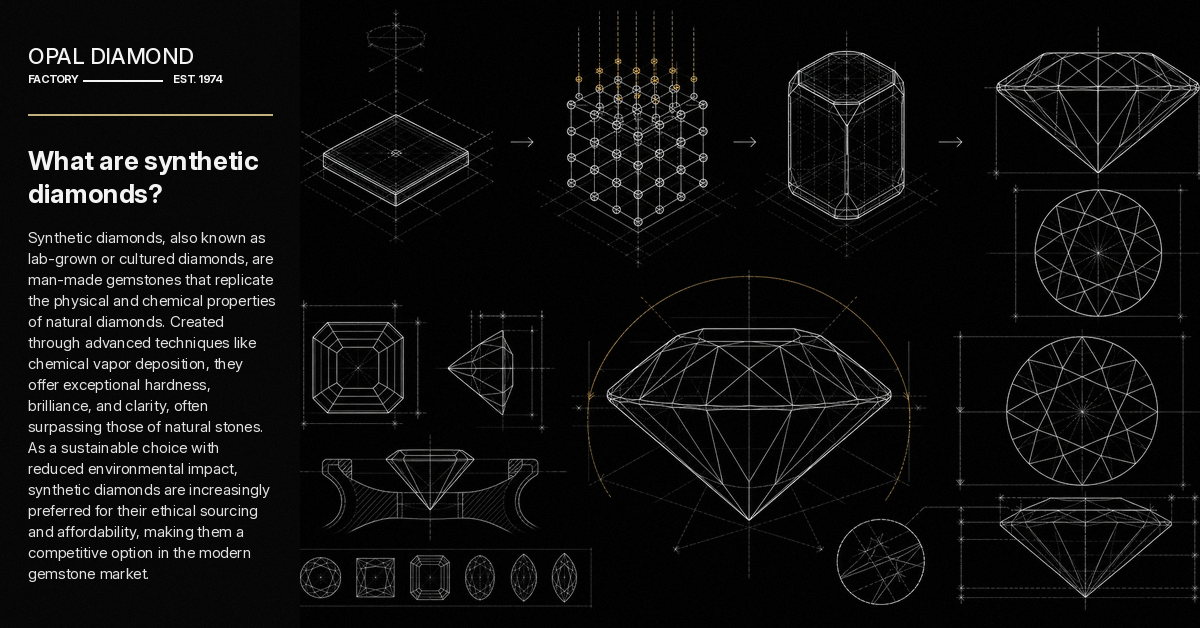
Synthetic diamonds, also known as lab-grown or cultured diamonds, are man-made gemstones that replicate the physical and chemical properties of natural diamonds. Created through advanced techniques like chemical vapor deposition, they offer exceptional hardness, brilliance, and clarity, often surpassing those of natural stones. As a sustainable choice with reduced environmental impact, synthetic diamonds are increasingly preferred for their ethical sourcing and affordability, making them a competitive option in the modern gemstone market.
How are synthetic diamonds made?
Synthetic Diamonds: A Modern Marvel
Synthetic or laboratory-grown diamonds are real diamonds created in controlled environments that replicate natural diamond formation. Instead of taking millions of years to form underground, these diamonds can be produced in a matter of weeks using two main methods:
High pressure, high temperature (hpht)
- Places carbon in a metal catalyst
- Subjects it to extreme pressure and heat
- Diamond crystals form from the carbon
Chemical vapor deposition (cvd)
- Heats hydrocarbon gas in a vacuum chamber
- Carbon atoms separate and settle on a base
- Builds diamond crystal layer by layer
The end result is a genuine diamond that shares identical chemical, physical, and optical properties with natural diamonds. These stones are becoming increasingly popular for jewellery and industrial applications due to their lower cost and ethical sourcing.
What do synthetic diamonds look like?
To the naked eye, synthetic diamonds are visually identical to their natural counterparts, displaying the same brilliance, clarity, and color characteristics. The only way to distinguish between natural and laboratory-grown diamonds is through specialised professional equipment that can detect subtle growth patterns and structural variations. Whether examining a colourless stone or fancy-coloured varieties, both types of diamonds share the same fundamental properties and can be crafted into identical jewellery pieces with the same beauty and durability.
What types of synthetic diamonds exist?
Synthetic diamonds are created in laboratories through various methods, with each type serving a distinct purpose. These lab-grown diamonds are categorised based on their intended use and quality specifications, ranging from industrial tools to fine jewellery. Here are the main types:
• Industrial Grade Basic quality diamonds used primarily in cutting tools, drilling equipment, and abrasives
• Jewellery Grade High-quality diamonds created specifically for use in jewellery, matching natural diamonds in appearance
• Research Grade Ultra-pure diamonds produced under strictly controlled conditions for scientific and laboratory use
• Technology Grade Specialised diamonds designed for electronic components and high-tech applications
Synthetic diamonds vs. natural diamonds: what’s the difference?
While chemically identical, synthetic and natural diamonds differ primarily in their origin, cost, and market value. Natural diamonds form over millions of years underground, while synthetic diamonds are created in laboratories within weeks. Natural diamonds command higher prices due to their rarity and mining costs, while synthetic diamonds typically cost 20-40% less.
The environmental impact also differs significantly – natural diamonds require extensive mining operations, while synthetic diamonds have a minimal environmental footprint. Traceability is another key difference, with synthetic diamonds being fully traceable from creation to market, unlike natural diamonds whose origins can sometimes be unclear. Natural diamonds generally maintain better resale value, though synthetic diamonds are gaining market acceptance. In terms of quality, natural diamonds show natural variations, while synthetic diamonds offer controlled quality through laboratory processes.
What are lab-grown diamond properties?
Lab-grown diamonds share identical fundamental properties with natural diamonds, as they are both pure crystalline carbon. Here are their key properties:
- Physical Properties Hardness – Rates 10 on Mohs scale, highest of any natural material Crystal Structure – Cubic system with perfect octahedral cleavage Density – 3.52 g/cm³, same as natural diamonds Durability – Extremely resistant to scratching and abrasion Thermal Conductivity – Excellent conductor of heat.
- Optical Properties Refractive Index – High brilliance and fire Light Performance – Superior sparkle and light return Colour Range – Available from colourless to fancy colours Transparency – Can be completely clear to opaque Dispersion – Strong rainbow effect when cut properly.
- Chemical Properties Composition – Pure carbon in crystalline form Stability – Highly stable at room temperature Resistance – Inert to most chemicals and acids Purity – Can be created with minimal inclusions Structure – Identical atomic arrangement to natural diamonds.
- Grading Characteristics Quality Assessment – Uses standard 4Cs grading system Clarity Range – Can achieve flawless grades Cut Options – Available in all traditional shapes Size Range – Can be grown in various carat weights Colour Grading – D to Z colour scale, plus fancy colours.
Are synthetic diamonds real?
Synthetic diamonds are real diamonds with identical properties to their natural counterparts. They are created under controlled growth environments in laboratories using modern growth conditions and specialised equipment. Both types of diamonds exhibit the same hardness scale ratings, clarity grades, and crystallographic orientation. The growth structure and formation process may differ from natural diamond crystals, but the end result is chemically identical diamond material.
Synthetic diamonds serve as electrical insulators and conductors of heat, similar to their natural counterparts. They can be set in yellow gold for jewellery or used in industrial applications, originating from controlled laboratory conditions rather than natural geological processes.
Why use synthetic diamonds?
Synthetic diamonds are gaining popularity due to their cost benefits, ethical considerations, and quality assurance. They offer a lower price point than natural diamonds, better value for larger stones, and are an affordable luxury option. They also provide consistent quality standards, are available in all cuts and colours, and offer faster availability and wider selection.
What are chemical vapour deposition chambers?
CVD chambers are sophisticated laboratory vessels where synthetic diamonds are grown under precisely controlled conditions. These specialised chambers use a combination of heat, gases (typically hydrogen and methane), and microwave energy to create plasma that breaks down carbon atoms, which then accumulate layer by layer on a diamond seed plate.
The process takes place in a sealed vacuum environment at temperatures around 800°C, with computer-monitored conditions ensuring precise control of temperature, pressure, and gas mixtures. This technology enables the creation of high-quality diamonds over several weeks, producing gems that are chemically identical to natural diamonds through a carefully managed growth process.
What is high pressure high temperature synthesis?
HPHT synthesis recreates natural diamond formation conditions using massive mechanical presses and extreme temperatures. This process transforms pure carbon into diamond by subjecting it to pressures exceeding 50,000 atmospheres and temperatures above 1,500°C in the presence of a metal catalyst.
The method compresses and heats carbon until it dissolves and recrystallises as diamond, accomplishing in days what takes millions of years in nature.
The result is genuine diamonds that are chemically and physically identical to natural stones and suitable for both jewellery and industrial applications, which is why lab-grown and mined diamonds are compared directly.
What are graphitisation suppression techniques?
Graphitisation suppression techniques are specialised methods used in synthetic diamond production to prevent carbon from forming graphite instead of diamond. These controls are crucial because carbon naturally prefers to form graphite under normal conditions.
The main methods include using specific metal catalysts, maintaining consistent high pressure, regulating temperature, controlling growth rates, and managing the atmospheric conditions. These techniques ensure carbon atoms arrange themselves in the desired diamond structure rather than defaulting to graphite formation, which is essential for successful diamond synthesis.
What are synthetic diamond certifications?
Synthetic diamonds undergo rigorous testing and certification processes to verify their authenticity and quality. The following certificates are widely recognised in the industry:
• GIA Laboratory-Grown Diamond Report Most prestigious lab diamond certification worldwide
• IGI Lab Grown Diamond Report Popular certification offering comprehensive grading
• GCAL Lab Grown Diamond Certificate Known for advanced light performance analysis
• HRD Grown Diamond Certificate European standard for lab diamond certification
• AGS Laboratory-Grown Report Detailed analysis of cut quality and light performance
• ICA Lab Grown Certificate International certification with global recognition
• JCGC Lab Created Report Japanese certification focusing on quality assessment
Each certificate includes detailed information about the diamond’s 4Cs (Cut, Colour, Clarity, Carat), growth method, treatments, and origin, ensuring transparency for consumers.
Do synthetic diamonds hold value?
While synthetic diamonds are real diamonds, their value retention differs significantly from natural diamonds. They typically cost 20-40% less than natural diamonds initially, and their prices continue to decrease as production technology improves and becomes more efficient. The resale market for synthetic diamonds is also more limited compared to natural diamonds.
Unlike natural diamonds, synthetic diamonds are viewed primarily as a consumer product rather than an investment, making them ideal for buyers focused on getting maximum quality for their budget rather than future resale value.
How are synthetic diamonds graded?
Synthetic diamonds are graded using the same standardised 4Cs criteria (Cut, Colour, Clarity, and Carat) as natural diamonds, following the GIA system. Cut evaluates proportions and sparkle, colour ranges from D (colourless) to Z (light yellow/brown), clarity spans from Flawless to Included, and carat measures the stone’s weight.
The only distinction in grading is that synthetic diamonds must be clearly identified as laboratory-grown on their certificates, but the quality assessment process remains identical to that of natural diamonds.
Can synthetic diamonds be customised?
Synthetic diamonds offer unique customisation possibilities through controlled laboratory conditions, giving buyers more options than naturally mined diamonds. Here are the main customisation options:
- Colour – Made to precise colour specifications, from colourless to fancy colours, using controlled growth conditions
- Size – Available in any carat weight, from tiny melee stones to large specimens, with consistent quality
- Shape – Can be cut into any traditional shape or custom design based on client specifications and requirements
- Clarity – Growth process adjusted to achieve desired clarity grades, from flawless to included, through controlled conditions
- Fluorescence – Engineered to display specific fluorescence characteristics based on customer preferences
- Growth Pattern – Crystal structure controlled to create specific internal patterns and characteristics
- Treatment – Post-growth enhancements available for colour or clarity improvement if desired
- Properties – Physical and optical properties modified for specific applications through growth parameter control
Are synthetic diamonds cheaper than natural ones?
Synthetic diamonds are typically 20-40% less expensive than natural diamonds of similar quality and size, with this difference becoming more significant due to improved production technology and manufacturing scale. The cost advantage is especially noticeable with larger stones, where natural diamond prices increase exponentially with size. However, synthetic diamonds don’t retain value as well as natural diamonds. As production becomes more efficient, prices decrease, making them ideal for buyers seeking the best quality and size for their current budget rather than long-term investment value.
Where to buy synthetic diamonds?
Synthetic diamonds are widely available through various retail channels, each offering different advantages for buyers:
• Traditional Jewellers Physical stores offering both natural and synthetic diamonds with expert guidance
• Online Retailers E-commerce platforms providing extensive selection and competitive pricing
• Direct Manufacturers Factory-direct purchasing options often offering better value
• Laboratory Specialists Retailers exclusively focused on lab-grown diamonds and jewellery
What industries use synthetic diamonds?
Synthetic diamonds serve multiple sectors beyond jewellery, with each industry utilising specific diamond properties. Here’s where they’re commonly used:
• Manufacturing – Cutting tools, grinding wheels, and high-precision machining equipment
• Electronics – Heat sinks, semiconductor components, and advanced computing devices
• Medical – Surgical tools, medical imaging equipment, and biotechnology applications
• Aerospace – Precision cutting tools, thermal management systems, and specialised coatings
• Scientific Research – Optical windows, high-pressure anvils, and research equipment
• Automotive – Cutting and grinding tools for engine components and precision parts
• Energy – Drilling equipment, wear-resistant components, and solar cell applications
• Construction – Heavy-duty cutting tools, drilling equipment, and abrasive materials
Are synthetic diamonds eco-friendly?
Lab-created diamonds offer significant environmental advantages over mined diamonds, primarily because they eliminate the need for destructive mining practices. While the production process requires substantial energy, many modern facilities utilise renewable energy sources and sustainable practices to minimise their environmental impact.
The controlled laboratory environment used for synthetic diamond creation results in a smaller carbon footprint, uses less water, and prevents ecosystem disruption compared to traditional mining. This makes lab-grown diamonds an increasingly popular choice for environmentally conscious consumers seeking a more sustainable alternative for jewellery and industrial applications.
What are future trends in synthetic diamonds?
The synthetic diamond industry is undergoing rapid technological advancements, reducing production costs and increasing quality and size capabilities. This growth is driven by increasing consumer acceptance, especially among environmentally conscious buyers, and is expanding the market for jewellery and industrial applications. Key developments include improved color engineering, larger stone production, and sustainable production methods using renewable energy.
Are synthetic diamonds ethical?
Synthetic diamonds are a more ethical choice than mined diamonds due to their fewer social and environmental concerns. They have a fully traceable production process, transparent supply chains, and documented origins. Consumers can trust their purchase’s ethical status. Renewable energy sources and sustainable practices are increasingly used in production, making synthetic diamonds a more responsible choice for ethical consumers.
Related diamond guides: What is cubic zirconia: know the material, the uses, the value; What do jewellers think about Moissanite: how jewellers view Moissanite’s value, durability, and sparkle.