
Moissanite is gaining recognition among jewellers and consumers as a durable option and affordable alternative to diamonds. First discovered in a meteor crater by a French chemist, this lab-created diamond substitute ranks high on the scale of hardness, just below diamonds-the hardest substance on Earth. Its remarkable visual properties, including a brilliant display of colours and intense flashes of light when exposed to white light, make it a stunning piece for those seeking a luxurious look on a tight budget. With a similar color grade and absence of color in premium moissanite, it rivals valuable diamonds in appearance while offering greater accessibility and minimal upkeep.
For broader context, compare this point with the diamond alternatives basics.
The difference between moissanite and diamonds lies in their chemical makeup, origin, and price references. Moissanite, grown in controlled temperature conditions, supports ethical practices and a commitment to sustainability, appealing to those conscious of sourcing and environmental impact. Its affordability of moissanite jewellery, combined with its excellent resistance and Style Versatility, positions it as a perfect choice for a center stone or a symbol of commitment. As consumers increasingly value transparency and ethics, and as skilled professionals highlight the key differences, moissanite continues to rise as an ideal option among precious stones-a gemstone suitable for those seeking beauty, performance, and meaning without compromise.
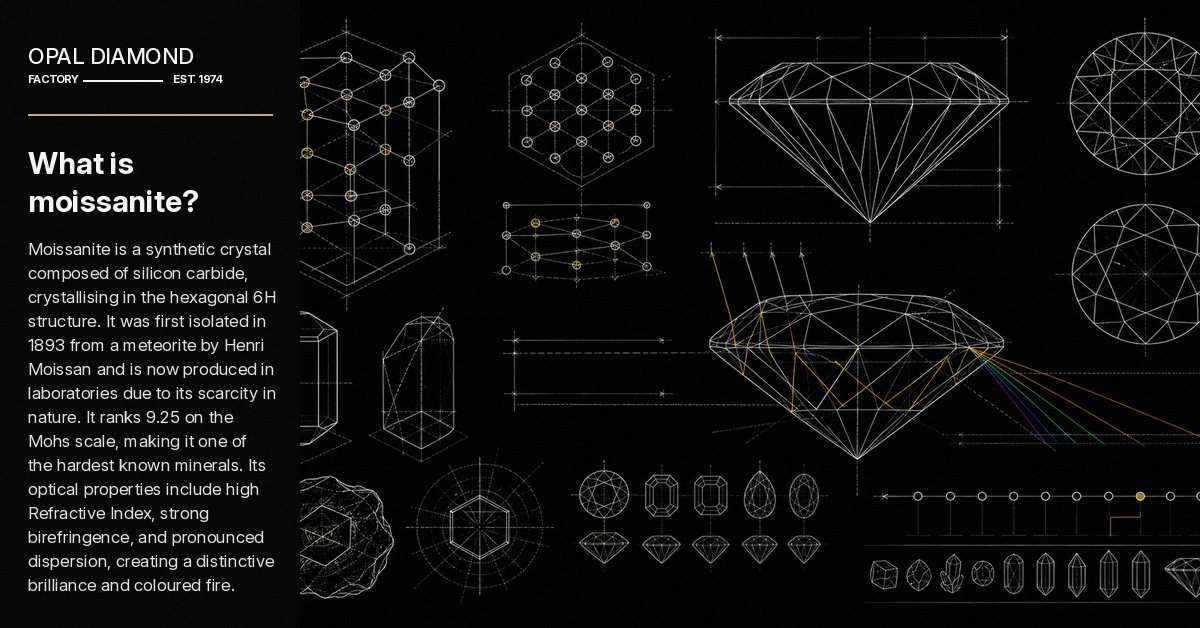
What is moissanite?
Moissanite is a synthetic crystal composed of silicon carbide, crystallising in the hexagonal 6H structure. It was first isolated in 1893 from a meteorite by Henri Moissan and is now produced in laboratories due to its scarcity in nature.
It ranks 9.25 on the Mohs scale, making it one of the hardest known minerals. Its optical properties include high Refractive Index, strong birefringence, and pronounced dispersion, creating a distinctive brilliance and coloured fire. Grown by sublimation with controlled temperature and pressure, it is chemically stable, thermally resilient, and commonly used in jewellery as a durable and cost-effective alternative to traditional gemstones.
Moissanite vs. diamond: what’s the difference?
Moissanite and diamond differ in composition, formation, and optical properties, making each distinct in both appearance and performance.
- Composition – Moissanite is silicon carbide (SiC); diamond is pure carbon (C).
- Origin – Moissanite is lab-created; diamond is naturally formed under high-pressure geological conditions.
- Hardness – Diamond rates 10 on the Mohs scale; moissanite is slightly lower at 9.25.
- Refractive Properties – Diamond is singly refractive (RI: 2.42); moissanite is doubly refractive (RI: 2.65-2.69).
- Brilliance – Diamond reflects more white light; moissanite disperses more colour (higher fire).
- Visual Differences – Moissanite shows double facet lines under magnification; diamonds do not.
- Thermal Conductivity – Diamonds conduct heat well; moissanite has poor thermal conductivity.
- Electrical Conductivity – Most diamonds are non-conductive; moissanite may conduct electricity slightly.
- Growth Conditions – Moissanite is produced in high-temperature lab conditions; diamonds form over millions of years in the Earth’s mantle.
- Spectroscopy – Diamonds show carbon-specific spectral lines; moissanite shows silicon-carbon bonding patterns.
- Cost and Availability – Moissanite is more affordable and readily available; diamonds are rarer and more expensive.
- Light Behaviour – Diamonds have sharp brilliance; moissanite exhibits strong dispersion and colourful fire.
How hard is moissanite compared to diamond?
Moissanite, ranked 9.25 on the Mohs scale, is a durable gemstone with excellent resistance against breakage, making it an excellent choice for jewellery. Despite its slightly lower hardness than diamonds, moissanite’s optical properties and brilliant sparkle rival those of diamonds, including lab-grown ones. This makes it an affordable alternative to traditional gemstones, offering resilience and aesthetic charm.
How does moissanite sparkle differently from diamond?
Moissanite sparkles more brightly and with more color than diamond due to its higher dispersion and double refraction. With a Refractive Index of 2.65-2.69, moissanite splits light into two rays, creating vivid, prismatic flashes. Diamond, with a lower dispersion and a Refractive Index of 2.42, reflects light in a sharper, more focused manner, producing a whiter brilliance. The difference in sparkle results from the distinct crystal structures and light behavior of each gemstone.
How does moissanite’s brilliance compare to diamond?
Moissanite actually has higher brilliance than diamond. This is because:
- Moissanite has a higher Refractive Index (2.65-2.69) compared to diamond (2.42)
- Moissanite displays more fire (colorful flashes) and brilliance (white light return) than diamonds
- The increased dispersion in Moissanite creates more rainbow-like flashes of color
- Moissanite’s double refraction property creates additional sparkle
While both stones are brilliant, Moissanite’s extra sparkle and fire can sometimes make it appear more flashy than a diamond. Some people prefer this extra brilliance, while others may prefer the more classic diamond look. The difference is most noticeable in larger stones and under bright lighting conditions.
How is moissanite made?
Moissanite is a rare and eco-friendly gemstone created in a laboratory using a sophisticated synthetic process. It is made from pure silicon and carbon, which undergo a thermal growing process at controlled temperatures. The most common production method is Chemical Vapor Deposition (CVD), but thermal sublimation is also used. The crystals are then cut, polished, and shaped into gemstones using diamond cutting techniques.
Although natural Moissanite exists, it is rare and was first discovered in meteorite fragments. Today, most jewelry is lab-created, making it an eco-friendly and conflict-free alternative to mined diamonds. The controlled laboratory environment ensures consistent quality and allows for the creation of various sizes and colours.
Why is moissanite cheaper than diamond?
Moissanite is cheaper than diamond primarily due to its affordable price and advanced technology used in its production process. Unlike diamonds, which form under natural conditions over millions of years, moissanite production relies on cutting-edge technology to create lab-grown moissanite gems. This method significantly reduces costs compared to the diamond seed process, where diamonds are formed under intense pressure deep in the Earth, often in regions like South Africa.
While both stones share similar chemical composition and a stunning sparkle, the dispersion of light in moissanite, which creates a rainbow of colours, is more intense due to its higher Refractive Index. Moissanite ranks 9.25 on the hardness scale, making it a durable choice for jewellery, though slightly softer than diamonds. The sparkle of moissanite rings often exhibits a captivating sparkle, outshining diamonds in terms of colourful flashes.
Is moissanite an ethical alternative to diamond?
Yes, Moissanite is considered an ethical alternative to diamonds. Since it’s lab-created, there are no concerns about conflict mining, worker exploitation, or environmental damage associated with diamond mining. Its production process is transparent, sustainable, and free from the ethical concerns that sometimes plague the natural diamond industry.
Who regulates gemstone sourcing ethics?
Several key organisations regulate and set standards for ethical gemstone sourcing:
- The Responsible Jewellery Council (RJC) sets comprehensive standards covering human rights, labor rights, environmental impact, and business ethics across the entire jewellery supply chain.
- The Gemological Institute of America (GIA) is renowned for its diamond and gemstone grading, serving as a leading authority for gem identification, grading, and authentication.
- CIBJO (The World Jewellery Confederation) works to harmonise global industry standards to ensure consumer confidence in the jewellery sector.
- The Kimberley Process, while specifically focused on diamonds, regulates rough diamond trade to prevent conflict stones from entering the market.
- Fairtrade and Fairmined certifications are also important regulatory mechanisms that ensure miners receive fair wages, operate in safe conditions, and benefit from community development initiatives.
As of 2025, there is increased focus on transparency and blockchain integration, with over 65% of consumers in the USA and Canada willing to pay premium prices for products adhering to ethical sourcing standards. Companies prioritising sustainable practices have reported up to a 40% increase in customer retention.
Why do consumers prefer conflict-free stones?
Consumers choose conflict-free stones primarily due to ethical concerns about blood diamonds and human rights violations in traditional mining. As an affordable option, lab-grown diamonds and lab-created gemstones like moissanite diamonds offer an ethical option without compromising on the dazzling display of a white stone. The moissanite vs diamonds diamond debate has shifted towards affordability of moissanite jewellery, making it an ideal choice for those seeking an affordable diamond engagement ring.
With its variety of colours and exceptional appearance of light reflected, this material on earth provides affordable brilliance while ensuring durability. Gemstones created in labs represent a conscious choice for jewellery that aligns with modern values, offering colour visible beauty without the ethical concerns of traditional mining, making them a compelling alternative in today’s market.
Why do people choose moissanite for engagement rings?
People choose Moissanite for engagement rings due to a combination of practical, ethical, and aesthetic benefits. Here are the main reasons:
• Cost-Effectiveness: Significantly more affordable than diamonds while offering similar beauty
• Ethical Sourcing: Lab-created, eliminating concerns about conflict mining and environmental impact
• Superior Brilliance: Greater sparkle and fire than diamonds due to higher refractive properties
• Durability: Ranks 9.25 on the Mohs scale, making it suitable for daily wear
• Modern Appeal: Appeals to younger, socially conscious consumers
• Size Options: Ability to get a larger stone for the same budget as a smaller diamond
• Quality Consistency: Lab creation ensures high-quality stones with minimal inclusions
• Environmental Impact: Smaller carbon footprint compared to mined diamonds
• Variety: Available in different colours and cuts
• Investment Value: Better value retention compared to other diamond alternatives
These factors make Moissanite an increasingly popular choice for couples seeking a beautiful, responsible, and practical engagement ring option.
What is the origin of moissanite in engagement rings?
Moissanite was discovered by French scientist Henri Moissan in 1893. Initially mistaken for diamonds, they were later identified as silicon carbide, a mineral named after Moissan. Initially impractical for commercial jewelry use, the breakthrough came in the 1990s when Charles & Colvard introduced moissanite as an alternative to diamonds. They developed laboratory-based production methods, making it accessible for engagement rings and other jewellery. The rise of moissanite in engagement rings has been driven by its exceptional properties and ethical production methods.
Its unique brilliance, durability, and ethical production methods have made it popular among modern couples. The cultural significance of moissanite extends beyond its physical beauty, as society shifts towards sustainability and ethical practices. Its journey from a cosmic discovery to a sought-after engagement ring choice represents a perfect blend of scientific innovation and evolving consumer preferences.
When did moissanite become popular for rings?
Moissanite’s popularity in rings emerged primarily after 1998 when synthetic versions were first introduced to the jewellery market. While initially kept quiet by traditional jewelers to protect diamond sales, moissanite gained significant traction in the 2010s due to improved production technology, increased awareness about ethical sourcing, and growing acceptance of alternative gemstones. Today, it has become the second most popular choice for engagement rings, driven by its superior brilliance, diamond fire, affordability, and ethical production methods.
How durable is moissanite compared to diamond?
Moissanite is highly durable, though slightly less than diamond.
On the Mohs hardness scale, moissanite ranks 9.25, while diamond ranks 10. This makes moissanite the second hardest gemstone suitable for daily wear.
In practical terms:
- Highly resistant to scratching
- Won’t chip or break easily
- Maintains brilliance over time
- Won’t cloud or change color
- Can withstand high temperatures
- Resistant to common chemicals
While diamonds are technically harder, moissanite’s durability is more than adequate for engagement rings and everyday jewellery. The difference in hardness between the two stones is rarely noticeable in normal wear conditions, making moissanite a practical and lasting choice for fine jewellery.
Does moissanite pass a diamond tester?
Yes, moissanite can pass traditional diamond testers that rely solely on thermal conductivity because both stones have similar thermal properties. However, modern testers that measure both thermal and electrical conductivity can accurately distinguish between moissanite and diamonds, as moissanite conducts electricity differently. Professional gemologists also use other methods, such as examining for double refraction, which is unique to moissanite, to definitively identify the stone.
Does moissanite turn cloudy over time?
No, moissanite does not turn cloudy over time. Unlike some other diamond alternatives like cubic zirconia, moissanite maintains its clarity and brilliance permanently. Its crystal structure is extremely stable, making it resistant to scratching, clouding, and discoloration.
The only maintenance needed is regular cleaning to remove everyday dirt and oils, just like any other fine jewelry. A simple solution of warm water and mild soap, along with gentle brushing, is typically sufficient to maintain its sparkle.
How does moissanite look under different lighting?
Moissanite displays distinct characteristics under different lighting conditions:
Natural Daylight:
- Shows its truest color
- Exhibits strong rainbow flashes (fire)
- Brilliance is most noticeable
- Can show slight color tints in larger stones
Indoor Lighting:
- Creates dramatic sparkles
- More colorful flashes than diamonds
- Maintains brightness even in dim conditions
- Can display more fire than in daylight
Artificial/Fluorescent Light:
- May show more rainbow effects
- Brilliant white light return
- Can appear more sparkly than diamonds
- Sometimes displays stronger color dispersion
The stone’s high Refractive Index means it’s generally more brilliant than diamonds across all lighting conditions. This increased brilliance and fire can make moissanite more noticeable, especially under artificial lighting.
What shapes and cuts are available for moissanite?
Moissanite is available in virtually all the same shapes and cuts as diamonds.
Popular shapes include:
- Round Brilliant: Most popular and maximizes sparkle
- Oval: Elongates the finger appearance
- Cushion: Classic vintage look
- Princess: Modern square cut
- Pear: Unique teardrop shape
- Emerald: Elegant step-cut design
- Radiant: Combines square shape with brilliant cut
- Marquise: Elongated pointed ends
- Heart: Romantic shape
- Asscher: Art deco inspired step-cut
Each cut can be customized to enhance:
- Brilliance
- Fire
- Sparkle
- Color performance
Since moissanite is lab-created, it can be cut with great precision, ensuring optimal light performance in any shape. The most popular choice remains the round brilliant cut as it best showcases moissanite’s natural fire and brilliance.
What are the best settings for a moissanite ring?
The best settings for a Moissanite ring include:
Popular settings:
- Solitaire: Maximises brilliance and light exposure
- Halo: Enhances center stone’s appearance
- Prong: Allows maximum light entry
- Bezel: Offers extra protection
- Pavé: Adds complementary sparkle
Best metals:
- White Gold: Most popular, enhances brilliance
- Platinum: Durable and bright
- Yellow Gold: Creates contrast
- Rose Gold: Modern, romantic look
The setting choice should balance your style preferences with practical durability needs. Most people choose white metals to best showcase moissanite’s natural brilliance.
Can a moissanite ring be resized?
Choosing the right setting for a Moissanite ring is important for its brilliance and resizing options. The process may vary depending on the metal, with white gold and sterling silver offering different durability levels. Larger carat weight rings may require specialised equipment for resizing. Consult a jeweller experienced in working with moissanite to ensure the ring’s beauty and fit remain intact during the resizing process.
What is silicon carbide polytype classification in moissanite?
Silicon carbide (Moissanite) polytypes are classified based on their crystal structure. The two main classifications are Beta (β) type, which crystallises in cubic lattice symmetry (like the 3C-SiC polytype), and Alpha (α) type, which crystallises in hexagonal symmetry (like the 6H-SiC polytype).
The most common polytype in moissanite is 6H-SiC, characterised by specific Raman bands at 789.6, 765.0, and 148.0 cm-1. The ‘6H’ designation indicates six stacking sequences in a hexagonal structure. Other significant polytypes include 3C-SiC (cubic), 4H-SiC (hexagonal), and 15R-SiC (rhombohedral).
While scientists have identified more than 250 polytypes of silicon carbide, only certain arrangements are practical for gemological applications. The polytype structure directly influences the material’s optical and physical properties, determining its suitability for jewellery use. Lab-created moissanite typically uses the most stable and optically advantageous polytypes for optimal gem performance.
What is thermal conductivity calibration in moissanite?
Thermal conductivity calibration in Moissanite is a precise measurement process that determines how the material transfers and conducts heat. This calibration is crucial because moissanite’s thermal properties are similar to diamonds, which affects how the stone responds to gem testing equipment.
The process uses advanced techniques including infrared thermography and ultrafast laser-based measurements to accurately assess heat transfer properties. These measurements must be precisely calibrated because thermal properties are linked to the material’s nano and micro-scale structure.
What is double refraction in moissanite?
Double refraction in Moissanite is an optical property where a single ray of light splits into two separate rays as it passes through the stone. This occurs because moissanite is anisotropic, meaning it has different optical properties in different crystal directions.
When looking through a moissanite stone, particularly from certain angles, you might notice:
- A doubling effect of facet edges
- Slightly blurred or doubled reflections
- More noticeable in larger stones
- Most visible when viewing straight down
This characteristic distinguishes moissanite from diamond, which is singly refractive. While double refraction can be a useful identifying feature for gemologists, it’s rarely noticeable to the naked eye during normal wear, especially in smaller stones or when the stone is set in jewellery.
What is moissanite’s resale value compared to diamond?
Moissanite’s resale value is generally lower than diamonds, with diamonds typically retaining 20-50% of their original value. However, this should be considered in context: moissanite’s initial cost is about 90% less than diamonds, making the actual financial loss much smaller in real terms.
While moissanite may not be a strong investment piece, its significantly lower purchase price and similar visual appeal make it a practical choice for those prioritizing initial cost savings over potential resale value. The stone’s resale value is influenced by factors like size, cut, clarity, color, market demand, and overall condition.
Is moissanite a good long-term choice?
Yes, Moissanite is an excellent long-term choice due to its durability (9.25 on Mohs scale), permanent brilliance, and resistance to scratching, chipping, and clouding. Unlike other diamond alternatives, it maintains its appearance indefinitely with proper care. While its resale value is lower than diamonds, the significant initial cost savings, ethical sourcing, and lasting beauty make it a practical and responsible long-term investment for engagement rings and fine jewelry. Its superior hardness means it can withstand daily wear for generations.
What are common myths about moissanite?
Common myths about Moissanite include:
Myth 1: “It’s just a fake diamond” Truth: Moissanite is its own unique gemstone with distinct properties and composition
Myth 2: “It loses sparkle over time” Truth: Moissanite maintains its brilliance permanently and doesn’t cloud or dull with age
Myth 3: “It’s not durable enough” Truth: With a 9.25 hardness rating, it’s the second hardest gemstone suitable for daily wear
Myth 4: “It’s easily identifiable as not diamond” Truth: Most people cannot distinguish between moissanite and diamond without specialized testing
Myth 5: “It’s an unethical choice” Truth: Moissanite is lab-created, making it an environmentally friendly and conflict-free option
Myth 6: “It’s inferior because it’s cheaper” Truth: The lower price reflects production methods, not quality or durability
Myth 7: “It looks too artificial” Truth: Its brilliance is natural to its composition, though some may find it more sparkly than diamonds
These misconceptions often stem from outdated information or comparison to other diamond alternatives.
How do you clean a moissanite ring?
Cleaning a Moissanite ring is straightforward and can be done at home:
Daily Cleaning:
- Warm water and mild soap solution
- Soft brush for gentle scrubbing
- Rinse thoroughly
- Pat dry with lint-free cloth
Additional Methods:
- Ultrasonic cleaners are safe to use
- Professional cleaning at jewelers
- Jewelry cleaning solutions designed for fine gems
Avoid:
- Harsh chemicals
- Abrasive cleaners
- Steam cleaning
- Bleach or chlorine
Regular cleaning keeps your moissanite sparkling and looking its best. A weekly cleaning routine is typically sufficient for maintaining its brilliance.
What can damage moissanite when cleaning?
While Moissanite is highly durable, certain cleaning methods can potentially damage the stone or its setting. Harsh chemicals, abrasive cleaners, and bleach should be avoided as they can weaken the setting or damage the metal. Steam cleaning can cause thermal shock, while ultrasonic cleaning, while generally safe, should be used cautiously if the stone has inclusions or the setting is loose.
Rough handling during cleaning, such as scrubbing with abrasive materials or using excessive force, can also potentially scratch the metal setting or loosen the stone. Stick to gentle cleaning methods using mild soap and water for the safest results.
Why does moissanite look dull sometimes?
Moissanite can appear temporarily dull due to everyday buildup of oils, lotions, soaps, and dirt on its surface, which blocks light from properly entering and reflecting through the stone. This isn’t a permanent condition but rather a sign that cleaning is needed. Environmental factors like hard water deposits and cosmetic products can create a film that diminishes the stone’s natural brilliance.
Regular cleaning with mild soap and water will restore its sparkle, as moissanite doesn’t inherently lose its brilliance over time. The stone’s exceptional light performance returns once surface contamination is removed.
What do jewellers think about moissanite?
Jewellers’ perspectives on moissanite have evolved significantly, with many now recognizing it as a legitimate choice for fine jewelry. Most professional jewelers acknowledge moissanite’s superior optical properties and durability, appreciating it as a practical alternative to diamonds. While some traditional jewellers still prefer diamonds, the growing demand for ethical and affordable options has led to increased acceptance of moissanite in the industry.
Modern jewellers particularly value moissanite’s ability to offer quality appearance, ethical sourcing, and long-term durability at a better price point, especially as younger consumers prioritise sustainability and affordability in their jewellery choices.
Why do jewellers recommend moissanite?
Jewellers recommend moissanite due to its exceptional value, high quality standards, and ethical origin. It offers superior brilliance, durability, and affordability, making it a popular choice for conscious consumers. Its consistent quality, resistance to scratches and chipping, and appeal to modern consumers prioritise aesthetics and ethical sourcing make it a reliable choice for engagement rings and fine jewellery.
Where do jewellers get moissanite?
Jewellers typically source moissanite through authorised distributors and wholesale suppliers who work directly with laboratory manufacturers. Since all commercial moissanite is lab-created, these suppliers maintain strict quality control standards and provide certification for their stones. Licensed jewelers can access wholesale networks and gemstone trading platforms where they can purchase loose moissanite stones or ready-to-set jewellery.
Many suppliers also provide custom cutting services to meet specific design requirements. The controlled production environment ensures consistent quality and ethical sourcing, while established distribution channels help maintain authenticity and prevent counterfeits from entering the market.
Related diamond guides: What makes sapphires a diamond alternative?: Hard facts, real colours, and why they shine like diamonds; What Are Synthetic Diamonds: Explore the Differences, the Benefits, and the Future of Diamonds Made in a Lab.