
Famous diamonds represent significant symbols of history and prestige, exceeding their identity as beautiful mineral formations. Since the 17th century, these valuable gems, such as the Cullinan II and Cullinan III, have adorned 3 types of prominent figures: French royalty, Queen Victoria, and other monarchs like Henry III and Henry IV. These notable examples illustrate the transformation from rough mineral formations to some of the world’s 2 largest categories of cut diamonds.
These exceptional gems, including specific stones owned by individuals like Henry Phillip Hope and Shah Jehan, were stored in Royal storehouses and utilised as partial indemnity in at least 2 historical negotiations.
For broader context, compare this point with the diamond history basics.
Their progression from uncut stones to perfect diamonds, measured precisely in metric carats, continues to achieve astronomical prices at major auction houses, such as Sotheby’s and Christie’s, with each beautiful stone possessing its own unique narrative of wealth, power, and cultural importance that captivates multiple generations.
What are famous diamonds?
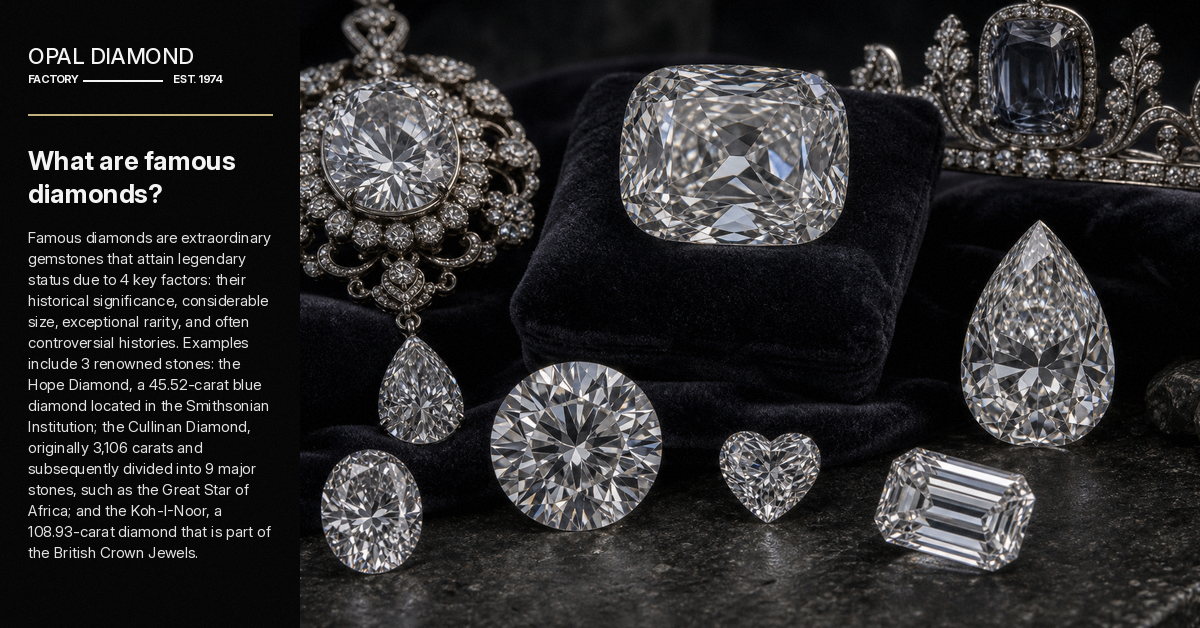
Famous diamonds are extraordinary gemstones that attain legendary status due to 4 key factors: their historical significance, considerable size, exceptional rarity, and often controversial histories. Examples include 3 renowned stones: the Hope Diamond, a 45.52-carat blue diamond located in the Smithsonian Institution; the Cullinan Diamond, originally 3,106 carats and subsequently divided into 9 major stones, such as the Great Star of Africa; and the Koh-I-Noor, a 108.93-carat diamond that is part of the British Crown Jewels.
These precious stones have passed through the hands of 3 main groups: royalty, wealthy collectors, and notable historical figures. They frequently carry fascinating stories involving 3 common themes: theft, curses, and power struggles. Their value extends beyond their monetary worth, as they represent significant cultural artifacts and symbols of power throughout human history.
Where are famous diamonds found?
Famous diamonds have been discovered across 5 continents, primarily in regions with significant geological diamond deposits. The main locations where history’s most celebrated diamonds have been found include 10 countries.
| Continent | Country | Notable Famous Diamonds Discovered |
|---|---|---|
| Africa | South Africa | Cullinan Diamond, Centenary Diamond, Taylor-Burton Diamond |
| Asia | India | Koh-I-Noor, Hope Diamond, Regent Diamond, Orlov Diamond |
| South America | Brazil | Dresden Green Diamond, Presidente Vargas Diamond |
| Africa | Botswana | Lesedi La Rona, The Constellation |
| Africa | Democratic Republic of Congo | Tiffany Yellow Diamond |
| Europe/Asia | Russia | Shah Diamond, Orlov Diamond (another distinct stone) |
| Africa | Lesotho | Lesotho Promise, Lesotho Brown |
| Africa | Sierra Leone | Star of Sierra Leone |
| Africa | Tanzania | Williamson Pink Diamond |
| Oceania | Australia | Argyle Pink Diamonds |
Each of these 10 locations possesses unique geological conditions that contribute to the formation of these extraordinary gems. Historically, 2 countries, India and South Africa, have been the most significant sources of famous diamonds.
Where do famous diamonds originate?
The heritage of famous diamonds is frequently linked to historic geological sites, such as the Golconda mines in India, where 2 specific diamonds, the Koh-I-Noor and the Great Mogul, were discovered. The largest gem-quality diamond, the Cullinan, weighing 3,106 carats, was discovered in Transvaal, South Africa, which enhanced the region’s diamond legacy. Andhra Pradesh in India, exemplified by diamonds in Catherine the Great’s collection, contributes to the mystique surrounding diamond shapes and royal connections. Each famous diamond carries a unique story that connects 3 elements: culture, history, and beauty.
How are famous diamonds formed?
Famous diamonds are formed deep within the Earth’s mantle under 2 extreme conditions: high heat (between 900 and 1,300 degrees Celsius) and intense pressure (between 45 and 60 kilobars), transforming pure carbon atoms into crystalline structures over millions or billions of years. These diamonds become unique in their specific size, particular colour, precise clarity, and overall quality due to their distinct combination of constituent elements. Rare coloured diamonds, such as the Hope Diamond’s deep blue hue or the Williamson Pink’s notable colour, acquire their hues from trace elements, like boron for blue or nitrogen for yellow, or structural anomalies during their formation.
These valuable stones are brought closer to the Earth’s surface through volcanic eruptions via geological formations known as kimberlite pipes, which ACT as natural elevators for the diamonds. The transformation from a rough stone to a famous diamond involves 2 key processes: skilled cutting and precise polishing by master craftsmen. This transformation can take many months or even years for exceptional stones; for instance, the Cullinan Diamond required several months of detailed study before the first cut was made, and its cleaving into 9 major stones was a historically significant event in diamond cutting history.
What are the characteristics of famous diamonds?
Famous diamonds possess 7 distinctive characteristics that set them apart from ordinary gems. These extraordinary stones are renowned for their unique combinations of the following attributes:
- Size: Famous diamonds are often exceptionally large, typically over 100 carats in their rough form, and remain significant even after cutting, often exhibiting record-breaking dimensions.
- Colour: They can exhibit rare natural colours, such as the intense blue of the Hope Diamond, the perfect pink of the Williamson Pink, the remarkable yellow of the Tiffany Yellow, or be flawless colourless specimens.
- Clarity: These diamonds demonstrate exceptional internal purity with minimal inclusions, superior transparency, and outstanding light reflection.
- Historical Significance: Many famous diamonds have 3 key historical aspects: royal ownership, cultural importance, and association with notable previous owners or documented historical events.
- Value: They command record-breaking prices at historical auction results, possess high insurance valuations, and hold cultural worth beyond mere monetary value.
- Rarity: Famous diamonds often have unique characteristics, making them one-of-a-kind specimens with limited comparable stones and distinctive features.
- Quality of Cut: They display superior cut, excellent symmetry, outstanding polish, and exceptional brilliance, resulting from masterful craftsmanship.
These 7 characteristics combine to create stones that are not just precious gems but also significant historical artifacts and cultural treasures.
colours are famous diamonds?”>What colours are famous diamonds?
Famous diamonds exhibit a remarkable variety of 8 main colours, each with its own unique characteristics and historical significance. These colours include blue, pink, yellow, green, red, brown, colourless/white, and black.
| colour Category | Example Famous Diamonds | Specific Carat Weights (if available) |
|---|---|---|
| Blue | Hope Diamond, Wittelsbach-Graff Diamond, Blue Heart Diamond | 45.52 ct (Hope), 31.06 ct (W-G) |
| Pink | Williamson Pink, Pink Star Diamond, Argyle Pink Diamonds | 59.60 ct (Pink Star) |
| Yellow | Tiffany Yellow Diamond, Florentine Diamond, Golden Jubilee | 128.54 ct (Tiffany) |
| Green | Dresden Green, Gruosi Green | 41 ct (Dresden) |
| Red | DeYoung Red, Moussaieff Red | 5.03 ct (DeYoung), 5.11 ct (Moussaieff) |
| Brown | Golden Pelican, various Champagne and Cognac diamonds | |
| Colourless/White | Cullinan I, Cullinan II, Centenary Diamond, Great Mogul | 530.20 ct (Cullinan I) |
| Black | Black Orlov, Spirit of de Grisogono | 67.5 ct (Black Orlov) |
What are the biggest famous diamonds?
The world’s biggest famous diamonds represent extraordinary discoveries in diamond mining history, with the Cullinan Diamond standing as the undisputed champion at an astounding 3,106 carats in its rough form. Discovered in 1905 in South Africa, it was later cut into 9 major stones and 96 smaller ones. Its 2 largest pieces are the Great Star of Africa (Cullinan I), weighing 530.20 carats, and the Lesser Star of Africa (Cullinan II), weighing 317.40 carats.
Following the Cullinan in size, other remarkable specimens include 4 notable diamonds: the Centenary Diamond, discovered at 599.10 carats and cut to a final weight of 273.85 carats with 247 facets; the Millennium Star, originally 777 carats and cut to 203.04 carats, ranking as the second-largest D-colour flawless diamond; the Orlov Diamond, weighing 189.62 carats with its distinctive bluish-green hue; and the Regent Diamond, discovered at 410 carats and cut to 140.50 carats. The historic Koh-I-Noor, which initially weighed approximately 190 carats, now weighs 108.93 carats and is part of the British Crown Jewels. Each of these 6 magnificent stones demonstrates the exceptional size and quality found in nature.
Which famous diamonds have rare shapes?
Famous diamonds with unique and rare shapes, such as pear, heart, and cushion cuts, have captivated audiences for many centuries.
Here are 5 categories of notable examples:
- The Pear-Shaped Diamonds: Examples include the Taylor-Burton Diamond (69.42 carats), the Millennium Star (203.04 carats), and the Star of South Africa (a 47.69-carat diamond with a pinkish-brown colour).
- Heart-Shaped Diamonds: Notable hearts include the Royal Purple Heart (a 7.34-carat fancy vivid purple, completely flawless diamond), The Supreme Purple Diamond Heart, The Purple Orchid, and the Blue Heart Diamond (30.62 carats).
- Cushion-Cut Rarities: Significant cushion cuts include the Hope Diamond (45.52 carats), the Black Orlov (67.5 carats, the largest known cushion-cut black diamond), and the Archduke Joseph (a 78.54-carat, internally flawless D-colour diamond).
- Unique Artistic Cuts: A prime example is The Koi Diamond (a 32+ carat diamond), shaped like a koi fish. It features multiple colours, including white, orange, light yellow, dark blue, and black, and was almost designated for industrial use before creative cutting saved it.
- Historical Shapes: Examples include The Dresden Green (a 41-carat, natural green diamond with a modified pear shape), the Noor-ul-Ain Diamond (a 60-carat, pale pink oval-cut diamond set in a unique tiara), and The Eye of Brahma (another name for the Black Orlov, a cushion-cut black diamond).
These 5 types of diamonds stand out not just for their size or colour, but for the masterful cutting techniques that transformed them into uniquely shaped masterpieces, often preserving their distinctive characteristics while maximising their beauty.
What makes famous diamonds unique?
Famous diamonds are renowned for at least 4 distinct qualities: their extraordinary shapes, profound historical significance, frequent setting in exquisite jewellery (such as diamond earrings), and captivating deep blue hues or rich lore for certain stones. Larger diamonds, which often possess higher carat weights, enhance their desirability among collectors and institutions. Each diamond, whether in its rough or finished state, tells a unique story composed of 2 elements: artistry and legacy.
What are iconic refractive artifacts?
Iconic refractive artifacts are notable objects or artworks that utilize principles of light refraction to create 2 primary outcomes: visual effects or illusions. The 5 most significant categories of examples include:
- Optical Art (Op Art): This includes Victor Vasarely’s geometric patterns, Bridget Riley’s black and white designs, and Richard Anuszkiewicz’s contrasting colours, all created to produce illusions of movement and depth.
- Historical Art Installations: An example is The Apotheosis of St. Ignatius (completed around 1690), a fresco that created multi-dimensional illusions, transformed ceiling appearances, and used perspective manipulation.
- Renaissance Masterpieces: The Camera degli Sposi frescoes (painted around 1473) by Andrea Mantegna created the illusion of sky views, used perspective tricks, and transformed architectural spaces.
- Modern Light Installations: Examples include Jesús Rafael Soto’s “Penetrables,” Marina Apollonio’s “Light Cones,” and Ludwig Wilding’s light projections, all designed to create immersive optical experiences.
- Contemporary Works: This category features Peter Kogler’s room-sized labyrinths, various digital and mechanical installations, three-dimensional optical spaces, and interactive light experiences.
These 5 types of artifacts demonstrate how artists throughout history have manipulated light and perspective to create powerful visual experiences by combining scientific principles with artistic vision.
What is prismatic legendry?
Prismatic legendry encompasses the rich historical and mythological tales surrounding objects that manipulate light in extraordinary ways. From the ancient world’s most famous example, the Lighthouse of Alexandria (one of the Seven Wonders), to the crystal oracles purportedly used in Egypt and the light chambers of Byzantine architecture, these stories reflect humanity’s enduring fascination with 2 types of light-bending phenomena: natural and artificial.
Throughout history, these prismatic objects have held deep cultural and religious significance, often associated with 3 concepts: divine communication, prophecy, and spiritual power. Whether in the form of sacred temple prisms, Medieval crystal balls, or ancient light-focusing devices, these artifacts represent the intersection of 2 domains: early scientific understanding and mystical beliefs, creating a unique legacy that continues to captivate our imagination today.
What are gemological provenance archives?
Gemological provenance archives are detailed historical records that document the complete history of significant gemstones, from their initial discovery to the present day.
These archives maintain 5 crucial types of information about precious stones: their origins, specific characteristics, records of ownership transfers, details of authenticity, geological data, and factors that influence resale value, often including precise measurements, high-resolution photographs, and official certificates.
These records serve as 3 essential tools for the gem industry: authenticating gems, preventing fraud, and ensuring ethical sourcing practices. Modern archives combine traditional documentation methods with 2 advanced technological approaches: spectroscopic analysis and digital tracking systems, to create verifiable chains of custody for precious stones from the mine to the market.
What is the history of famous diamonds?
The history of famous diamonds spans millennia, originating in ancient India’s riverbeds and streams in the 4th century BC. Notable figures like Nadir Shah, Mohammed Shah, and the French king Louis XVI coveted these beautiful diamonds. The Koh-I-Noor Diamond and the Cullinan, discovered by Thomas Cullinan, represent some of the largest and most expensive diamonds in history.
Diamond merchants and cutters like Wilhelm Fals and Julius Cohen transformed rough diamonds into faceted masterpieces. Notable owners included Napoleon Bonaparte, Napoleon III, Queen Mary, Queen Alexandra, King Edward VII, and American widow Evalyn Walsh. The Hope Diamond’s journey through Henry Philip Hope, Henry Thomas Hope, and various owners marked by financial difficulties became legendary.
These stones eventually found homes in museums and royal collections, with some, like the Tavernier Blue, being transformed into larger crystals. Contemporary sales have seen diamonds achieving record prices at auction, with collectors like Joseph Lau acquiring these prestigious gems. The journey of these diamonds through time reflects both their material value and their role as symbols of power across cultures and civilisations.
Who has owned famous diamonds?
Famous diamonds have been possessed by some of history’s most notable figures and 5 primary categories of institutions throughout many centuries:
- Royal Ownership: Examples include Queen Elizabeth II (Cullinan Diamonds), Louis XIV of France (Hope Diamond, then known as the French Blue), Queen Victoria (Koh-I-Noor), Marie Antoinette (various French Crown Jewels including the French Blue), and Shah Jehan (diamonds in the Peacock Throne).
- Noble Families: Specific families include the Hope Family (Hope Diamond), the Wittelsbach Family (Wittelsbach-Graff Diamond), the Orlov Family (Orlov Diamond), and the Habsburg Dynasty (Florentine Diamond).
- Wealthy Collectors: Notable individuals include Elizabeth Taylor (Taylor-Burton Diamond), Harry Winston (numerous major diamonds), and Richard Burton (multiple famous stones). Major jewellery houses like Cartier also acquired significant pieces.
- Modern Institutions: Key institutions include the Smithsonian Institution (Hope Diamond), the British Crown (British Crown Jewels collection), the Louvre Museum (French Crown Jewels), and the Diamond Fund in Moscow (Russian Imperial collection).
- Corporate Owners: Companies such as De Beers (Centenary Diamond), Graff Diamonds (various major pieces), Tiffany & Co. (Tiffany Yellow Diamond), and Louis Vuitton (Sewelô Diamond) have owned famous diamonds.
These 5 types of owners have played crucial roles in preserving and documenting the history of these extraordinary gems, contributing to their legendary status.
Which famous diamonds were stolen?
Famous diamonds that were stolen throughout history have fascinating tales involving at least 2 common elements: audacious heists and mysterious disappearances. Six of the most notorious stolen diamonds include:
- The Hope Diamond (as the French Blue): It was stolen during the French Revolution from the Royal Treasury, disappeared, was likely recut to avoid detection, and resurfaced years later in London.
- The French Blue Diamond: This specific stone was taken during the Crown Jewels heist in 1792, vanished for 20 years, and is believed to have been recut into the Hope Diamond; its original, larger form has never been recovered.
- The Florentine Diamond: This 137.27-carat yellow diamond disappeared after the fall of the Austrian Empire in the early 20th century, has never been recovered, and is believed to have been recut. Its estimated worth is many millions in today’s currency.
- The Eagle Diamond: This 16.25-carat diamond was stolen from the American Museum of Natural History by Jack Murphy, known as “Murph the Surf,” in 1964, was never recovered, and is widely believed to have been recut.
- The Orlov Diamond: This 189.62-carat diamond was originally stolen from the eye of a Hindu deity statue in a temple, smuggled to Amsterdam, and eventually sold to Russian nobility; it is currently located in the Moscow Diamond Fund.
- The De Beers Diamond (Centenary): While the Centenary itself was not stolen, other diamonds from De Beers’ collections or associated retailers like Harry Winston have been targeted. For example, several pieces were stolen from a Harry Winston store in Paris as part of a $108 million heist in 2008; some pieces were recovered, but many stones remain missing.
These 6 thefts often resulted in the diamonds being recut to disguise their identity, rendering many impossible to recover in their original form.
Which famous diamonds are cursed?
Famous “cursed” diamonds have captivating histories detailing misfortune and tragedy associated with at least 3 of their owners or those connected to them. Five of the most notorious examples are:
- The Hope Diamond: Associated with the deaths of multiple owners, including Marie Antoinette’s execution, it brought multiple bankruptcies and family tragedies for the McLean family. It is now housed at the Smithsonian Institution.
- The Black Orlov (Eye of Brahma Diamond): This 67.50-carat black diamond is said to have caused three of its owners to commit suicide after it was allegedly stolen from a Hindu idol. It was later cut into three smaller stones to break the curse; traditionally, it was linked to the deaths of three Russian princesses.
- The Koh-I-Noor: Legend states it brings misfortune to male owners but is safe for female possession. It has been associated with multiple wars fought over its ownership and the death of several maharajas. It is now in the British Crown Jewels, customarily worn only by female consorts or queens regnant.
- The Delhi Purple Sapphire: This gem is actually a large amethyst, not a sapphire. It is famed for bringing disaster to its owners, including multiple mysterious deaths, and was stored with protective charms in the British Museum (Natural History Museum) collection for many years.
- The Regent Diamond: This 140.64-carat diamond was reportedly stolen by an Indian slave who was then murdered for it. It has been linked to Napoleon’s defeat and casualties of the French Revolution, with multiple owners meeting violent ends or misfortune.
The legendary curses of these 5 diamonds often stem from 3 primary sources: their controversial acquisitions, theft from sacred places, or association with significant historical tragedies.
How are famous diamonds handled?
Famous diamonds require extraordinary care and 3 precise handling protocols, managed exclusively by expert gemologists and specially trained professionals. These professionals use protective gear, including lint-free gloves and specialised tools, to prevent contamination while working with these precious stones in climate-controlled environments featuring specialised equipment and lighting.
The transportation and display of these valuable diamonds involve 3 key elements: elaborate security systems, custom-made holders, and strict documentation procedures. Institutions like the Smithsonian Institution and royal collections maintain specific protocols for handling these gems, including 4 measures: temperature and humidity control, UV light protection, vibration monitoring, and multiple layers of physical and electronic security. Each instance of handling requires careful planning and often multiple authorizations to ensure the preservation and safety of these invaluable stones.
How are famous diamonds shaped and polished?
The process of shaping and polishing renowned diamonds is meticulous, focusing on their internal crystal structure to achieve maximum brilliance and light return. Larger diamond crystals are often utilised as center stones in jewellery, while smaller ones are frequently used as accent stones. Cutting techniques, such as the cushion cut (e.g., the Hope Diamond) and the pear shape (e.g., the Taylor-Burton Diamond), are employed to enhance their natural allure. Lab-grown diamond alternatives mirror the chemical and optical properties of natural diamonds and require similar precision in their cutting and polishing. This detailed craftsmanship elevates white diamonds and fancy coloured diamonds from mere gems to symbols of elegance and significant cultural value.
Where are famous diamonds displayed?
Famous diamonds are displayed in 5 primary types of prestigious institutions and collections around the world, allowing public access to these treasures.
| Institution / Collection | City, Country | Key Famous Diamonds Displayed |
|---|---|---|
| Smithsonian Institution | Washington D.C., USA | Hope Diamond, Winston Red Diamond, Blue Heart Diamond, Portuguese Diamond, Oppenheimer Diamond |
| Tower of London | London, UK | British Crown Jewels, including Koh-I-Noor, Cullinan I, Cullinan II, Imperial State Crown diamonds |
| Diamond Fund, Moscow Kremlin | Moscow, Russia | Orlov Diamond, Shah Diamond, Russian Crown Jewels, Imperial Scepter diamonds |
| Louvre Museum | Paris, France | French Crown Jewels (historical), including the Regent Diamond, Sancy Diamond |
| Dresden Green Vault (Grünes Gewölbe) | Dresden, Germany | Dresden Green Diamond, Saxon royal collection, other historic cut stones |
These 5 institutions maintain specialised security systems, climate-controlled environments, and employ expert curatorial staff to preserve and showcase these extraordinary gems for public viewing while ensuring their comprehensive protection.
What is the cultural and economic value of famous diamonds?
Famous diamonds possess extraordinary cultural and economic significance that extends far beyond their simple monetary value. As potent symbols of at least 3 concepts-power, divine right, and sovereignty-these specific stones have shaped history through their inclusion in religious traditions, royal ceremonies, and cultural narratives across numerous civilizations. They serve as 2 types of assets: national treasures and diplomatic gifts, representing both tangible wealth and intangible cultural heritage.
The economic impact of these unique gems is substantial. Some famous diamonds achieve record-breaking auction prices, reaching into the tens or hundreds of millions of U.S. dollars, while others are considered literally priceless due to their unparalleled historical significance. These diamonds influence the broader diamond market by setting 2 benchmarks: quality standards and price expectations. They also generate significant tourism revenue for the at least 5 major institutions that house them. Their unique position at the intersection of material worth and cultural importance makes them invaluable assets in both financial and historical terms.
What do famous diamonds represent?
Famous diamonds represent at least 3 core concepts: power, wealth, and enduring legacy. The historical narrative includes figures like Shah Jahan, who, inspired by the beauty of precious gems like those speculated to be similar to the French Blue, commissioned magnificent structures such as the Taj Mahal. The 17th-century gem merchant Jean Baptiste Tavernier’s acquisition and subsequent sale of large Indian diamonds to European royalty, including King Louis XIV, transformed European perceptions of these stones.
Rulers such as King Louis XV and Empress Eugenie adorned themselves with iconic stones, which cemented their status and the diamonds’ symbolism. Modern marvels like the Centenary Diamond (a 273.85-carat D-colour flawless diamond) and the Taylor-Burton Diamond (a 69.42-carat pear-shaped diamond) exemplify 2 qualities: exceptional craftsmanship and extreme rarity.
As noted by gemological experts like Richard W. Wise, these jewels reflect significant aspects of culture and history. The British Crown Jewels, containing several famous diamonds, showcase their enduring national and monarchical significance. Even laboratory-grown diamonds now enter this narrative, representing modern luxury intertwined with a long tradition of valuing exceptional gemstones.
How much do famous diamonds cost?
Famous diamonds command extraordinary prices in today’s market, with some recent sales establishing remarkable records; for example, the Pink Star Diamond sold for 71.2 million U.S. dollars, while the Oppenheimer Blue achieved 57.5 million U.S. dollars at auction. However, many historic diamonds, such as the Hope Diamond and the Koh-I-Noor, are considered literally priceless due to their unique cultural and historical significance, which makes their actual market worth impossible to calculate accurately.
Notable examples include the Hope Diamond, which is insured for 250 million U.S. dollars, though many experts suggest its true value could be considerably higher. The Cullinan I and Koh-I-Noor, as integral parts of the British Crown Jewels, are beyond conventional market valuation. While standard diamond prices fluctuate based on the 4 Cs (carat, cut, colour, clarity), famous and historically significant stones typically maintain and often increase their worth over time, commanding prices far above the average market range, which for exceptional 1-carat diamonds can be from $9,249 to $21,997 depending on specific qualities.
What are famous blue diamonds?
Famous blue diamonds represent some of the most valuable and historically significant gemstones in existence, prized for their rarity and intense colouration. Five of the most renowned blue diamonds include:
- The Hope Diamond: This is a 45.52-carat fancy dark grayish-blue antique cushion-cut diamond, currently housed at the Smithsonian National Museum of Natural History. It is valued at approximately $250 million and was previously owned by French royalty, including King Louis XIV.
- The Wittelsbach-Graff Diamond: This is a 31.06-carat fancy deep blue internally flawless diamond. Originally part of the Spanish Crown Jewels, it was recut by diamantaire Laurence Graff after its purchase in 2008 for $24.3 million.
- The Blue Heart Diamond (Unternährer Blue): This is a 30.62-carat heart-shaped brilliant-cut blue diamond, discovered in South Africa around 1908. It is currently part of the Smithsonian collection and is noted for its exceptional clarity.
- The Tereschenko Diamond: This is a 42.92-carat pear-shaped fancy blue diamond, once owned by the Tereschenko family of Russian nobility. It is known for its highly pure specimen quality and is currently privately owned.
- The Blue Moon of Josephine: This is a 12.03-carat cushion-cut fancy vivid blue internally flawless diamond. It sold for $48.4 million in 2015, setting a record price per carat for any gemstone at the time.
These 5 rare blue diamonds acquire their distinct colour from trace amounts of the element boron within their crystal structure, a characteristic that makes them among the most valuable and sought-after diamonds in the world.
Who uses famous diamonds today?
Famous diamonds today are primarily utilized in 2 distinct ways: displayed in prestigious museums, such as the Smithsonian Institution, or used in royal ceremonies by reigning families, for instance, the British monarchy with the Crown Jewels. The vast majority of these historic stones reside in public institutions, where they serve 2 main functions: as significant cultural artifacts and as major tourist attractions.
A small number of famous diamonds remain in private collections or appear occasionally at high-profile auctions. Additionally, 3 groups of professionals-museum curators, academic researchers, and expert gemologists-continue to study these extraordinary stones, using them to advance our understanding of 2 key areas: diamond formation processes and human history related to gems.
Why are famous diamonds important?
Famous diamonds are important for at least 5 key reasons, functioning as both historical artifacts and potent cultural symbols that represent pivotal moments in human civilisation and advancements in technological achievement. They serve as tangible links to royal dynasties and major historical events, while simultaneously demonstrating humanity’s finest achievements in the field of gemology, including cutting and polishing techniques.
These extraordinary stones contribute to scientific understanding, particularly in geology and material science. They also establish benchmark values and quality standards for the global diamond market. Furthermore, famous diamonds symbolise national heritage and can play roles in diplomatic relationships. Their overall significance extends far beyond their material worth, making them invaluable markers of human history and extensive cultural exchange.
Related diamond guide: How have diamonds shaped culture, what are current ethical debates, and what is their future significance?.