
Diamonds have been symbols of love, power, and status for over 700 years, with their cultural significance evolving over time. Traded extensively since the 13th century, diamonds gained prominence in Western cultures during the 20th century as a symbol of romantic commitment. The intricate art of diamond cutting has evolved over centuries, from natural octahedral crystal shapes to complex and brilliant arrangements like Art Deco diamonds. However, the romanticised perception of diamonds faces challenges from ethical considerations surrounding extraction methods, leading to a contemporary focus on sustainability and ethical sourcing practices.
For broader context, compare this point with the diamond history guide.
The diamond industry faces a significant crossroads as society increasingly values ethical practices. As the industry strives to maintain its relevance, it must align the symbolism of an ‘eternal bond’ with the growing demand for responsible sourcing. This evolving narrative around diamonds reveals a deepening commitment to resilience and the meticulous preservation of both the gem’s natural splendour and the integrity of its complex supply chain.
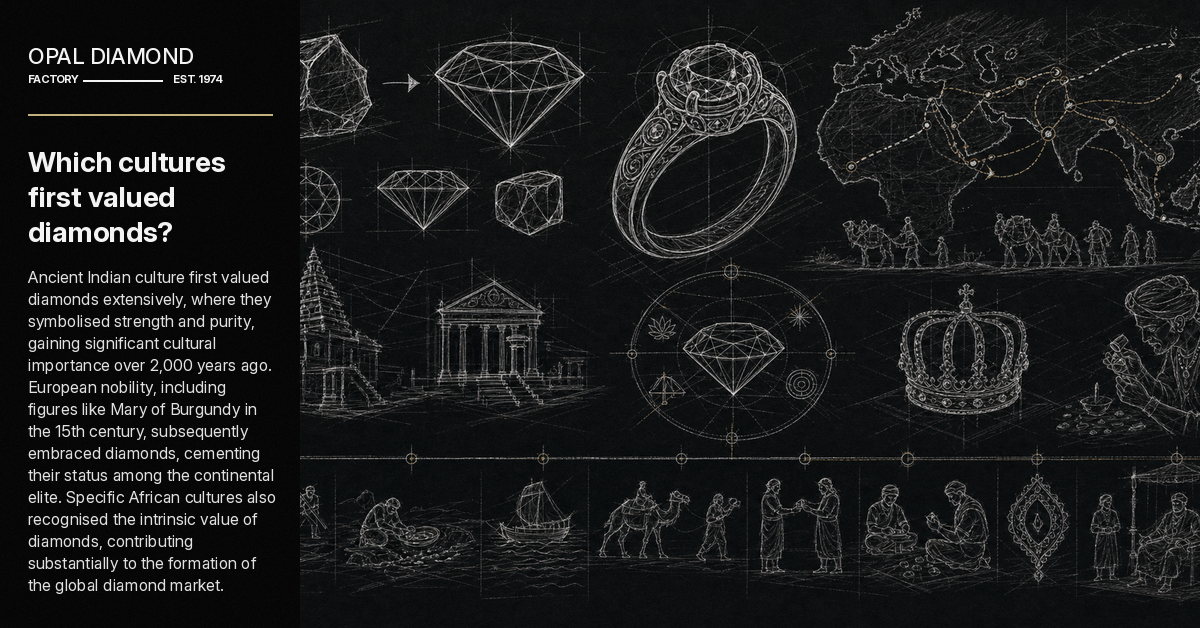
Which cultures first valued diamonds?
Ancient Indian culture first valued diamonds extensively, where they symbolised strength and purity, gaining significant cultural importance over 2,000 years ago. European nobility, including figures like Mary of Burgundy in the 15th century, subsequently embraced diamonds, cementing their status among the continental elite. Specific African cultures also recognised the intrinsic value of diamonds, contributing substantially to the formation of the global diamond market. Current ethical sourcing discussions highlight the complex journey of these gemstones, their intertwined history with power, wealth, and diverse cultural heritage.
What are 9 key symbolic meanings of diamonds?
Diamonds possess nine principal symbolic meanings that transcend time and specific cultures, rooted in their unique physical properties as the hardest natural material on Earth. These symbols represent concepts and emotions resonating deeply with human experience:
- Represent eternal love and commitment: Diamonds are a traditional choice for engagement rings, signifying an unbreakable bond and everlasting devotion.
- Symbolise strength and resilience: Known for their exceptional durability, diamonds signify endurance and the capacity to withstand life’s greatest pressures.
- Reflect purity and innocence: The clarity and brilliance of a diamond are metaphors for purity, indicating the wearer’s integrity.
- Display wealth and status: Throughout history, diamonds have demonstrated affluence, their rarity making them a status symbol for royalty and the elite.
- Convey power and invincibility: The extreme hardness of a diamond associates it with power and the ability to overcome adversity.
- Embody perfection and perseverance: The flawless crystal structure of diamonds, formed under intense geological conditions, represents achieving perfection through protracted struggle.
- Signify light and hope: The sparkling radiance of diamonds makes them symbols of light, metaphorically piercing darkness and embodying optimism.
- Indicate clarity and vision: Diamond facets refract light, symbolising mental clarity and foresight.
- Represent eternity and immortality: Their unchanging nature makes diamonds emblems of everlasting life or relationships.
Diamonds encapsulate the duality of human aspiration-the tangible and the intangible, the material and the emotional-making them powerful emblems across numerous aspects of human culture.
Why are diamonds linked to strength?
Diamonds are intrinsically linked to strength due_to their unmatched physical hardness (10 on the Mohs scale), exceptional durability, and inherent resilience. They symbolise enduring love, particularly in engagement rings, carrying deep emotional significance. Modern interpretations include two specific types of ethical alternatives: lab-grown and ethically sourced natural diamonds, reflecting a shift towards sustainability within the diamond industry. These synthetic diamonds maintain timeless elegance and the symbolism of strength, challenging traditional mining views. Diamonds consistently represent both physical toughness and emotional fortitude in personal and diverse cultural contexts.
What is humanlike gemology?
Humanlike gemology is the specialised study of gemstones that considers not only their 6 fundamental physical properties but also their profound emotional, cultural, and psychological impact on people.
This comprehensive approach emphasises the following six distinct aspects:
- Examine emotional resonance: The personal feelings and connections gemstones inspire, such as love, joy, or solace.
- Assess cultural value: The significance of gemstones within diverse societies, including their roles in traditions like marriage ceremonies or religious rituals.
- Understand personal expression: How gemstones are utilised to convey the wearer’s identity, individual style, and unique personal narrative.
- Recognise symbolic importance: The specific meanings attributed to gemstones, such as associations with the 12 birth months or particular virtues like courage or wisdom.
- Study historical background: The influence of a gemstone’s provenance, including past ownership by notable figures and significant historical events linked to the stone.
- Analyse aesthetic trends: The influence of fashion movements, artistic styles, and prevailing social trends on preferences for gemstone colours, precise shapes, and specific cutting styles.
Humanlike gemology integrates the scientific understanding of gemstones with the nuanced ways humans emotionally engage with and assign value to these natural artistic creations.
What are some common gemstone symbols and meanings?
Gemstones hold significant cultural and spiritual meaning beyond their physical beauty, with at least five widely recognised examples:
- Diamonds symbolise strength and eternal love, making them a popular choice for engagement rings.
- Rubies symbolise passion and courage, often associated with royalty and power.
- Sapphires symbolise wisdom and fidelity, with their characteristic blue colour promoting spiritual insight.
- Emeralds symbolise rebirth and tranquility, their vivid green colour suggesting growth and renewal.
- Pearls are linked to purity and humility, often associated with the serene qualities of the sea.
Birthstones, each tied to one of the 12 specific months, are believed to hold unique powers or benefits for individuals born in that particular month. Culturally, gemstones possess varied meanings, such as jade in Eastern cultures (e.g., China, Japan) serving as a protective stone, and lapis lazuli in ancient Egypt being regarded as divine. Gemstones are not merely ornamental; they carry layers of meaning connecting to human emotions, aspirations, and cultural narratives.
What are 9 common gemstone rituals in society?
Gemstone rituals are nine common ceremonial practices that harness the symbolic power of gemstones within various cultural and spiritual contexts, often serving therapeutic, protective, or celebratory purposes:
- Healing: Placing specific gemstones (e.g., amethyst for stress relief, rose quartz for heart healing) on the body to align the 7 chakras and promote physical and emotional well-being.
- Meditation: Using certain gemstones (e.g., clear quartz to enhance intentions, lapis lazuli to foster wisdom) to deepen meditative states.
- Marriage and Commitment: Exchanging gemstone rings, such as diamond engagement rings, to symbolise everlasting love and fidelity.
- Birthstones: Celebrating personal milestones by wearing or gifting gemstones corresponding to one of the 12 birth months, believed to bring good fortune.
- Protection: Wearing or carrying specific stones (e.g., black tourmaline, obsidian) to ward off negative energy.
- Feng Shui: Arranging particular gemstones (e.g., citrine for wealth, rose quartz for love) in living spaces to harmonise energy flow.
- Religious Rituals: Incorporating specific gemstones into worship and prayer, reflecting their significance in religious symbolism and sacred traditions.
- Grieving: Using certain gemstones (e.g., jet, onyx) in mourning rituals to offer solace and remembrance.
- Crowning Ceremonies: Embedding precious gemstones in royal regalia to signify authority, divine right, and the transfer of power.
These rituals, deeply embedded in societal traditions, highlight the multifaceted role gemstones play.
How did diamonds gain luxury status?
Diamonds gained their esteemed luxury status through a combination of three key factors: inherent rarity, significant historical desirability, and highly effective strategic marketing. Initially prized in ancient times by civilisations like the Romans and Indians for their natural beauty and extreme hardness, diamonds became potent symbols of power and wealth among royalty and nobility. The development of advanced cutting techniques in Europe, particularly during the 15th and 16th centuries of the Renaissance, enhanced their brilliance, further increasing their monetary value and aesthetic appeal.
In the 20th century, the De Beers company’s influential marketing campaigns, featuring the legendary “A Diamond is Forever” slogan launched in 1947, permanently linked diamonds with romance and the concept of eternal love, making them synonymous with engagement rings. Endorsements by numerous celebrities and depictions in popular films and media reinforced their image as the epitome of glamour and sophistication. De Beers’ control over approximately 80-85% of the rough diamond supply at its peak also played a crucial role in maintaining high prices and a perception of exclusivity.
Who controlled the early diamond trade?
The early diamond trade was initially controlled by Indian merchants from approximately the 4th century BCE until the 17th century, as India was the primary global source of diamonds. By the 16th century, Portuguese traders, such as Garcia de Orta, gained significant influence over this trade through their established presence in Goa. Subsequently, the Dutch East India Company (VOC) established a near-monopoly in the 17th century, leveraging its control over key Indian and Southeast Asian ports like Surat and Banten.
In the 18th and 19th centuries, the British East India Company expanded British influence in the diamond trade as part of its broader colonial dominance in India. The discovery of diamonds in Brazil in the 1720s diversified the trade routes but did not significantly alter European control. The most dramatic shift occurred with the discovery of substantial diamond deposits in South Africa in the late 19th century, leading to the founding of De Beers Consolidated Mines Ltd. by Cecil Rhodes in 1888. De Beers soon consolidated its control over the global diamond market.
Why are diamonds a universal luxury symbol?
Diamonds are a universal luxury symbol due to three primary contributing factors: their extraordinary physical properties, their deep historical association with power and romance, and successful global marketing. Their unrivaled hardness (10 on the Mohs scale), exceptional brilliance, and enduring durability symbolise everlasting value and strength.
Their historical association with royalty, such as the British Crown Jewels, and status, combined with the De Beers marketing strategy that aligned them with romance and eternal love, especially through the tradition of diamond engagement rings since the mid-20th century, has reinforced their luxurious reputation. The global appeal of diamonds, their ability to maintain substantial value over time, and their consistent portrayal in international media as the ultimate token of love and sophistication, have all contributed to their status.
What role did diamonds play in royalty?
Diamonds have historically played at least five crucial roles in royalty, symbolising power, wealth, and divine authority.
- They were prominently featured in crown jewels and royal regalia, such as sceptres and crowns, serving as emblems of legitimacy and grandeur during official ceremonies like coronations and state portraits.
- Monarchs frequently exchanged significant diamonds as diplomatic gifts to cement political alliances.
- Royalty often adorned themselves with elaborate diamond jewellery for state events and to signify romantic tokens, including notable engagement rings.
- Large, valuable diamonds were maintained in royal treasuries as both a conspicuous display and a tangible reserve of wealth.
- Diamonds were also incorporated into mourning jewellery to honor the memory of deceased royal family members.
The consistent association of diamonds with royalty has significantly contributed to their enduring status as symbols of the highest social standing.
When were diamonds first tied to love?
Diamonds were first significantly tied to love in 1477 when Archduke Maximilian of Austria gifted a diamond ring to Mary of Burgundy, setting a precedent for diamond wedding jewelry among European royalty and the elite. While diamonds had symbolised strength and invincibility for centuries, this specific event initiated their association with romantic commitment. This tradition was later popularised for a wider audience in the 20th century, largely due to De Beers’ marketing campaigns. Marilyn Monroe’s famous 1953 song, “Diamonds Are a Girl’s Best Friend,” further solidified their place in popular culture as symbols of love and desirability.
How did diamonds shape marriage customs?
Diamonds fundamentally shaped modern marriage customs by becoming the preeminent symbol of engagement for royalty and subsequently the general populace, symbolising eternal love and commitment primarily from the 20th century onwards. In ancient times, artisans created intricate jewellery designs, but the widespread adoption of diamonds as the preferred choice for wedding and engagement rings was heavily influenced by De Beers’ marketing efforts starting in the mid-1900s.
This practice also sparked debates about ethical diamond sourcing and its societal impact. As diamonds became synonymous with marriage, their significance evolved, reflecting personal devotion and broader cultural values, intertwining love with luxury and status for many couples.
What are 9 common gemstone myths?
Gemstone myths encompass nine common themes of folklore and superstitions attributing mystical powers and symbolic meanings to precious stones, woven into cultural narratives over millennia:
- Possess healing abilities: Various gemstones (e.g., amethyst for sobriety, aquamarine for digestive issues) are believed to cure illnesses.
- Serve as protective talismans: Stones like turquoise are thought to offer protection against evil and negative energies.
- Grant strength and courage: Rubies are said to impart valour, particularly in battle.
- Enhance love: Diamonds are often linked to lasting romantic relationships.
- Provide divine connection: Lapis lazuli is thought to bridge earthly and divine realms.
- Attract wealth: Citrine and peridot are considered magnets for prosperity.
- Correspond with astrology: Gemstones are connected to the 12 zodiac signs, believed to harmonise with astrological influences.
- Offer talismanic effects: Emeralds are used as talismans for legal success.
- Have supernatural origins: Myths sometimes describe gemstones as divine remnants, such as “tears of the gods.”
These myths have historically guided gemstone use in cultural practices, including jewellery making and religious ceremonies.
What is crystalline folklore?
Crystalline folklore is a collection of traditional myths, specific narratives, and ingrained beliefs about gemstones, including prominent examples like diamonds, sapphires, and rubies, reflecting deep-seated traditional beliefs and diverse spiritual meanings. As contemporary ethical debates arise over the sourcing of mined versus lab-created diamonds, these ancient stories and cultural perceptions shape societal values and influence how different communities interpret and utilise these stones.
Gemstones, functioning as powerful symbols of love, potent protective talismans, or conduits of healing energy, embody these deep-rooted beliefs, preserving rich cultural heritage and sparking ongoing global discussions about ethics and the future of diamond consumption.
What is supernaturalism in gemstones?
Supernaturalism in gemstones is the widespread belief in mystical and divine powers attributed to both precious and semiprecious stones, such as diamonds, amethysts, and quartz. It encompasses at least seven core ideas:
- Gemstones can interact with human energy fields.
- Gemstones possess inherent healing properties for physical ailments.
- Gemstones serve as powerful protective talismans against negative influences.
- Gemstones aid in divination and fortune-telling practices.
- Gemstones foster spiritual enlightenment and connection to higher realms.
- Gemstones align with specific astrological forces and planetary influences.
- Gemstones balance emotions and improve mental well-being.
These beliefs are central to various spiritual and alternative healing practices, though these supernatural properties are not supported by empirical scientific evidence.
What 9 key meanings do diamonds hold today?
Today, diamonds hold nine key multifaceted meanings that have evolved from their significant historical and diverse cultural importance:
- Symbolise eternal love and commitment: Diamonds remain the traditional choice for engagement rings.
- Represent wealth and success: Diamonds signify financial prosperity and achievement.
- Embody strength and resilience: Their hardness makes diamonds emblems of indestructibility.
- Reflect purity and perfection: Diamond clarity is a metaphor for flawlessness.
- Indicate status and prestige: Diamonds are associated with high social standing.
- Commemorate personal milestones: Diamonds are given for anniversaries and graduations.
- Signify timeless beauty: Diamonds are appreciated for their enduring aesthetic appeal.
- Convey romance and glamour: Popular culture portrays diamonds as ultimate expressions of romance.
- Involve ethical considerations: Emphasis is increasing on conflict-free and responsibly sourced diamonds.
In contemporary society, diamonds blend tradition with modern values, representing emotional and tangible assets alongside evolving ethical ideals.
What is the public perception of lab-grown diamonds?
Lab-grown diamonds are gaining increasing public acceptance due to at least three primary factors: their enhanced environmental sustainability, ethical production methods, and comparable quality to natural diamonds. They are created in controlled laboratory conditions, which avoids the negative environmental and social impacts associated with some traditional mining operations.
These diamonds are chemically, physically, and optically identical to natural diamonds, making them an attractive alternative for a growing number of consumers. Advancements in technology over the past decade have improved the quality and variety of lab-grown diamonds, leading to greater consumer trust. Their typical affordability, often 20-40% less than natural diamonds of similar carat, cut, colour, and clarity, also offers a cost-effective option.
Where are diamonds prominently shown in media?
Diamonds are ubiquitously present across at least nine distinct media platforms, where they are often depicted as powerful emblems of love, significant luxury, and notable success:
- Movies and Television: Featured in romantic proposals (e.g., “Breakfast at Tiffany’s”) and high-stakes plots.
- Advertising Campaigns: Iconic slogans like “A Diamond is Forever” link diamonds to eternal love.
- Fashion Magazines: Displayed in glossy spreads (e.g., Vogue, Harper’s Bazaar) and advertisements.
- Celebrity Red Carpets: Worn by stars at high-profile events such as the Oscars and Met Gala.
- Online and Social Media: Shared by influencers and brands on platforms like Instagram and TikTok.
- Music Videos: Showcased to symbolise affluence, particularly in hip-hop and pop genres.
- Reality Shows: Featured in segments on wealth and personal milestones (e.g., “Keeping Up with the Kardashians”).
- News and Documentaries: Examined for economic and ethical implications (e.g., reports on blood diamonds).
- Literature: Used symbolically to convey characters’ social positions (e.g., in novels by F. Scott Fitzgerald).
Diamonds’ portrayal in these media channels contributes significantly to their enduring allure.
How did diamonds shape fashion?
Diamonds have pivotally shaped fashion over several centuries, serving as enduring icons of luxury and timeless elegance. Their use in jewellery has evolved with significant cultural shifts, from opulent royal adornments in the 17th century to the modern-day diamond engagement ring, a tradition De Beers helped popularise in the mid-20th century as a universal symbol of everlasting love. In haute couture, designers such as Chanel and Cartier consistently utilise diamonds to enhance the allure of high fashion, gracing international runways and exclusive red carpets as emblems of sophistication and wealth.
Their versatility allows integration into a wide range of styles, from traditional solitaires to contemporary avant-garde pieces, influencing broader fashion trends and setting benchmarks for glamour. The recent advent of ethically sourced lab-grown diamonds has also introduced a new dimension to fashion, aligning with the values of a conscientious global consumer base.
What are 3 main ethical concerns of diamond mining?
The ethics of diamond mining involve three primary concerns: significant environmental damage, severe labor exploitation, and the illicit funding of conflicts.
- Traditional mining methods, such as open-pit mining, often lead to substantial habitat destruction, soil erosion, and water pollution.
- The industry has a documented history of association with poor working conditions, use of child labor, and human rights violations in several mining regions, particularly in parts of Africa and South America.
- Revenues from “conflict diamonds” or “blood diamonds” have historically fueled wars and civil unrest in countries like Sierra Leone and Angola.
Initiatives such as the Kimberley Process Certification Scheme, established in 2003, have sought to curb the trade in conflict diamonds, but the scheme’s scope has limitations.
How did lab-grown diamonds change diamond valuation?
Lab-grown diamonds have altered the diamond value proposition by introducing four key changes for consumers and the industry:
- Improve affordability: Lab-grown diamonds are generally 20-40% less expensive than natural diamonds of comparable size and GIA-certified quality.
- Offer ethical and sustainable alternatives: Lab-created diamonds avoid the ecological and social issues associated with some traditional mining practices, such as habitat destruction and unfair labour conditions.
- Ensure quality and consistency: Advances in technology, specifically HPHT and CVD methods, allow for the production of high-quality diamonds with fewer natural inclusions and a wider range of fancy colour options.
- Drive innovation: The lab-grown diamond industry continuously evolves with ongoing improvements in crystal growth techniques and customisation capabilities.
These factors enhance their appeal and adjust traditional valuation metrics.
What will diamonds mean in the future?
The meaning of diamonds in the future will likely evolve to reflect at least three significant societal shifts, particularly as ethical debates regarding traditional mining practices intensify. The allure of famous natural diamonds, such as the Hope Diamond (a deep-blue diamond) and those cut in classic marquise styles, may see their narratives recontextualized. Immersive digital environments showcasing faceted and uniquely colored diamonds could redefine public appreciation and accessibility. Epic diamonds, historically associated with figures like Queen Elizabeth II and state power, will continue to symbolise status, but this will be increasingly viewed through the lens of changing ethical perspectives and the availability of sustainable alternatives like lab-grown diamonds.
Related diamond guide: Famous Diamonds.