
Ethical diamond sourcing involves multiple certification layers, such as the Kimberley Process and the Responsible Jewellery Council, to ensure transparency and prevent conflict diamonds from entering the supply chain. This system uses third-party audits and modern technology like blockchain in diamond trading to provide consumers with peace of mind when purchasing diamonds.
Alternatives like recycled diamonds and synthetic diamonds offer reduced environmental footprints. Despite reputable jewellers and brands emphasising sustainable practices, questions remain about the effectiveness of verification. Understanding labour rights, water pollution, and community impact is important for consumers making informed purchases in the modern diamond market.
For broader context, compare this point with the ethical diamonds basics.
What is ethical diamond sourcing?
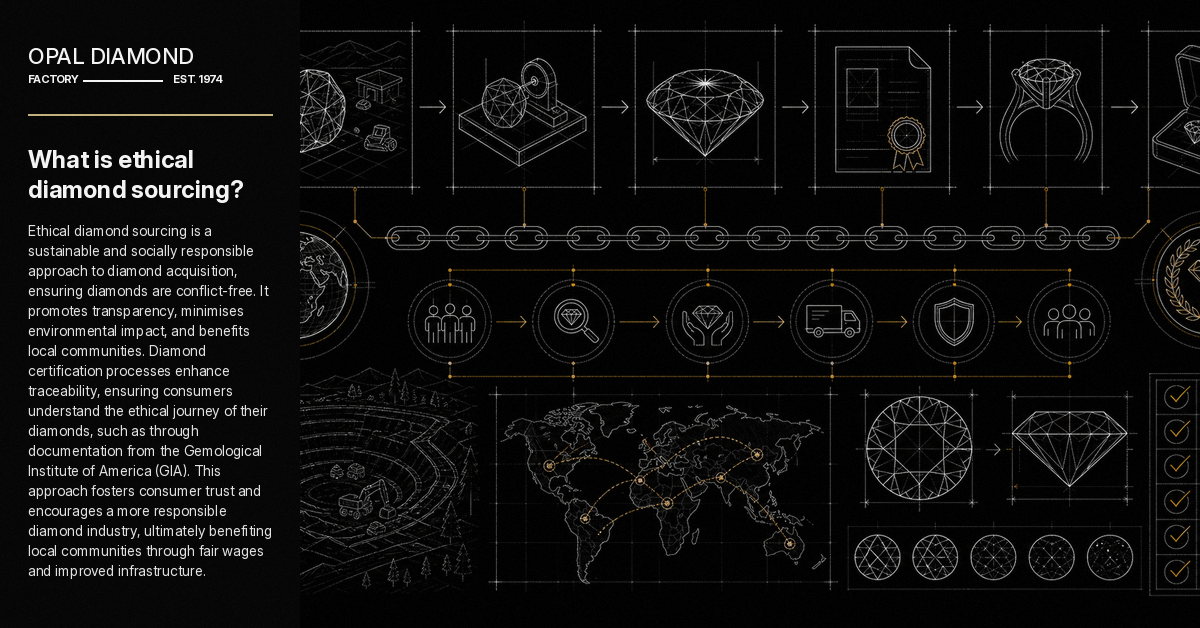
Ethical diamond sourcing is a sustainable and socially responsible approach to diamond acquisition, ensuring diamonds are conflict-free. It promotes transparency, minimises environmental impact, and benefits local communities. Diamond certification processes enhance traceability, ensuring consumers understand the ethical journey of their diamonds, such as through documentation from the Gemological Institute of America (GIA). This approach fosters consumer trust and encourages a more responsible diamond industry, ultimately benefiting local communities through fair wages and improved infrastructure.
Who certifies ethical diamond sourcing?
Seven key types of entities certify ethical diamond sourcing, working at different levels of the supply chain, from mine to market, each playing a crucial role in maintaining ethical standards. These organisations are responsible for certification:
| Certifying Entity | Primary Role in Ethical Diamond Sourcing |
|---|---|
| The Kimberley Process Certification Scheme (KPCS) | An international certification system that regulates rough diamond trade to prevent conflict diamonds from entering the legitimate market. |
| Responsible Jewellery Council (RJC) | A standards-setting organisation that certifies companies across the jewellery supply chain for responsible business practices, such as fair labour and environmental protection. |
| International Organisation for Standardisation (ISO) | Provides standards for sustainable and ethical practices in the diamond industry, such as ISO 14001 for environmental management. |
| Fair Trade Gemstone Certification | Ensures fair labour practices, sustainable mining methods, and community development in gemstone mining, including diamonds. |
| Diamond Development Initiative (DDI) | Focuses on improving working conditions and standards in artisanal diamond mining. |
| Independent Third-Party Auditors | Professional organisations that verify compliance with ethical sourcing standards and certification requirements, such as SCS Global Services. |
| Geological Institutes | Organisations, such as the GIA, that provide diamond origin certification and tracking services. |
What is chain of custody verification?
Chain of custody verification is a crucial tracking system in the international diamond industry that documents a diamond’s journey from mine to market, ensuring Kimberley Process-certified diamonds remain conflict-free and ethically sourced. The system prevents the flow of conflict diamonds from war-torn areas, such as Sierra Leone in the past, while monitoring environmental impact, labour practices, and sustainability commitments.
This comprehensive framework combines 3 main components: documentation, verification checkpoints, and modern technology, such as radio-frequency identification (RFID) tags, to maintain transparency throughout the supply chain, from rough diamond shipments to finished pieces of jewellery, such as rings and pendants. This process gives consumers confidence that their purchases support ethical practices and positive community impact rather than contributing to armed conflicts or environmental degradation.
What is the kimberley process?
The Kimberley Process (KP) is an international certification scheme established in 2003 to prevent conflict diamonds from entering the legitimate diamond market and ensure ethical practices in the diamond trade. This multi-stakeholder initiative unites governments, such as those of Botswana and Canada, industry organisations, like the World Diamond Council, and civil society groups to increase transparency and oversight in the diamond supply chain. The primary focus is on preventing rough diamonds from funding conflicts against legitimate governments in war-torn areas.
While the Process has successfully prevented most conflict diamonds from entering the market, it continues to evolve to address 2 modern challenges in the international diamond industry: environmental concerns and broader human rights considerations.
Who runs the kimberley process?
The Kimberley Process operates through a collaborative governance structure involving 8 key types of stakeholders working together to prevent conflict diamonds from entering the legitimate market. These entities are responsible for running the Process:
| Entity | Role in the Kimberley Process |
|---|---|
| Chair and Vice Chair | Annual rotating positions held by member countries, responsible for overseeing implementation and coordinating international efforts. |
| Permanent Secretariat | Based in Gaborone, Botswana, providing administrative support and ensuring continuity in the Process’s operations. |
| Working Groups | Specialised teams focusing on monitoring, statistics, and technical issues, composed of experts from member countries. |
| Committees | Dedicated groups overseeing participation, rules, and reform initiatives to maintain and improve the certification system. |
| Member Nations | Fifty-nine participants representing 85 countries (with the European Union as a single participant) who implement and enforce certification. |
| Civil Society Organisations | Independent organisations, such as the KP Civil Society Coalition, providing oversight, advocacy, and ensuring accountability. |
| Diamond Industry Representatives | Industry experts, such as those from De Beers, contributing technical knowledge and supporting implementation. |
| Technical Experts | Specialists providing guidance on specific aspects of the certification scheme, such as diamond valuation. |
What does the responsible jewellery council do?
The Responsible Jewellery Council (RJC) is the leading global membership and standards organisation dedicated to promoting responsible practices throughout the 8 stages of the jewellery supply chain.
These are the key functions and responsibilities of the RJC:
- Develops Standards: The RJC creates and maintains the comprehensive ‘Code of Practices’ that aligns with international human rights agreements, such as the UN Guiding Principles on Business and Human Rights, labour standards from the International Labour Organisation, and sustainable development principles.
- Certifies Industry Participants: It provides rigorous certification programs and guidance to companies committed to sustainability and social responsibility in the jewellery and watch sectors.
- Oversees Supply Chains: The RJC monitors ethical practices from mine to retail, ensuring transparency and responsible standards at every step of the value chain, including cutting and polishing facilities.
- Supports Members: It assists its global membership of over 1,800 companies across 71 countries in implementing and maintaining responsible business practices.
- Educates and Trains: The RJC delivers professional development programs and resources to support member compliance with industry standards.
- Refines Standards: It continuously updates and improves standards to address emerging industry challenges, such as lab-grown diamond traceability, and opportunities.
- Collaborates with Industry: The RJC works with stakeholders across the supply chain, including miners, manufacturers, traders, and retailers, such as Tiffany & Co., to promote ethical practices.
- Protects Consumers: It ensures transparency and builds consumer confidence through strict certification requirements and industry oversight.
What are fair trade gemology criteria?
Fair Trade gemology criteria establish comprehensive standards for ethically sourced gemstones, focusing on 2 main areas: environmental sustainability and social responsibility throughout the mining and trading process. These standards require transparent supply chains, documented proof of origin, fair labor practices, safe working conditions, and appropriate compensation for miners while protecting local communities and ecosystems, such as rivers and forests.
The certification process involves regular third-party audits to verify compliance with 5 key requirements: fair pricing mechanisms, proper safety equipment and training, environmental rehabilitation, such as replanting native vegetation, and community development initiatives, including schools and healthcare clinics. These criteria ensure certified gemstones contribute to sustainable development while maintaining ethical practices in mining communities, with a portion of profits reinvested in local infrastructure, education, and healthcare projects.
Who are the main ethical diamond certifiers?
The global diamond industry relies on 8 prominent types of organizations to ensure ethical standards and responsible practices throughout the supply chain. These are the main ethical diamond certifiers:
| Certifier | Key Focus | Examples of Standards/Services |
|---|---|---|
| Responsible Jewellery Council (RJC) | Sets comprehensive standards for the jewellery industry. | Code of Practices covering legal compliance, labour rights, such as no child labour, and environmental concerns, like water management. |
| SCS Global Services | Provides Sustainability Rated Diamond certification. | Verified origin traceability, ethical stewardship, carbon footprint measurement, sustainable production, sustainability investments. |
| GIA (Gemological Institute of America) | Offers certification focusing on diamond characteristics and ethical sourcing verification. | Diamond Origin Report, GIA Source Verification Service. |
| Diamond Certification Laboratory of Australia (DCLA) | Works with international bodies to ensure diamond grading and certification standards. | Alignment with global best practices, such as those of the World Jewellery Confederation (CIBJO). |
| International Organisation for Standardisation (ISO) | Develops global standards for sustainable and ethical practices. | ISO 24016:2020 standard for jewellery chain of custody. |
| Kimberley Process Certification Scheme | Provides international certification specifically focused on preventing conflict diamonds. | Requirements for import/export controls and internal controls. |
| Independent Third-Party Auditors | Verify compliance with ethical sourcing standards and certification requirements. | Audits against RJC Code of Practices or SCS-007. |
| Fair Trade Gemstone Certification | Ensures fair labor practices, sustainable mining methods, and community development. | Standards for fair wages, safe working conditions, environmental protection. |
What is fairmined certification?
Fairmined certification is a globally recognised assurance label that certifies gold and associated precious metals, such as platinum and silver, from artisanal and small-scale mining (ASM) organisations.
The certification supports responsible mining practices through ethical diamond sourcing checks, establishing 3 strict types of requirements: environmental protection, safe working conditions, and fair labour practices, while guaranteeing miners receive fair compensation and additional premiums for community development.
The system provides complete traceability from certified mines through refiners to end consumers, requiring regular third-party audits to verify compliance with environmental and social standards. These include 4 key prohibitions/assurances: banning child labour, ensuring gender equality, minimising environmental impact, such as reducing mercury use, and promoting workers’ rights. Through this certification, consumers can be confident their jewelry purchases directly support responsible mining practices and contribute to sustainable community development in mining regions, such as those in Colombia and Peru.
What is the scs-007 sustainability standard?
SCS-007 is a sustainability standard aimed at promoting 3 key areas: ethical diamond sourcing, environmental standards, and social responsibility in the diamond supply chain. It focuses on fair labor practices and transparency in the industry, ensuring compliance with environmental standards, such as water conservation and energy efficiency. This standard ensures that diamonds are sourced responsibly, ensuring consumers’ purchases support ethical practices and contribute to a sustainable future.
What is canadamark?
CanadaMark is a certification program that ensures diamonds are sourced from 2 specific types of mines: ethical and environmentally responsible mines in Canada, such as the Diavik and Ekati mines. It meets strict sustainability standards and adheres to responsible sourcing practices. CanadaMark diamonds are conflict-free, providing consumers with assurance about ethical sourcing. The certification process validates the origin and traceability of each stone, promoting transparency in the diamond trade and enabling consumers to make informed choices based on verified Canadian origin.
What is blockchain diamond tracking?
Blockchain diamond tracking is a digital ledger technology that creates an immutable record of a diamond’s journey from mine to market, ensuring transparency and authenticity throughout the supply chain. Each diamond receives a unique digital identity, often linked to a GIA report number, that captures its characteristics, such as the 4Cs (carat, cut, clarity, colour), origin, and every transaction or transformation, making it impossible to alter or falsify its history.
This decentralised system stores and verifies information about each stone’s journey, helping prevent conflict diamonds from entering the market while providing consumers with complete confidence in their purchases. Several major diamond companies, such as De Beers with its Tracr platform, have adopted this technology to enhance transparency, reduce fraud, and enable real-time tracking capabilities that traditional paper-based certification methods cannot match.
What are third-party audit standards?
Third-party audit standards in the diamond industry are independent verification protocols designed to ensure compliance with 3 main categories of requirements: ethical sourcing, environmental, and social responsibility. These standards involve systematic assessments conducted by qualified external organisations, such as Bureau Veritas or Intertek, with no direct interest in the diamond supply chain, ensuring unbiased evaluation of practices and claims.
The audits examine 9 multiple aspects: labour practices, worker safety, environmental impact management, supply chain transparency, community relations, legal compliance, anti-corruption measures, certification validity, and sustainability commitments. These rigorous standards help maintain integrity in the diamond industry while providing consumers and stakeholders with confidence that ethical sourcing claims are genuine and verified through independent assessment.
How do jewellers prove sourcing?
Jewellers employ 8 various methods and documentation types to verify and demonstrate the ethical sourcing of their diamonds and precious materials, such as gold and platinum.
These are the key ways jewellers prove their sourcing:
- Provides Certification Documentation: Jewellers maintain detailed records of Kimberley Process certificates and other recognised international certifications, such as RJC certification, for each diamond.
- Utilises Supply Chain Tracking: They use blockchain and digital tracking systems, like Tracr or Gemological Institute of America (GIA) Source Verify, to document the complete journey of diamonds from mine to showcase.
- Undergoes Third-Party Audits: Jewellers undergo regular independent assessments to verify compliance with ethical sourcing standards and industry best practices.
- Shows Origin Documentation: They provide detailed information about the country and mine of origin for diamonds and other precious materials, such as CanadaMark certificates.
- Maintains Industry Memberships: Jewellers maintain active membership in recognised organisations, such as the Responsible Jewellery Council or American Gem Society, that require adherence to strict standards.
- Verifies Suppliers: They work exclusively with verified suppliers who can demonstrate their commitment to ethical sourcing and sustainable practices through systems like the RJC Chain-of-Custody standard.
- Keeps Transaction Records: Jewellers maintain comprehensive documentation of all diamond purchases and transfers throughout the supply chain, including invoices and shipping documents.
- Implements Quality Assurance: They implement internal controls and verification processes to ensure all products meet ethical sourcing requirements.
What papers show ethical sourcing?
The jewellery industry relies on 6 essential types of documents to verify and demonstrate ethical sourcing. At the core is the Kimberley Process Certificate, which proves diamonds are conflict-free and legally traded. Chain of Custody documentation, such as invoices and shipping manifests, tracks a diamond’s complete journey from mine to market.
Additional verification comes from Laboratory Grading Reports, like those from GIA or IGI, RJC Certification, Mine-of-Origin Certificates, such as CanadaMark, and Import/Export Documentation, including customs declarations. These papers work together to create a comprehensive trail of evidence ensuring diamonds are ethically sourced, legally traded, and meet international standards for responsible practices throughout the supply chain.
What do gia and igi say about sourcing?
GIA and IGI are primarily diamond grading organisations that have evolved to address ethical sourcing concerns through 3 main avenues. GIA offers the Diamond Origin Report service, using scientific analysis to match polished diamonds to their rough origins. It also maintains strict documentation standards for its clients and provides educational resources about responsible sourcing practices.
IGI focuses on certification services for both natural and lab-grown diamonds, supporting ethical practices through verified supplier relationships and documentation requirements. Both organisations complement existing sourcing verification systems, such as the Kimberley Process, contributing to supply chain transparency through their grading standards and documentation processes rather than directly enforcing sourcing standards themselves.
How do countries control diamond ethics?
Countries control diamond ethics through a combination of 8 key control mechanisms: international agreements, national legislation, and industry oversight.
- Participate in the Kimberley Process: Mandatory implementation of certification schemes is required to prevent conflict diamonds from entering legitimate markets.
- Enact National Legislation: Country-specific laws, such as Canada’s Diamond Export and Import ACT, govern mining practices, labour conditions, environmental protection, and trade regulations.
- Implement Border Controls: Strict customs procedures and documentation requirements for diamond imports and exports are enforced.
- Regulate the Industry: Government oversight of diamond businesses, including licensing requirements and regular audits, is common.
- Utilise Law Enforcement: Dedicated units, such as specialised police forces, investigate illegal trading, money laundering, and violations of ethical standards.
- Form Trade Agreements: Bilateral and multilateral agreements, such as the US-Colombia Free Trade Agreement, include provisions for ethical diamond trading.
- Protect the Environment: Regulations governing mining practices, land rehabilitation, and environmental impact assessments are in place.
- Enforce Labour Standards: Laws ensuring fair wages, safe working conditions, and prohibition of child labour are critical.
This multi-layered approach helps ensure diamonds traded internationally meet ethical standards while supporting sustainable industry practices.
How does sourcing affect price?
Diamond sourcing directly impacts price through 2 main factors: transparency and ethical certification costs. Ethically sourced diamonds with complete documentation and verified origin, such as those with GIA Origin Reports, command higher prices due to additional expenses in tracking, certification, and maintaining responsible supply chains. Four additional factors also contribute to the final cost: country of origin, mining conditions, labor practices, and environmental standards. Ethically sourced diamonds often include premiums supporting fair wages, community development projects, and sustainable mining practices, reflecting responsible business practices throughout the supply chain.
How do buyers check diamond origin?
Buyers can verify diamond origin through 8 primary methods involving official documentation and technological verification systems.
- Review Certification Papers: Official documents, including Kimberley Process certificates and laboratory grading reports from GIA or AGS, detail the diamond’s source.
- Examine Origin Reports: Specialised documentation from organisations, such as GIA, scientifically matches polished diamonds to their rough origins.
- Check Blockchain Records: Digital tracking systems, like Everledger, provide transparent, tamper-proof records of a diamond’s journey.
- Request Seller Documentation: Detailed records from jewellers show the supply chain and sourcing verification.
- Consider Laboratory Analysis: Scientific testing can determine geological characteristics linking diamonds to specific regions, such as Australian Argyle diamonds.
- Use Digital Platforms: Online verification tools allow buyers to check certification authenticity by entering report numbers.
- Seek Retailer Transparency: Direct information from authorised retailers, such as Tiffany & Co., about their sourcing practices and supply chain is valuable.
- Consult Industry Databases: Access to registered certification numbers and origin verification systems can be available.
These verification methods help ensure buyers can make informed decisions about their diamond purchases.
What problems affect ethical sourcing?
Ethical diamond sourcing faces 6 major challenges. These include tracking diamonds through multiple countries and handlers, maintaining transparent supply chains, and dealing with informal mining sectors. Inadequate local enforcement in some mining regions, the persistent risk of conflict diamonds entering legitimate markets, and varieties in standards and regulations across countries also pose significant problems.
Limited resources for monitoring and verification, along with economic pressures, can compromise ethical practices, especially in developing regions, such as some parts of Africa. The industry must balance commercial interests with 3 key ethical considerations: environmental protection, fair labour practices, and community development, while combating attempts to circumvent ethical sourcing requirements, for example, through smuggling.
Why use ethical certification?
Ethical certification promotes 2 primary benefits: sustainable development and positive social impact, allowing consumers to make informed choices. It helps combat dangerous working conditions, such as those found in unregulated artisanal mines, and condemns unethical practices in diamond mining, including forced labour and environmental degradation.
How do brands apply ethical labels?
Brands apply ethical labels by adhering to specific standards that verify their diamonds are sourced responsibly. This process often involves 2 key actions: partnerships with non-governmental organizations, such as the Diamond Development Initiative, and obtaining certifications from bodies like the Responsible Jewellery Council to guarantee real diamonds come from certified sourcing.
Related diamond guide: How do diamonds impact the environment?.