
The environmental harm of diamond mining operations extends far beyond surface damage. Traditional mining methods require vast acres of earth to be moved, destroying agricultural soil and contaminating aquatic ecosystems. In the world’s largest diamond reserves, these operations contribute significantly to climate change through carbon emissions, while the destruction of land affects local communities and biodiversity, compounded by the complexities of conflict diamonds in countries heavily dependent on diamond revenues.
However, technological advances have led to sustainable alternatives, with lab-grown diamond companies now creating customizable diamonds in controlled laboratory environments using clean energy and energy-efficient methods.
For broader context, compare this point with the ethical diamonds guide.
As conscious consumers drive demand for environmentally responsible products, the industry is evolving to address carbon offsets and improve business practices, though questions remain about whether these alternatives can fully satisfy both consumer expectations and environmental responsibilities while maintaining the timeless beauty of diamonds.
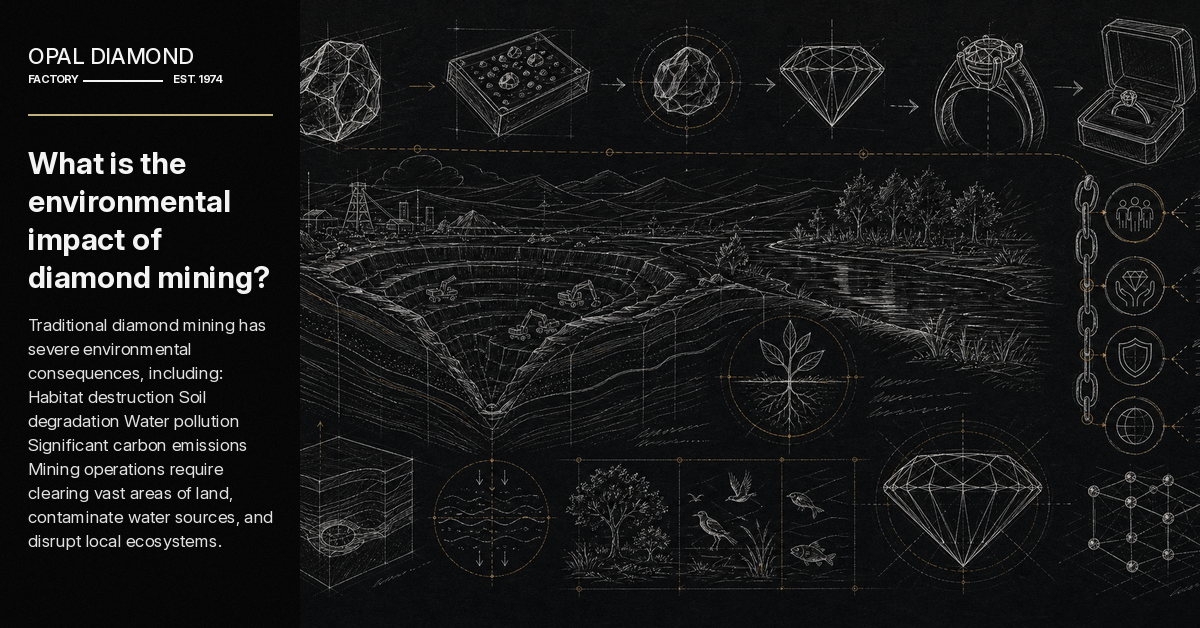
What is the environmental impact of diamond mining?
Traditional diamond mining has severe environmental consequences, including:
- Habitat destruction
- Soil degradation
- Water pollution
- Significant carbon emissions
Mining operations require clearing vast areas of land, contaminate water sources, and disrupt local ecosystems.
How are diamonds mined?
There are 5 main methods used to extract diamonds from the Earth’s surface and beneath it:
- Open-Pit Mining: Large crater-like mines are excavated in layers, creating massive holes that can be up to a kilometer deep, used for deposits near the surface.
- Underground Mining: Vertical shafts and tunnels are created to access diamond deposits deep below the surface, often extending hundreds of meters down.
- Alluvial Mining: Diamonds are extracted from sand, gravel, and clay in riverbeds and coastal areas where natural processes have transported diamonds from their original sources.
- Marine Mining: Specialised ships vacuum diamond-bearing sediments from the ocean floor, particularly common off the coast of Namibia and South Africa.
- Artisanal Mining: Small-scale operations where miners use simple tools and manual methods to extract diamonds, often in developing countries.
This list represents the primary extraction methods, each with varying levels of environmental impact and technological sophistication.
What is open-pit diamond mining?
Open-pit diamond mining is a surface excavation method that extracts diamonds from the earth by removing large volumes of soil and rock, exposing kimberlite pipes. This method can yield significant amounts of diamonds but also causes environmental harm, including:
- High energy consumption
- High water usage
- Increasing carbon footprint
- Irreversible damage to ecosystems
Open-pit operations leave lasting scars on the landscape, necessitating careful consideration of alternatives.
What is alluvial diamond mining?
Alluvial diamond mining is the extraction of diamonds from sedimentary deposits, primarily in diamond-rich areas. Although less invasive than traditional mining, it can cause significant environmental harm, affecting water resources and ecosystems. Various mining methods lack sustainable practices, exacerbating the impact of diamonds on the environment. As ethical sourcing awareness grows, there is a push for responsible diamond mining practices that minimise ecological disruptions and ensure the integrity of the diamond supply chain.
How much energy does diamond mining use?
Diamond mining operations consume massive amounts of energy, comparable to small towns, accounting for a significant portion of global electricity use. The complex process involves extracting carbon atoms through various technological processes, which creates environmental harm through the degradation of diamonds and surrounding ecosystems. The negative impacts extend beyond just energy consumption, affecting amounts of water usage, soil needs, and creating stagnant water that can damage coral and aquatic life.
While traditional mining diamonds continues to supply industrial diamonds and larger diamonds for the demand for diamond jewellery, the industry is shifting toward energy efficiency and climate action. Many countries diamonds-dependent economies are now exploring alternatives like Customizable Lab-grown diamonds, which require less energy and operate under controlled conditions rather than potentially abusive conditions. The certification process and polishing process for both natural and lab-grown diamonds remain energy-intensive, but concerned consumers and the largest economies are pushing for more sustainable practices, considering climate change considerations and biological processes in diamond creation.
How does diamond mining affect land?
Diamond mining dramatically transforms landscapes and ecosystems, causing both immediate and long-term impacts on the environment. From massive open-pit mines to underground tunnels, the extraction of diamonds leaves lasting scars on the Earth’s surface.
Diamond mining affects land in these 7 main ways:
- Habitat Destruction: Mining operations require clearing vast areas of land, removing vegetation, and displacing wildlife from their natural environments.
- Soil Degradation: The extraction process disrupts soil structure and removes topsoil, making the land unsuitable for agriculture or natural regeneration.
- Landscape Alteration: Creation of massive open pits and underground tunnels permanently changes the topography, leaving behind large crater-like formations.
- Erosion Issues: Exposed soil and rock from mining operations increase erosion, affecting surrounding areas and waterways.
- Waste Generation: Large amounts of waste rock and processed materials are left behind, creating substantial waste dumps that affect land use.
- Groundwater Disruption: Mining activities can alter natural groundwater patterns and contaminate underground water sources.
- Infrastructure Impact: Construction of mining facilities, roads, and processing plants leads to additional land disturbance and fragmentation.
These impacts often persist long after mining operations cease, requiring extensive rehabilitation efforts to restore the land to a usable state.
How does diamond mining pollute water?
Diamond mining significantly impacts water quality through multiple channels of contamination. Mining operations release:
- Sediments
- Chemicals
- Heavy metals into water systems
The process of extracting diamonds requires large volumes of water that often becomes contaminated. This polluted water can seep into groundwater, contaminate local water supplies, and harm aquatic ecosystems.
What are water reclamation rules in diamond mining?
Diamond mining operations must follow strict water reclamation rules to protect water resources.
Here are 9 key regulations and requirements:
- Closed-Loop Systems: Mines must implement water recycling systems that minimise water waste and maximise reuse.
- Water Quality Standards: Any water discharged from mining operations must meet strict quality parameters before release into the environment.
- Treatment Requirements: Contaminated water must undergo proper treatment processes before reuse or discharge.
- Monitoring Systems: Regular water quality monitoring and reporting are mandatory to ensure compliance.
- Storage Regulations: Specific requirements for water storage facilities and containment systems must be followed.
- Discharge Permits: Special permits are required for any water discharge from mining operations.
- Emergency Protocols: Mines must maintain emergency response plans for potential water-related incidents.
- Documentation Requirements: Detailed records of water usage, treatment, and discharge must be maintained.
- Environmental Impact Assessment: Regular evaluations of the mining operation’s impact on local water resources.
These regulations aim to protect water resources and minimise the environmental impact of diamond mining operations while ensuring sustainable water management practices.
How does diamond mining affect biodiversity?
Diamond mining has severe and far-reaching effects on biodiversity through multiple pathways:
- Ecosystem Destruction: Mining operations clear vast areas of natural habitat, destroying vegetation and forcing wildlife displacement.
- Habitat Fragmentation: The creation of mines, roads, and infrastructure divides previously connected ecosystems, disrupting animal migration patterns and breeding grounds.
- Species Loss: The destruction of native vegetation and wildlife habitats leads to decreased biodiversity and potentially endangers local species.
- Aquatic Impact: Water pollution from mining operations affects aquatic ecosystems, harming fish populations and other water-dependent species.
- Soil Disruption: The removal of topsoil and vegetation affects soil microorganisms and plant life, disrupting the local food chain.
- Long-term Effects: Even after mining operations cease, the altered landscape and damaged ecosystems may take decades to recover, if at all.
These impacts create a cascade effect throughout the ecosystem, where the loss of one species can affect many others in the food web, leading to long-lasting changes in local biodiversity. The negative effects on biodiversity are particularly severe in sensitive ecosystems and areas with high species diversity.
How does diamond mining disturb ecosystems?
Diamond mining severely disrupts ecosystems by creating a cascade of environmental changes that affect both physical landscapes and living systems. The process begins with the complete removal of vegetation and topsoil, which immediately destroys existing habitats and displaces wildlife. This physical transformation is accompanied by changes to natural water systems, including altered drainage patterns, contaminated groundwater, and disrupted aquatic ecosystems.
The disturbance extends beyond the immediate mining site, as dust, noise, and chemical pollution affect surrounding areas. These changes disrupt natural food chains, breeding patterns, and migration routes, while the fragmentation of habitats creates new edge effects that expose previously protected species to additional threats. Even after mining operations cease, these ecosystem disruptions can persist for decades, as the altered landscape and damaged environmental systems struggle to recover their original balance and biodiversity.
What chemicals are used in diamond mining?
Diamond mining operations utilise various chemicals throughout the extraction and processing stages.
Here’s a comprehensive overview of 7 categories:
- Froth Flotation Chemicals: Specialised reagents like xanthates and dithiophosphates help separate diamonds from ore through surface tension manipulation.
- Flocculants and Coagulants: These chemicals help settle suspended particles in processing water and aid in wastewater treatment.
- Mineral Processing Agents: Chemical compounds enhance the efficiency of diamond recovery and ore concentration.
- Dewatering Aids: Chemicals assist in removing water from processed materials and managing waste products.
- pH Adjusters: Substances like lime and caustic soda help control acidity levels in processing and waste management.
- Dust Suppressants: Chemical solutions help control airborne particles during mining and transportation.
- Grinding Aids: Specialised chemicals improve the efficiency of crushing and grinding operations.
How do diamond mines produce waste?
Diamond mining operations generate significant amounts of waste through various processes.
Here’s how 7 different types of waste are produced:
- Overburden Waste: Massive amounts of soil and rock must be removed to access diamond deposits, creating large volumes of waste material.
- Process Plant Waste: The separation and processing of diamonds from ore produces tailings and slurry waste.
- Chemical Waste: Residual chemicals from processing operations require proper disposal and management.
- Water Waste: Contaminated water from washing and processing operations needs treatment before disposal.
- Equipment Waste: Used machinery parts, oils, and maintenance materials contribute to industrial waste.
- Dust and Emissions: Mining operations produce air pollutants and particulate matter.
- Rock Waste: Large quantities of non-diamond-bearing rock are extracted and must be stored or disposed of.
The management of these waste products presents significant environmental challenges, as improper disposal can lead to long-term environmental damage and contamination of surrounding areas, making responsible sourcing more than a marketing claim. Diamond mines typically produce hundreds of tons of waste material for each carat of diamond recovered.
What is the carbon footprint of diamond mining?
Diamond mining has a significant carbon footprint primarily due to intensive energy consumption in extraction and processing operations. The industry contributes to greenhouse gas emissions through:
- Heavy machinery operation
- Land clearing that eliminates natural carbon sinks
- Energy-intensive processing activities
Estimates suggest that producing a single carat of mined diamonds generates between 125 and 250 kg of carbon dioxide emissions.
Transportation of materials, infrastructure development, and waste management further increase the industry’s carbon footprint. While some mining companies are transitioning to renewable energy sources and implementing carbon reduction strategies, traditional diamond mining remains a considerable contributor to global carbon emissions.
How do diamond mines affect air quality?
Diamond mining significantly degrades air quality through multiple sources of pollution.
Mining operations release large amounts of:
- Dust
- Particulate matter during excavation
- Crushing
- Transportation activities
While heavy machinery emissions add:
- Nitrogen oxides
- Sulfur dioxide
- Carbon monoxide to the air
The combination of dust, vehicle exhaust, chemical processing emissions, and the loss of natural air filtration from cleared vegetation creates persistent air quality challenges that affect both mining operations and surrounding communities.
How are communities affected by diamond mining?
Diamond mining has complex and far-reaching effects on local communities, creating both opportunities and challenges. Here’s how communities are impacted:
| Impact Category | Description |
|---|---|
| Economic Impact | Mining operations provide employment opportunities, increased wages, and local business development |
| Infrastructure Development | Companies often invest in roads, schools, hospitals, and other community facilities |
| Displacement Issues | Communities may be forced to relocate from traditional lands to make way for mining operations |
| Environmental Health | Local residents face health risks from water pollution, air quality issues, and soil contamination |
| Social Disruption | Traditional lifestyles and cultural practices can be disturbed by mining activities |
| Land Rights Conflicts | Indigenous communities often face challenges protecting their territorial rights |
| Resource Competition | Mining operations can strain local water and land resources used by communities |
| Skills Development | Workers receive training and education, though these may be mine-specific |
| Long-term Sustainability | Communities face uncertainty when mines eventually close |
These impacts vary significantly depending on the location, scale of operations, and company policies regarding community engagement and support.
How does diamond mining affect indigenous land?
Diamond mining severely impacts indigenous lands through:
- Forced displacement
- Environmental degradation
- Disruption of traditional ways of life
Mining operations often violate ancestral territories, destroying sacred sites and compromising indigenous communities’ ability to maintain cultural practices, hunting grounds, and gathering areas. The resulting pollution and habitat destruction affect traditional food sources, medicinal plants, and water supplies, while the long-term environmental damage can permanently alter indigenous peoples’ relationship with their ancestral lands, even after mining operations end.
What are lab-grown diamonds?
Lab-grown diamonds, created in controlled environments through advanced technological processes, offer an ethical option to counter the environmental harm diamond mining causes, including soil erosion and destruction of streams in fragile ecosystems. Unlike blood diamonds and traditional mining industry practices that generate toxic chemicals, greenhouse gases, and marine ecosystem damage, these diamonds have identical chemical properties to natural diamonds without the detrimental impacts on marine biodiversity and poor working conditions.
These diamond alternatives are becoming increasingly popular among clued-up consumers who recognise their reduced environmental footprints in the diamond market. Created on a human time scale rather than requiring amounts of soil needs and generating waste material, lab-grown diamonds provide a sustainable solution to meet consumer demand while avoiding the social impacts associated with traditional diamond commodity chains and dependence on diamond revenues.
What is ion implantation in diamond production?
Ion implantation in diamond production is a sophisticated technological process where ions (charged particles) are accelerated and embedded into the diamond’s surface to modify its properties. This technique is used to create specific colours in diamonds or enhance their characteristics by introducing controlled impurities into the crystal structure. In lab-grown diamonds, this process can be precisely controlled to create customised colours and properties, offering an advantage over naturally occurring colour variations. The process is important in both scientific applications and the jewellery industry, where it helps create unique and desirable diamond characteristics.
What is microwave plasma activation in diamond making?
Microwave plasma activation is a key technique in lab-grown diamond production that uses microwave energy to create a plasma state of carbon-containing gases. This high-energy plasma breaks down the gas molecules into carbon atoms, which then deposit layer by layer onto a diamond seed crystal under carefully controlled conditions. The process, often used in Chemical Vapour Deposition (CVD) methods, allows for precise control over diamond growth and quality, creating pure diamonds at lower temperatures than traditional high-pressure methods. This technology enables efficient production of high-quality diamonds with consistent properties.
How is diamond purity grade improved?
Diamond purity grade is improved through several sophisticated treatment and enhancement processes. Here are 8 ways to enhance a diamond’s purity:
| Treatment Type | Description |
|---|---|
| Heat Treatment | High-temperature exposure under controlled conditions to remove or alter inclusions and improve clarity. |
| HPHT Treatment | High Pressure-High Temperature processing to remove colour impurities and enhance overall clarity. |
| Laser Drilling | Precise removal of dark inclusions through microscopic channels. |
| Fracture Filling | Introducing special materials to fill microscopic cracks and improve appearance. |
| Surface Coating | Application of thin films to enhance colour and appearance. |
| Irradiation | Controlled exposure to radiation to modify colour characteristics. |
| Chemical Treatment | Use of specific chemicals to dissolve or alter unwanted inclusions. |
| Plasma Treatment | Surface modification using plasma technology to improve appearance. |
These processes must be disclosed in diamond certification, as they affect both the value and natural state of the stone. Modern technology allows for increasingly sophisticated enhancement methods, though some purists prefer untreated stones.
How do synthetic diamonds cut emissions?
Synthetic diamonds significantly reduce greenhouse gas emissions by eliminating the need for extensive mining operations, heavy machinery, and long-distance transportation. Lab-grown diamonds require approximately 85% less energy per carat than mined diamonds, and many facilities use renewable energy sources in controlled environments. This production method avoids the environmental damage associated with traditional mining, such as deforestation and soil erosion, while allowing for localised production that further reduces transportation emissions and overall carbon footprint.
What are eco-friendly diamond options?
Eco-friendly diamond options combine sustainable practices with ethical production methods to minimize environmental impact.
The 5 main alternatives are:
- Lab-Grown Diamonds: Created in controlled laboratory environments using significantly less energy and resources than traditional mining.
- Recycled Diamonds: Previously owned diamonds that are recut and reset, eliminating the need for new mining.
- Blockchain-Certified Diamonds: Stones with transparent supply chains that ensure ethical sourcing and sustainable practices.
- Carbon-Neutral Diamonds: Produced using renewable energy and carbon offset programs.
- Antique Diamonds: Vintage stones that don’t require new mining or processing.
What are sustainable diamond labels?
Sustainable diamond labels represent certifications and standards that verify a diamond’s ethical and environmental credentials.
These certification systems ensure:
| Verification Type | Description |
|---|---|
| Verified origin traceability | Guarantees the source of the diamond is known and documented. |
| Environmental impact documentation | Provides data on the environmental effects of diamond production. |
| Social responsibility standards | Certifies fair labor practices and community support. |
| Production practice transparency | Discloses methods used in diamond manufacturing. |
| Carbon footprint verification | Quantifies the emissions produced during diamond creation. |
| Ethical sourcing confirmation | Confirms diamond was obtained responsibly. |
The main sustainable diamond labels are:
- SCS-007 Certification: A comprehensive sustainability standard that evaluates environmental, social, and governance criteria for both natural and lab-grown diamonds
- Certified Sustainability Rated Diamonds: Provides documentation of environmental and social impacts, including origin verification and carbon footprint assessment
- Net Zero Carbon Footprint Designation: Awarded to diamonds that meet specific benchmarks for carbon neutrality
- Sustainability Rated Diamond Ecolabel: Accreditation for diamond industry participants meeting strict sustainability criteria
The labels provide consumers with confidence in their purchase while encouraging industry-wide adoption of sustainable practices. Each certification requires rigorous third-party verification and ongoing compliance monitoring to maintain standards.
Where are ethical diamonds sourced?
Ethical diamonds primarily come from two main sources:
- Lab-grown facilities in technologically advanced nations like the United States, Singapore, and Western Europe, where production occurs under strict environmental and labor standards.
- Responsibly-managed mines in countries like Canada, Botswana, and Namibia, which enforce robust regulatory frameworks for environmental protection and fair labor practices.
Additional ethical sources include certified artisanal mining operations and recycled diamonds, all of which must maintain transparent supply chains and comply with international standards for responsible sourcing.
How does diamond recycling help the environment?
Diamond recycling significantly reduces environmental impact by eliminating the need for new mining operations and their associated damage. By reusing existing diamonds, this process avoids habitat destruction, water pollution, and carbon emissions typically linked to diamond extraction. The recycling process only requires minimal energy for cleaning, recutting, and resetting stones, compared to the extensive resources needed for mining or lab-grown production.
The process supports environmental conservation by preventing additional land disruption, reducing energy consumption, and eliminating the need for chemical processing and water resources in mining. This sustainable approach to diamond sourcing not only preserves natural ecosystems but also meets growing consumer demand for environmentally responsible jewellery options while supporting the circular economy.
What are brands doing to cut diamond impact?
Diamond brands are implementing numerous initiatives to reduce their environmental impact through various sustainability efforts.
Leading manufacturers are adopting renewable energy sources, particularly solar power, across their facilities. Companies are achieving significant reductions in greenhouse gas emissions through:
| Initiative | Description |
|---|---|
| LEED Platinum-certified green buildings | Using designs and materials to minimize energy consumption. |
| Water conservation technologies | Decreasing water usage in mining and processing operations. |
| Waste reduction programs | Recycling and reusing materials to limit landfill waste. |
| Sustainable mining practices | Minimising ecological disruption during extraction. |
| Energy-efficient processing methods | Reducing energy consumption through streamlined operations. |
| Supply chain transparency initiatives | Tracking diamonds from mine to market to verify ethical sourcing. |
| Carbon offset programs | Investing in projects that reduce carbon emissions to balance their own output. |
Major brands are also investing in recycled materials and implementing comprehensive “cradle-to-grave” sustainability strategies. Many companies have set ambitious targets to reduce their carbon emissions, with some pledging to become carbon-neutral organisations by 2025. Industry organisations are launching initiatives to promote responsible sourcing and reduce environmental impact, demonstrating the sector’s growing commitment to environmental responsibility.
How can buyers lower their diamond footprint?
Buyers can reduce their diamond footprint by:
- Choosing lab-grown diamonds, which require less energy and resources to produce
- Selecting recycled and vintage diamonds that eliminate the need for new mining
- Purchasing from companies with strong sustainability certifications
- Opting for smaller stones
- Selecting diamonds from countries with strict environmental regulations
Being informed about a diamond’s origin and production methods, while supporting brands that use renewable energy and practice responsible sourcing, helps promote industry-wide sustainability.
Related diamond guide: Who certifies ethical diamond sourcing: from mine to market, who checks the truth.