
Diamonds are more than gemstones-they are a marvel of nature and science. Forged in the Earth’s mantle under high pressure and high temperature, diamonds are the hardest material known to man, a solid form of pure carbon where carbon atoms are bonded in a perfect crystal lattice. These natural diamonds rise through volcanic eruptions, carried in magma through kimberlite pipes or settled in alluvial deposits. Whether gem-quality diamonds sparkle in jewellery or industrial diamonds power cutting tools, the diamond’s physical properties-hardness, clarity, and thermal conductivity-make it unmatched.
The diamond industry grades diamonds by cut, colour, clarity, and carat weight to assess diamond quality. Today, both mined diamonds and lab-grown diamonds fill markets, while conflict diamonds raise ethical concerns. From white diamonds to fancy coloured diamonds-blue, pink, yellow, or black-each stone tells a story. Whether a faceted gemstone on an engagement ring or a synthetic diamond in quantum computing, this allotrope of carbon remains one of Earth’s most remarkable creations.
What is a diamond?
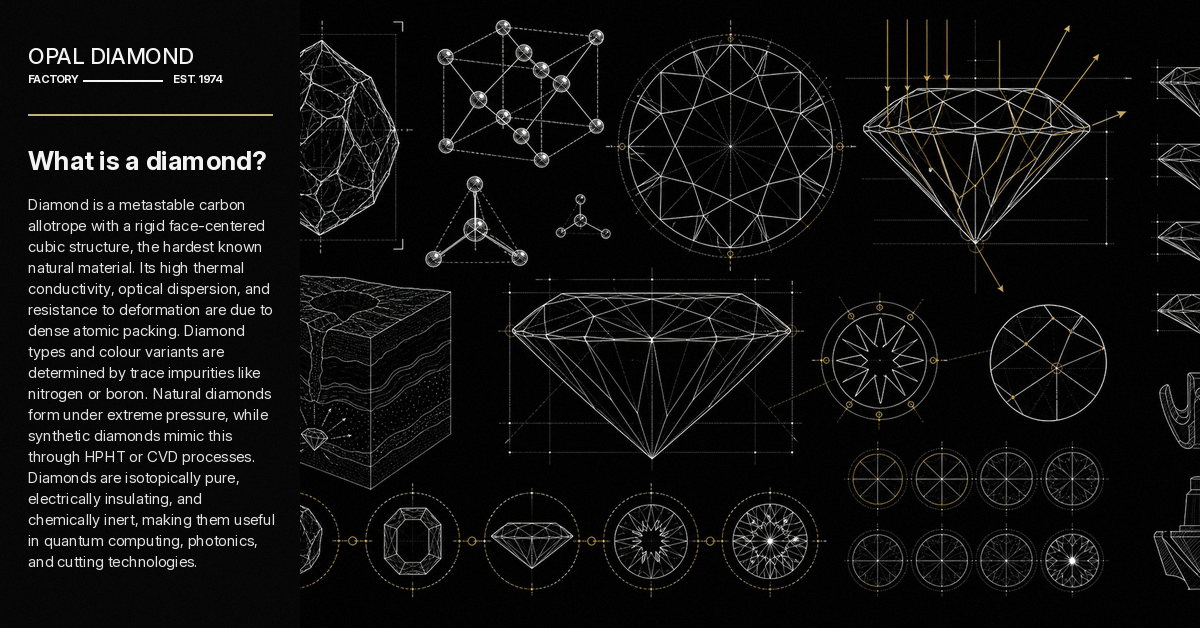
Diamond is a metastable carbon allotrope with a rigid face-centered cubic structure, the hardest known natural material. Its high thermal conductivity, optical dispersion, and resistance to deformation are due to dense atomic packing. Diamond types and colour variants are determined by trace impurities like nitrogen or boron. Natural diamonds form under extreme pressure, while synthetic diamonds mimic this through HPHT or CVD processes. Diamonds are isotopically pure, electrically insulating, and chemically inert, making them useful in quantum computing, photonics, and cutting technologies.
What makes a diamond hard?
Diamonds are colourless crystals made of carbon atoms linked in a diamond cubic structure, making them the hardest gemstone and rated 10 on the Mohs scale. They are preferred for engagement rings and 75th wedding anniversaries due to their durability and brilliance. Diamond properties, including clarity grades, carat weight, cutchosen for diamonds, and light performance, affect value.
They come in various shapes and colours, with rare blue colour types like the Cullinan Diamond. Diamonds are found in primary and secondary deposits and are used in industrial and electronic applications for thermal conductivity and electrical insulators. Diamonds have symbolized strength and status since the 15th century and through the 20th century, with studies conducted by institutions like the Carbon Observatory.
What are the types of diamonds?
Diamonds are grouped based on origin, chemical composition, clarity, colour, and cut. Each type influences how the diamond looks, performs, and is valued.
- Natural Diamonds – Formed naturally in the Earth’s mantle over billions of years under extreme pressure and temperature.
- Synthetic Diamonds – Created in laboratories using High Pressure High Temperature (HPHT) or Chemical Vapor Deposition (CVD) to mimic natural diamond formation.
- Type Ia Diamonds – The most common type; contain clustered nitrogen atoms that cause a yellow tint.
- Type Ib Diamonds – Rare; contain isolated nitrogen atoms, often producing vivid yellow or brown colour.
- Type IIa Diamonds – Extremely pure; free from nitrogen and other impurities; often colourless or pink.
- Type IIb Diamonds – Contain boron atoms; may appear blue and conduct electricity.
- Colored Diamonds (Fancy Colour) – Naturally coloured diamonds including yellow, brown, pink, blue, green, and rare red.
- Clarity Types – Classified from Flawless (FL) to Included (I3), based on internal and external imperfections.
- Cut Types – Defined by shape and facet style, such as round, princess, cushion, emerald, and other fancy shapes.
- Alluvial Diamonds – Found in riverbeds and sedimentary deposits, carried from primary sources.
- Diamond Pipes – Volcanic channels of kimberlite or lamproite rock where diamonds are mined.
- Enhanced Diamonds – Treated natural diamonds modified to improve colour or clarity using laser drilling, fracture filling, or HPHT.
- Simulant Diamonds – Imitation stones like cubic zirconia and moissanite that resemble diamonds but lack their hardness and crystal structure.
What are the common diamond colours?
Diamonds come in a variety of colours, ranging from the classic colourless to rare hues like red and blue. The colour of a diamond is one of the key factors in determining its value, with the most sought-after diamonds being those with little to no colour. Here are the most common diamond colours:
- Colourless (D-F) – The highest grade; completely transparent with no noticeable colour.
- Near Colourless (G-J) – Slightly tinted with a faint yellow or brown hue, but still considered near colourless.
- Faint Yellow (K-M) – Noticeable yellow tint, though still light in tone.
- Light Yellow (N-R) – Clear yellowish tone becomes more evident, but not overpowering.
- Yellow (S-Z) – Strong yellow colour, often with noticeable saturation.
- Brown – Ranges from light to dark brown, sometimes referred to as “chocolate diamonds” or “cognac diamonds.”
- Blue – A rare and highly prized colour, often with a noticeable bluish hue.
- Green – Naturally occurring green diamonds are rare, often caused by radiation exposure, giving them a distinct green tint.
- Pink – Rare and highly valuable, these diamonds can range from pale pink to deep, intense pink.
- Red – Extremely rare, red diamonds are one of the rarest and most expensive diamond colours.
How does light affect a diamond?
Diamonds are renowned for their ability to capture light, making them ideal for engagement rings and dream diamonds. Their stable, tetrahedral structure allows light to refract and reflect within the stone, resulting in dazzling flashes of colour known as fire. The diamond cutter maximises light by cutting the stone, revealing its best features.
Yellow diamonds intensify the yellowish colour, while colourless diamonds allow pure brilliance. Diamonds’ hardness also contributes to their durability and resistance to destruction, making them ideal for industrial applications. Diamonds have been used in volcanic pipes and wedding rings for centuries, making them a unique choice for their ability to reflect light.
What is the best diamond colour?
The best diamond colour is colourless (D-F), offering the highest brilliance and light reflection due to its absence of colour. Diamonds are incredibly durable, being times harder than most materials, with their atomic structure and carbon atoms bond in a stable tetrahedral form. This structure enhances their light performance when cut into faceted diamonds. Diamonds are sourced from volcanic pipes, and their clarity, such as in SI1 clarity diamonds, is impacted by visible inclusions.
Fancy diamonds, like diamond blue, are prized for their unique colours. The correct angle and finished shape maximise their sparkle, making them a sought-after choice for engagement rings. Diamond identification tests can differentiate real diamonds from simulants, and their value is linked to their exceptional light reflection, which has been admired since Ancient Greek times.
How do diamonds form?
Diamonds form under extreme pressure and temperature in the Earth’s mantle, where carbon atoms bond in a stable tetrahedral structure, creating the hardest known natural material.
This unique structure of diamond gives it unmatched hardness and durability, making it highly valuable as both a precious stone and for industrial applications.
Diamond crystals grow deep within the Earth, with the source of diamonds often being volcanic pipes. Their ability to refract light is influenced by the diamond facet cut and the bonds in diamonds that link the carbon atoms together.
Diamonds come in various shapes, including the common shape of round and elongated shapes, with alternative diamond cuts enhancing their beauty. The colour concentration and colour grade, such as in blue diamonds, add to their rarity and value, especially in engagement rings. The carat diamond weight and the characteristic of gem diamonds are further descriptors used to evaluate their worth. As hard materials, diamonds are difficult to facet, and their destruction is a rare but notable occurrence.
Where are diamonds found?
Diamonds are found in various geological settings where high pressure and temperature allow carbon to crystallise. These precious stones are primarily extracted from deep within the Earth, but they can also be discovered in locations shaped by natural forces like volcanic eruptions and water movement.
- Volcanic pipes – Deep underground, formed through volcanic eruptions that bring diamonds to the Earth’s surface.
- Alluvial deposits – Diamonds eroded from their original source and transported by water to riverbeds or beaches.
- Kimberlite pipes – Rare volcanic rock formations that are rich in diamonds, often mined for their gem-quality stones.
- Metamorphic rocks – In certain geological conditions, diamonds can form in high-pressure, high-temperature environments.
- Marine deposits – Offshore diamond mining in ocean beds, where diamonds are carried by rivers and deposited underwater.
What are the biggest diamond mines?
The largest diamond mines in the world are known for their significant production and deep geological origins. The Jwaneng mine in Botswana is the richest, producing large quantities of high-quality diamonds. The Orapa mine, also in Botswana, is another major source, known for its large scale and high output.
Russia’s Yakutia region, with mines like Mirny and Udachny, holds some of the largest deposits, contributing a substantial portion of the global diamond supply. In Canada, the Diavik and Ekati mines are notable for their remote locations and high-grade diamond extraction. These mines, found in regions rich in kimberlite pipes, continue to dominate the diamond industry with their vast resources and advanced extraction methods.
What are the most famous diamonds?
Famous diamonds are known for their extraordinary size, colour, and captivating histories. These stones have become symbols of wealth, power, and intrigue.
- Hope Diamond – A blue diamond famous for its curse and rich historical significance.
- Cullinan Diamond – The largest gem-quality diamond ever discovered, cut into several notable stones, including the Great Star of Africa.
- Koh-i-Noor – A diamond with a complex history, now set in the British Crown Jewels.
- Tiffany Yellow Diamond – A vivid yellow diamond, showcased in prominent jewellery displays.
- Pink Star Diamond – A rare, large pink diamond known for its colour and record auction price.
What are the 4Cs of diamonds?
The 4Cs of diamonds refer to the four key factors that determine a diamond’s quality and value:
- Cut – Refers to how well a diamond has been shaped and faceted, affecting its brilliance and sparkle.
- Colour – Describes the presence of colour in a diamond, with the best diamonds being colourless (graded from D to Z).
- Clarity – Measures the presence of internal or external flaws (inclusions or blemishes), with higher clarity diamonds having fewer imperfections.
- Carat Weight – Indicates the size of the diamond, with larger diamonds being rarer and more valuable.
How is diamond clarity graded?
Diamond clarity is graded based on the presence of inclusions (internal flaws) and blemishes (external imperfections). The grading scale ranges from Flawless (FL) to Included (I1, I2, I3). The key factors in grading are the size, location, number, and visibility of these imperfections. Here’s a brief overview:
- Flawless (FL) – No inclusions or blemishes visible under 10x magnification.
- Internally Flawless (IF) – No internal inclusions, only minor surface blemishes.
- Very, Very Slightly Included (VVS1, VVS2) – Minute inclusions that are very difficult to detect under 10x magnification.
- Very Slightly Included (VS1, VS2) – Minor inclusions that are visible under magnification but not to the naked eye.
- Slightly Included (SI1, SI2) – Inclusions visible under magnification and sometimes to the naked eye.
- Included (I1, I2, I3) – Inclusions visible to the naked eye, which can affect the diamond’s durability and appearance.
What affects a diamond’s cut?
A diamond’s cut is influenced by various factors, including its shape, facets’ proportions, and the angle of setting. The diamond cutter must choose the right proportions to maximise light performance, ensuring optimal light reflection from each facet. A poorly cut diamond can appear dull, even with high carat weight or clarity. The diamond’s structure, including its crystalline form, dictates how it should be faceted to preserve its hardness and brilliance.
Depth and table size also affect the diamond’s sparkle, as improper proportions can reduce brilliance. The finished shape, whether round or square, also impacts light interaction. Skilled cutters must balance colour, clarity, and carat to showcase the stone’s best attributes.
What is crystalline allotrope morphology in diamonds?
Crystalline allotrope morphology in diamonds refers to the unique arrangement of carbon atoms in a diamond cubic lattice, where each carbon atom is bonded to four others, forming a tetrahedral structure. This gives diamonds their hardness, high refractive index, and stable form. The diamond clarity scale is influenced by inclusions that affect appearance and value.
Diamonds are difficult to facet due to their tough structure, and their crystalline arrangement is key to their light performance and resistance to destruction.
The presence of carbon atoms bonded together enhances their durability and makes them highly valuable, often used in engagement rings and industrial applications.
What are octahedral growth patterns in diamonds?
Octahedral growth patterns in diamonds occur when carbon atoms bond in a tetrahedral structure, forming a stable eight-faced crystal. This shape contributes to diamonds’ exceptional hardness and light reflection. The tough structure makes diamonds difficult to facet, but the octahedral form enhances their brilliance and spectral colours. These diamonds are highly valued, especially for engagement rings, and their carbon atoms are tightly linked, contributing to their durability. Inclusions can affect clarity, but diamonds with fewer imperfections are more valuable.
What is carbon isotope fractionation in diamonds?
Carbon isotope fractionation in diamonds refers to the variation in the ratio of carbon isotopes (^12C and ^13C) within diamond crystals. This process occurs when carbon dioxide or other carbon sources interact with atoms in diamonds, influencing the diamond’s content and the conditions under which it formed. The hardness of diamond is a result of the tightly bonded carbon atoms forming a stable structure. The fractionation can be used to trace the source of diamonds and their growth conditions, shedding light on their descriptors and value.
Understanding this process helps in evaluating diamond authenticity and its material to facet, especially when clarity-reducing inclusions are present. Carbon atoms form tetrahedral bonds within the unit cells of the diamond, making it a difficult material to cut. This knowledge contributes to the value of diamonds, particularly in engagement rings, where the clarity and strength of the stone are key factors.
How does carat weight impact value?
Carat weight impacts a diamond’s value because larger diamonds are rarer and more sought after. As the weight increases, the price typically rises due to the increased rarity and the demand for larger, visually impressive stones. Carat weight alone isn’t the only factor-cut, colour, and clarity also influence the diamond’s overall value. A well-cut diamond of higher quality with fewer imperfections can be more valuable than a larger, lower-quality stone.
What affects diamond prices?
Diamond prices are influenced by four main factors: carat weight, cut, colour, and clarity. These are collectively known as the “four Cs.” Carat weight affects size and rarity, with larger diamonds typically commanding higher prices. The cut influences how well the diamond reflects light, which impacts its brilliance. Colour is graded on a scale from colourless to light yellow or brown, with colourless diamonds being more valuable. Clarity refers to the presence of inclusions or blemishes; fewer imperfections lead to a higher value.
Why are diamonds used in jewellery?
Diamonds are a popular choice for jewellery due to their exceptional qualities and symbolism. Here are the key reasons they are favoured in jewellery:
- Durability – As the hardest natural material, diamonds resist scratching and wear.
- Brilliance – Their light-reflecting properties create a captivating sparkle.
- Symbolism – Diamonds represent love, luxury, and commitment, making them ideal for engagement and wedding jewellery.
- Rarity – Their scarcity adds to their exclusivity and high value.
- Versatility – Diamonds can be cut into various shapes, fitting many jewellery styles.
- Timelessness – Diamonds have been cherished for centuries, symbolising elegance and enduring value.
Why are diamonds a symbol of luxury?
Diamonds are a symbol of luxury because of their rarity, brilliance, and enduring value. As one of the rarest and hardest materials on Earth, diamonds have long been associated with wealth and exclusivity. Their ability to reflect light and create an exceptional sparkle gives them a unique allure, making them highly sought after for fine jewellery.
Over centuries, diamonds have been used by royalty, celebrities, and the wealthy, further solidifying their connection to opulence. Diamonds represent timelessness, as their durability ensures they last for generations, making them a lasting investment and a symbol of enduring luxury.
When did diamonds become popular in jewellery?
Diamonds became popular in jewellery during the 19th century, particularly after the discovery of large diamond deposits in South Africa in the 1860s. This increased the availability of diamonds and made them more accessible. The diamond’s association with wealth and power, already established among royalty and the elite, grew as diamond-cutting techniques improved.
In 1947, De Beers launched its famous “A Diamond is Forever” marketing campaign, which further cemented diamonds as the ultimate symbol of love and luxury, particularly in engagement rings. Since then, diamonds have become a central element of high-end jewelry across the world.
What are diamonds used for industrially industry?
Diamonds are used industrially for cutting, grinding, and drilling due to their hardness, which is a result of the carbon atoms in their structure being tightly bonded in a tetrahedral arrangement. Their value extends beyond jewelry, with diamonds playing a key role in manufacturing, aerospace, and electronics. The hardness and durability of diamonds make them ideal for tasks that require precision, such as cutting through hard materials.
Diamond content and size also influence their worth, whether in industrial tools or engagement ring stones, where diamonds are a standard choice for their brilliance and rarity. Diamonds value diamonds in various applications, with synthetic diamonds gaining traction in industrial sectors. Though common simulants exist, real diamonds remain unmatched in their spectral colours and strength.
Why are diamonds used in cutting tools?
Diamonds are used in cutting tools because of their unparalleled hardness. As the hardest known natural material, diamonds can cut through and shape even the toughest substances, including metals, stone, and concrete. The strong bonds between carbon atoms in a diamond’s crystal structure make it incredibly resistant to wear and tear, ensuring that diamond cutting tools last much longer than those made with other materials.
This durability is essential in industries such as mining, construction, and manufacturing, where precision and long-lasting performance are required. Diamond-tipped tools, such as saw blades, drill bits, and grinding wheels, allow for efficient and precise cutting, grinding, and drilling of hard materials, making them invaluable in various industrial applications.
How are diamonds used in technology?
Diamonds are used in technology for their exceptional hardness, thermal conductivity, and electrical insulating properties. In electronics, synthetic diamonds are used for semiconductors, high-power devices, and as heat sinks to dissipate heat in high-performance components. They are also employed in laser technology, where diamond crystals are used in high-precision instruments.
Due to their stability under extreme conditions, diamonds are used in high-performance machinery, aerospace technologies, and medical devices. Diamond coatings are applied to tools and equipment to improve durability and performance in demanding environments.
How do diamonds improve thermal conductivity in electronics?
Diamonds improve thermal conductivity in electronics due to their exceptional ability to transfer heat. As one of the best natural thermal conductors, diamonds can efficiently dissipate heat from electronic components, preventing overheating. This is particularly valuable in high-performance devices, such as semiconductors, where managing heat is critical for maintaining optimal function and prolonging the lifespan of the equipment. Synthetic diamonds, often used in heat sinks and substrates, help in cooling systems by providing a stable and efficient heat transfer medium, ensuring that electronic components operate at their peak performance without thermal damage.
Why are diamonds useful in high-precision optics?
Diamonds are useful in high-precision optics due to their hardness, optical clarity, and resistance to wear. Their exceptional hardness allows them to be finely cut and polished into precise optical components, such as lenses, windows, and mirrors, without distortion or degradation. Diamond’s high refractive index also enhances its ability to focus and manipulate light in advanced optical systems.
Diamonds are chemically inert, making them resistant to scratches and environmental damage, which is crucial for maintaining optical clarity and performance over time. These properties make diamonds ideal for use in cutting-edge technologies such as lasers, high-precision microscopes, and optical sensors.
How do diamonds work in quantum computing?
Diamonds are used in quantum computing due to their unique atomic structure, specifically the nitrogen-vacancy (NV) center. NV centers are defects in the diamond crystal where a nitrogen atom replaces a carbon atom, creating a vacancy. These centers have electron spins that can be manipulated and controlled, making them ideal for storing and processing quantum information.
The ability to control the spin of electrons in diamonds allows for quantum computing tasks, such as superposition and entanglement, which are critical for quantum algorithms. Diamonds are stable at room temperature, offering an advantage over other materials that require ultra-low temperatures. This makes diamonds a promising material for developing robust quantum computers in the future.
What is a conflict diamond?
Conflict diamonds, also known as blood diamonds, are diamonds mined in war zones and sold to finance armed conflict against governments. These diamonds often have a history of human rights abuses, including forced labor and violence. They come in various colour grades and possess the same spectral colours as ethically sourced diamonds. Despite their beauty, conflict diamonds are sometimes used to fund violence, making them a controversial choice for engagement rings.
The Kimberley Process aims to track diamond origins and prevent conflict diamond sales, but challenges remain. The atoms in diamonds and their stable structure make them prized, but the ethics of sourcing can overshadow their natural beauty.
What is the Kimberley Process?
The Kimberley Process is an international initiative established in 2003 to prevent the trade of conflict diamonds. It requires diamonds to be certified as conflict-free before being traded between participating countries, ensuring they are not used to finance armed conflict. While it has helped reduce the trade of blood diamonds, critics point out its enforcement gaps.
Where are conflict diamonds found?
Conflict diamonds are primarily found in regions affected by war and civil unrest, particularly in Africa. Major sources include countries like Sierra Leone, Angola, the Democratic Republic of Congo, Liberia, and the Central African Republic. These areas have historically been plagued by armed conflict, with diamonds being mined under conditions of exploitation and used to fund rebel groups fighting against legitimate governments. While the Kimberley Process has helped reduce the trade, some conflict diamonds still enter the market through illicit channels.
How do conflict diamonds affect the economy?
Conflict diamonds negatively impact the economy by fueling violence and destabilizing governments. The revenue from diamond sales often supports rebel groups, prolonging conflicts and hindering infrastructure development. This causes economic instability and poverty in affected regions. The illegal trade of conflict diamonds damages a country’s reputation, reducing trade and investment opportunities. It also undermines the legal diamond market, affecting global prices and the profitability of ethically sourced diamonds.
How do you buy ethical diamonds?
To buy ethical diamonds, look for those certified by the Kimberley Process, which ensures they are conflict-free and sourced responsibly. Choose retailers who are transparent about their sourcing practices and provide information on the diamond’s origin. Consider lab-grown diamonds, which are an ethical alternative, offering the same beauty without the environmental and human rights concerns of mined diamonds. Some jewellers also offer “fair trade” diamonds, which are mined under strict labour and environmental standards.
What certifications prove a diamond is ethical?
These certifications help ensure that diamonds are mined and traded under fair, environmentally responsible, and humane conditions.
- Kimberley Process Certification Scheme (KPCS) – Ensures diamonds are conflict-free and not used to finance armed conflict.
- Responsible Jewellery Council (RJC) – Certifies that diamonds have been sourced and produced in a socially and environmentally responsible way.
- Fairmined – A certification for responsibly mined gold and diamonds, focusing on fair labor practices and environmental protection.
- Certified Ethical Diamond (CED) – Guarantees ethical sourcing and adherence to human rights and environmental standards.
- Sustainable Gemstones Certification – Focuses on the sustainable and ethical mining practices of the gemstone industry, including diamonds.
How do lab-grown diamonds compare?
Lab-grown diamonds are identical to natural diamonds in terms of chemical composition, physical properties, and appearance. They are created through high-pressure, high-temperature (HPHT) or chemical vapour deposition (CVD) processes that mimic the conditions under which diamonds naturally form. These diamonds have no environmental or ethical concerns related to mining, offering a sustainable and humane alternative.
Lab-grown diamonds are graded the same way as natural diamonds, based on the 4Cs: carat, cut, clarity, and colour. They are typically more affordable than mined diamonds, providing a cost-effective option without sacrificing quality. The production process is transparent, and lab-grown diamonds can be made in various sizes and colours.
Are lab-grown diamonds real diamonds?
Yes, lab-grown diamonds are real diamonds. They have the same chemical structure, physical properties, and appearance as natural diamonds. The only difference is their origin-they are created in controlled laboratory conditions, while natural diamonds form over millions of years deep within the Earth. Despite this difference, lab-grown diamonds are recognised as real diamonds and are graded using the same criteria as mined diamonds, including the 4Cs: carat, cut, clarity, and colour.
What can damage a diamond?
While diamonds are the hardest known natural material, they can still be damaged under certain conditions. The most common causes of damage include:
- Hard impact – Although diamonds are extremely hard, they are also brittle. A strong enough blow, especially along the cleavage planes, can cause them to chip or fracture.
- Exposure to high heat – Extreme temperatures can cause diamonds to crack or discolour. While diamonds can withstand a lot of heat, sudden temperature changes (such as being exposed to a flame) can cause thermal shock.
- Chemical exposure – Certain chemicals, such as strong acids or bleach, can damage the diamond’s surface or its clarity, especially if they contain sulfur or other reactive compounds.
- Scratches – While a diamond can scratch almost any other material, it can still be scratched by other diamonds if they come into contact in the right way. Keeping diamonds in separate settings or compartments is a good practice.
How should you protect a diamond from damage?
To protect a diamond from damage, avoid exposing it to hard impacts, extreme temperatures, or harsh chemicals. Store it separately in a soft cloth or jewelry box to prevent scratching. Regularly clean the diamond using a gentle solution and soft cloth to maintain its brilliance. When not wearing it, remove diamonds during physical activities or tasks that may put pressure on the stone.
How do you clean a diamond?
To clean a diamond, mix a few drops of mild dish soap with warm water. Soak the diamond for 15-20 minutes, then gently scrub it with a soft brush or toothbrush. Rinse with clean water and dry with a soft cloth to restore its shine. Avoid harsh chemicals or abrasive materials.
How do you store diamonds?
Store diamonds in a soft cloth pouch, velvet-lined jewelry box, or separate compartment to prevent scratching. Keep them away from other jewelry, especially harder materials like other diamonds, and avoid exposure to extreme temperatures or harsh chemicals. A cool, dry environment is ideal for preserving their clarity and brilliance.