
The diamond industry is complex, with numerous factors influencing diamond value that go far beyond the basic “Four Cs” of diamond grading. Elements such as the color of the diamond, the clarity of the diamond, carat weight (e.g., a rare 7.25 ct diamond), and origin play a critical role in determining price. Unique diamonds from locations like the Arkansas Crater of Diamonds or lab-created synthetic diamonds add further intricacies to the market. Professionals rely on tools such as the Rapaport Prices List, IDEX Diamond Price Report, and Weekly Diamond Price List, as well as resources like the Diamond Price Calculator™ and Diamond Price History Charts, to analyse market trends and determine value. These systems provide insight into natural diamond prices and help both buyers and sellers navigate a market where prices for seemingly similar diamonds can vary significantly.
For diamonds, understanding market factors and leveraging price guides or calculators can make a significant financial difference. Buyers may turn to services like Help Me Buy My Diamond, while sellers can benefit from platforms such as Help Me Sell My Diamond. Without access to these resources, average buyers risk overpaying or undervaluing their stones, unaware of the nuanced factors driving price disparities. Whether purchasing or liquidating a diamond, tools like the Rapaport Prices List or IDEX reports give a clearer picture of value, ensuring informed and confident decisions in a market shaped by brilliance, rarity, and fluctuating pricing trends.
What is diamond value?
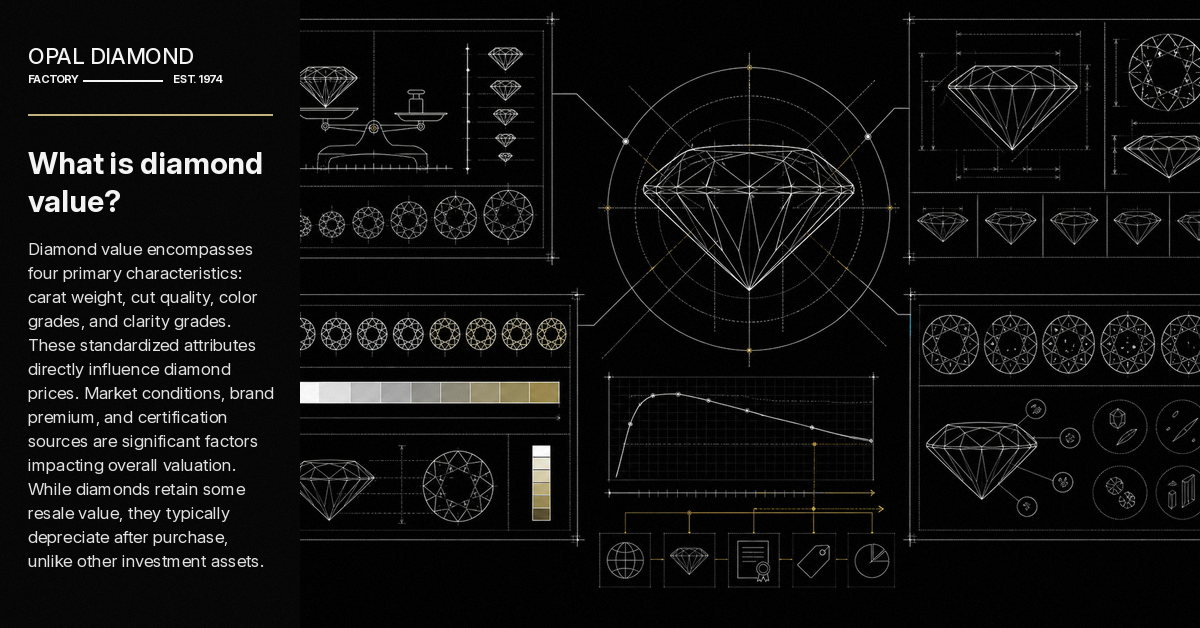
Diamond value encompasses four primary characteristics: carat weight, cut quality, color grades, and clarity grades. These standardized attributes directly influence diamond prices. Market conditions, brand premium, and certification sources are significant factors impacting overall valuation. While diamonds retain some resale value, they typically depreciate after purchase, unlike other investment assets.
How is diamond value determined?
Diamond value primarily hinges on measurable physical characteristics, known as the Four Cs: carat weight, cut quality, colour grade, and clarity level. Each of these four Cs contributes differently to a diamond’s market worth, with rare combinations commanding premium prices. Beyond these primary indicators, secondary features such as fluorescence and polish also influence a diamond’s final valuation in the marketplace.
What physical features affect diamond value?
When determining a diamond’s value, several key physical features significantly influence its desirability and market price. These attributes directly impact both a diamond’s appearance and its market standing.
| Feature | Description | Impact on Value |
|---|---|---|
| Carat Weight | Refers to the diamond’s size. | Larger diamonds are generally more valuable due to their increased rarity. |
| Cut Quality | Indicates how well the diamond is shaped and faceted. | Better cuts enhance brilliance and light return, thereby increasing value. |
| Colour Grade | Measures the absence of colour in the diamond. | Diamonds that are colourless or near-colourless typically have higher value. |
| Clarity Grade | Assesses the presence of internal or external imperfections. | Diamonds with fewer inclusions and blemishes are more valuable. |
| Shape | The specific geometric form of the diamond. | Shapes such as round, princess, or emerald can affect its appeal and resale value. |
| Fluorescence | The diamond’s reaction to ultraviolet light. | Can either enhance or detract from value depending on its type and intensity. |
| Cut Proportions | Precise measurements of the diamond’s facets, angles, and overall structure. | Affect how light interacts with the stone, significantly influencing its perceived brilliance and value. |
How do brilliance dispersion metrics work?
Refractive Index variability in diamonds occurs when light passes through different parts of the stone, creating shifts in how light bends and splits. This variability directly affects a diamond’s brilliance metrics, as stones with higher and more consistent refractive indices typically display superior light performance. Diamond cutters measure these variations using specialized optical equipment to maximize a stone’s fire and sparkle, factors that profoundly influence its market value.
Why does Refractive Index variability occur?
A diamond’s brilliance stems from its unique optical properties, specifically its variable Refractive Index across the visible light spectrum. This variability occurs because different wavelengths of light slow down at varying rates when passing through the diamond’s crystal structure. A well-cut diamond leverages this phenomenon to create spectacular light dispersion.
This Refractive Index variability directly impacts diamond quality and price. To the naked eye, this creates the colourful flashes characteristic of fancy diamonds. High-quality polish enhances these effects, while inclusions diminish clarity and reduce light performance. Diamond value strongly correlates with how effectively it manages light through this variable refraction.
Light performance is one part of the broader diamond guide.
What are inclusion mapping technologies?
Advanced imaging technologies have revolutionized diamond evaluation by precisely documenting internal flaws. Inclusion mapping technologies create three-dimensional representations of a diamond’s interior imperfections, enabling accurate grading and value analysis. The Gemological Institute of America (GIA) utilizes these systems to determine if diamonds qualify as “eye clean” or “internally flawless” for certification purposes.
Modern diamond value estimators incorporate these precise maps into sophisticated diamond price calculators. Diamond search engines now feature inclusion maps alongside traditional specifications, offering consumers unprecedented insight into a stone’s structure before purchase. This fundamentally changes how diamond price estimates are calculated and communicated throughout the market.
What is the cut symmetry deviation index?
The Cut Symmetry Deviation Index incorporates Symmetry Alignment Analysis to evaluate a diamond’s structural precision. This analytical process measures the geometric consistency between corresponding facets across the diamond’s crown and pavilion. Symmetry Alignment Analysis identifies even minor angular variations that affect light performance, thereby providing a quantitative basis for determining a diamond’s optical quality.
What is symmetry alignment analysis?
Symmetry Alignment Analysis evaluates how precisely a diamond’s facets align with its geometric center, directly impacting value and light performance. This technical measurement examines loose diamonds of all shapes and carat weights, identifying deviations that affect brilliance. Diamond price charts incorporate symmetry grades when determining fair market values for engagement rings.
Unlike basic symmetry grading, alignment analysis uses advanced imaging to quantify microscopic irregularities invisible to the naked eye. The resulting data provides a more thorough diamond pricing guide than traditional assessments, revealing why seemingly identical stones command dramatically different prices.
What key factors affect diamond value?
Seven major factors influence a diamond’s value, impacting its desirability and pricing in the market.
| Factor | Description |
|---|---|
| Supply and Demand Dynamics | The balance between diamond availability and consumer demand significantly impacts prices. |
| Carat Weight | Larger diamonds are generally rarer and more valuable. |
| Cut Quality | A well-cut diamond reflects light more beautifully, increasing its desirability and value. |
| Colour Grade | Colourless diamonds or those with minimal colour are typically more sought after. |
| Clarity Grade | Diamonds with fewer inclusions and blemishes are valued higher. |
| Ethical Sourcing | The preference for ethically sourced diamonds can enhance their perceived value. |
| Lab-Grown versus Natural | The rise of lab-grown diamonds affects the pricing and value of natural diamonds, creating a distinct market segment. |
How does diamond cut impact value?
Among all the factors that determine a diamond’s value, cut stands as the most critical element.
The cut quality directly impacts a diamond’s brilliance and fire, greatly affecting carat pricing. Round brilliant diamonds command premium prices due to their excellent light performance and increased cutting complexity. Distinctive alternatives, such as emerald cut, cushion shape, and marquise diamonds, offer varying price points. Historical styles, including rose cut and old mine cut, appeal to vintage enthusiasts but typically fetch lower prices than modern cuts. Well-polished diamonds with precise proportions can see value increases of 50% to 100% over poorly cut stones of identical carat weight and clarity.
How does diamond clarity influence value?
Diamond clarity measures the absence of inclusions and blemishes, considerably affecting diamond value. The GIA diamond price chart categorizes clarity from Flawless (FL) to Included (I), with clearer stones commanding premium prices. Clarity serves as a critical adjustment factor in the diamond calculator formula. While natural diamonds often contain microscopic imperfections, lab-grown diamonds typically feature higher clarity ratings. Each clarity grade impacts carat diamond price exponentially; a one-grade improvement can increase value by 10% to 20%. Diamonds with fluorescence may see values adjusted downward, particularly in higher clarity grades.
How does diamond colour affect value?
Colourless diamonds command noticeably higher prices than those with yellow or brown tints. The diamond color scale ranges from D (completely colorless) to Z (light yellow), with each grade appreciably affecting value. Diamond price indices, such as the Rapaport Price List, show premium valuations for colourless stones. Paradoxically, certain colored diamonds carry exceptional value. Fancy vivid diamonds, particularly rare green, blue, and pink varieties, can exceed white diamond value by orders of magnitude. Yellow diamond value increases when color saturation passes beyond the standard scale into “fancy” territory, demonstrating that color’s impact on diamond value is complex.
How does diamond carat weight change value?
Diamond carat weight represents the most visually apparent value factor in the marketplace. As diamond carat weights increase, prices rise exponentially rather than linearly. For instance, a 2-carat stone typically costs substantially more than twice a 1-carat diamond of equal quality. The price index for diamonds reflects this scaling principle.
A quarter carat diamond’s value differs dramatically from a 5-carat diamond’s value, while a 9-carat diamond’s value represents exceptional rarity. Loose diamond value assessment focuses primarily on weight before considering other factors. Diamond value ultimately reflects scarcity, as larger specimens require mining more material, with a diamond’s real value tied directly to this mathematical progression of increasing rarity.
How do treatments affect value?
Diamond treatments can have a significant impact on their value and desirability. Five primary ways describe how treatments affect diamond value:
| Impact | Description |
|---|---|
| Value Reduction | Treated diamonds generally have a lower resale value compared to natural, untreated diamonds due to market perception favouring natural stones. |
| Consumer Desirability | Many consumers prefer untreated diamonds for their authenticity, leading to higher demand and prices for natural stones. Treated diamonds may be less desirable in the market. |
| Stability of Treatments | The long-term stability of a treatment affects value. Stable treatments, such as laser drilling or High-Pressure/High-Temperature (HPHT), might maintain some value, whereas unstable treatments, like fracture filling, can further diminish worth over time. |
| Disclosure Factors | Transparency about a diamond’s treatment status is important. Sellers are ethically and often legally obligated to disclose treatments; a lack of disclosure can lead to mistrust and lower values. |
| Aesthetic Enhancements | While treatments can improve a diamond’s appearance, making it look clearer or more colourful, they do not equate to the same value as natural diamonds. The perception of enhancing natural beauty remains essential for higher values. |
How is crown angle optimization achieved?
Precisely balancing angles and proportions stands at the heart of crown angle maximization. Diamond cutters achieve this through meticulous adjustments to the round brilliant cut diamond’s crown facets, creating ideal light return. Old cut diamonds often suffer from suboptimal angles, while modern cuts utilize precise calculations for maximum diamond value. Different diamond shapes require specific crown angles for perfect performance.
This process has a considerable effect on price, with maximized stones commanding premium positions on diamond price calculators. Diamond deal ratings typically favour well-maximized crowns showing superior crown of light characteristics. Savvy buyers consult complete guides and diamond price snapshots to find maximization within their budget.
What origin influences diamond value?
While most consumers focus on the Four Cs, geographic origin substantially influences diamond valuation in the marketplace. Certain regions command premium prices due to quality reputation or ethical considerations. Diamond dealers reference Rapaport price lists while considering origin-specific market conditions. Countries such as Botswana and Canada often fetch higher values than regions associated with blood diamonds, which ethical consumers avoid when selecting engagement ring stones.
Diamond data shows market demand varies by origin, with the global rough diamond price index reflecting these geographical preferences. Jewellery retailers increasingly highlight ethical sourcing, responding to consumer concerns. Origin transparency has become essential in diamond price alerts, with provenance verification systems gaining prominence.
How do diamond certifications impact value?
Diamond certifications play a huge role in determining a diamond’s value and marketability. Six key ways illustrate how diamond certifications impact value:
| Impact | Description |
|---|---|
| Credibility and Trust | Certifications from reputable gemmological laboratories provide assurance of a diamond’s quality and characteristics, helping build consumer trust and confidence in its value. |
| Standardized Grading | Certifications offer standardized grading for a diamond’s key attributes (cut, colour, clarity, and carat weight), which helps buyers make informed decisions and facilitates consistent pricing in the market. |
| Insurance and Resale Value | A certified diamond is easier to insure and assess for resale, as the certification provides clear documentation of its quality, thereby enhancing its market value. |
| Consumer Preference | Many buyers prefer certified diamonds, often willing to pay a premium for stones that come with an official certification, which increases their overall market value. |
| Market Differentiation | Certification can distinguish a diamond in a competitive market, especially if graded by a well-known and respected laboratory, which enhances perceived value. |
| Potential Price Stability | Certified diamonds tend to hold their value better over time compared to non-certified stones, as buyers understand the quality they are purchasing and are generally more willing to pay. |
How does setting influence diamond value?
The setting of a diamond enormously impacts its perceived value and market price. The base price fluctuates drastically when stones are mounted in premium settings versus sold loose on the wholesale market. Non-round diamonds typically command lower prices in comparable settings. Major diamond retailers, such as James Allen and Blue Nile, price settings separately from stones, allowing consumers to search similar diamonds across platforms. Lab-grown diamonds generally require identical setting costs despite their lower stone prices. Setting quality also affects resale value tremendously. Diamond price calculators often exclude setting costs when determining a stone’s intrinsic worth, focusing instead on the gem’s inherent characteristics.
What branding impacts diamond value?
Various branding elements markedly influence diamond valuation in the marketplace. Premium jewellers such as Tiffany, known for iconic pieces like the Tiffany Yellow Diamond, command substantial price premiums beyond intrinsic stone value. The Bluebird diamond ring and similar branded offerings typically maintain stronger resale value compared to generic alternatives. Lab-grown diamonds face different branding challenges affecting their value over time.
While traditional diamonds hold historical mystique, for example the Hope Diamond (valued at approximately $350 million today), lab diamonds generally experience steeper depreciation in the resale market. Despite claims that “diamonds have no value,” branding profoundly impacts consumer perception and monetary worth throughout a diamond’s commercial lifecycle.
What are current diamond value trends?
Market demand for diamonds fluctuates with economic conditions, consumer preferences for ethical sourcing, and competition from lab-grown alternatives. Increasing a diamond’s value requires attention to the Four Cs: carat weight, color grade, clarity rating, and cut quality. Investors and collectors should track auction results, industry reports, and retail pricing to effectively compare diamond values across different time periods and market segments.
What market demand shapes diamond value?
Four major factors influence diamond market demand and consequently their value: economic conditions, consumer preferences, marketing campaigns, and investment potential. During economic downturns, specialty items such as black Alaskan diamond rings lose value considerably. Conversely, traditional pieces maintain stronger pawn value, with diamond tennis bracelets retaining 30% to 40% of retail pricing. Luxury market fluctuations directly impact these values, with urban markets showing greater resilience than rural areas.
How can one increase diamond value?
Five strategic enhancements can increase a diamond’s value substantially. Professional recutting improves proportion and symmetry. Proper cleaning reveals brilliance hidden by oils and dirt. Certification from respected laboratories, such as GIA, adds credibility. Setting diamonds in custom designs by renowned jewellers elevates value. Finally, timing sales during market peaks, typically holiday seasons, maximises return on investment.