
Diamonds display an extraordinary diversity beyond common colourless stones, classified by physical structure, colour, and applications, as emphasised by the Gemological Institute of America (GIA). The GIA Diamond Grading Report evaluates diamonds based on the four Cs: Carat, Colour, Cut, and Clarity, with popular cuts like the Asscher Cut, Marquise Cut, and Pear Cut offering unique appeal. Composition further distinguishes diamonds; Type 1a diamonds, the most common, contain aggregated nitrogen impurities, while rare Type 2b diamonds are nitrogen-free and often exhibit a blue or gray hue due to boron. Synthetic diamonds, such as CVD and HPHT diamonds, require advanced techniques like spectroscopy for differentiation, while high-quality natural diamonds-such as D colour diamonds and VVS diamonds-are highly coveted for their rarity and exceptional characteristics.
Fancy-coloured diamonds and rare stones often command extraordinary prices at auction, with premium sellers like Australian Diamond Brokers advising buyers to consider tools like a diamond engagement ring checklist to navigate key factors, including the four Cs and Carat Diamond Price. A deep understanding of natural diamonds, synthetic alternatives, unique cuts, and meticulous grading allows buyers to appreciate why certain diamonds, such as those with GIA certification or fancy colours, hold exceptional market value. Whether it’s a rare Type 2b diamond or a perfectly cut Pear-shaped stone, each diamond reflects a unique story and craftsmanship that continues to captivate collectors and buyers alike.
What is a type of diamond?
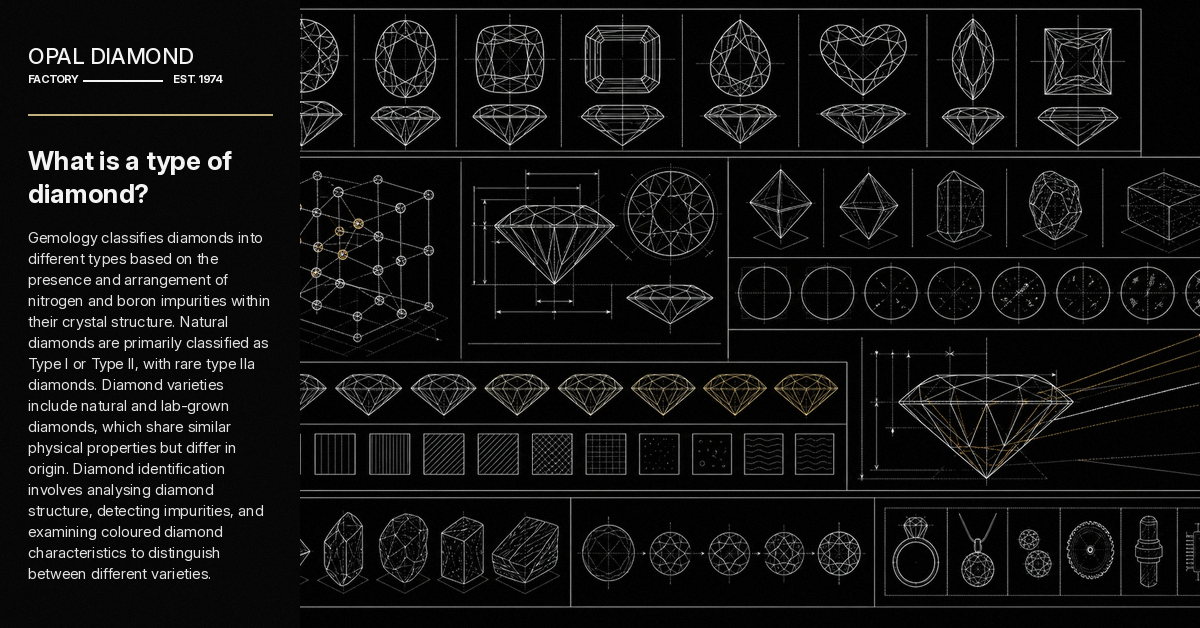
Gemology classifies diamonds into different types based on the presence and arrangement of nitrogen and boron impurities within their crystal structure. Natural diamonds are primarily classified as Type I or Type II, with rare type IIa diamonds. Diamond varieties include natural and lab-grown diamonds, which share similar physical properties but differ in origin. Diamond identification involves analysing diamond structure, detecting impurities, and examining coloured diamond characteristics to distinguish between different varieties.
What are diamond types by physical features?
Diamonds are categorized into different types based on their physical and chemical characteristics, particularly the presence or absence of impurities. These differences influence colour, brilliance, and other unique properties.
Below is a summary of these types:
- Type Ia Diamonds: The most common type (95% of natural diamonds), containing nitrogen impurities in clusters, often resulting in yellow or brown hues.
- Type Ib Diamonds: Rare (less than 1% of natural diamonds) with nitrogen impurities in isolated atoms, giving them intense yellow, orange, or brown colours.
- Type IIa Diamonds: Exceptionally pure and free from nitrogen, leading to superior transparency and brilliance; often colourless and highly valued.
- Type IIb Diamonds: Nitrogen-free but containing trace amounts of boron, which gives them a blue or gray colour and allows them to conduct electricity.
- CVD and HPHT Diamonds: Lab-grown diamonds created in controlled environments, mimicking natural properties but distinguishable by their internal structures or inclusions.
What is a kimberlite xenolith inclusion?
Kimberlite xenolith inclusions are foreign rock fragments found within diamonds during their formation, originating from kimberlite magma. These inclusions offer valuable insights into diamond origin, composition, and formation conditions, and influence clarity grades in rough diamond evaluation. Unlike other diamond inclusions, xenoliths are unique to kimberlite diamonds and cannot be found in treated diamonds. They help scientists identify diamond authenticity and distinguish them from synthetic alternatives.
How is synthetic moissanite detected?
Gemological tests can distinguish synthetic moissanite from diamonds by detecting double refraction characteristics, while spectroscopic analysis can identify HPHT enhancement in diamonds, revealing specific absorption patterns and the presence of artificial nitrogen vacancies. Advanced instruments like Diamond Sure and Diamond View can detect these differences.
- Double Refraction: Unlike diamonds, moissanite refracts light twice.
- Advanced Tools: Instruments like Diamond Sure and Diamond View detect this property.
How is hpht enhancement identified?
Identifying HPHT enhanced diamonds requires specialized equipment and trained gemologists. Laboratories use spectroscopy and fluorescence imaging to detect HPHT treatment signatures. Diamond certification reports typically indicate these enhancements, affecting diamond grading attributes and market value.
HPHT-treated stones often exhibit distinctive phosphorescence patterns and specific absorption spectra. On the diamond colour scale, dramatic improvements from brown to colourless or fancy colours indicate potential treatment. Professional gemologists recognize diamond type and structure modifications through microscopic examination, observing characteristic stress patterns and inclusions.
What are coloured diamonds?
Coloured diamonds are natural or synthetic diamonds that exhibit hues other than the traditional colourless or near-colourless spectrum.
These colours result from specific impurities or structural irregularities in the diamond during its formation, making them rare and highly valuable. Here is a quick overview:
| Colour | Cause |
|---|---|
| Yellow | Nitrogen absorbs blue light. |
| Blue | Trace boron content. |
| Pink | Structural distortions. |
| Green | Natural radiation exposure. |
| Red | Atomic-level structural changes. |
What is chameleon diamond thermochromism?
Among the rarest phenomena in gemology, chameleon diamond thermochromism describes the unique ability of certain diamonds to temporarily change colour when exposed to heat or kept in darkness. These natural diamonds typically shift from their stable olive-green or grayish-yellowish green state to a more vivid yellow or orangey yellow when heated to approximately 150°C, then revert to their original colour upon cooling.
Unlike typical fancy coloured diamonds, chameleon diamonds cannot be found on standard diamond colour charts. Diamond identification laboratories distinguish these diamonds through specialized testing of their thermochromic properties. This diamond type represents one of nature’s most fascinating colour-changing diamond materials.
What is colour zoning in fancy diamonds?
Fancy diamonds exhibit uneven colour distribution throughout their crystal structure, a phenomenon known as colour zoning. This characteristic affects how light interacts with different areas of the diamond, creating varied colour intensities across the gem. In natural diamonds, colour zoning may appear as patches, bands, or veins of different hues.
Diamond type, shape, and carat weight influence how noticeable zoning appears. Gemologists use this feature in diamond identification, distinguishing natural from synthetic stones. When comparing fancy coloured diamonds, experts evaluate whether colour zoning enhances or diminishes value. Skilled cutters often design fancy shape diamonds to showcase attractive zoning while minimizing less desirable patterns.
What is nitrogen aggregation spectroscopy?
Nitrogen aggregation spectroscopy represents a specialized analytical technique used to determine the age and formation conditions of diamonds. This method analyses how nitrogen atoms cluster within the carbon crystal structure, providing vital information about diamond type classification (type iaab, type iia lab diamond, or type 1b diamonds).
The technique measures absorption patterns created when nitrogen atoms form aggregates over geological time. Diamond identification experts use these patterns to authenticate natural diamonds and distinguish them from synthetic varieties.
The degree of nitrogen aggregation correlates with diamond hardness and formation depth, making this information crucial for diamond buying and jewellery assessment professionals who need to accurately determine diamond variety names and market value.
What are white diamonds?
White diamonds owe their colourless appearance to the absence of D-grade optical absorption bands, which occur when diamond lattices contain impurities. Submicroscopic graining layers within these diamonds create imperceptible structural variations that influence light dispersion properties without affecting transparency.
Fluorescence quenching effects, caused by certain trace elements, can suppress the bluish glow typically seen in diamonds under ultraviolet light, contributing to the pristine appearance of high-quality white diamonds.
What are d-grade optical absorption bands?
The D-grade optical absorption bands represent specific spectral features found in diamonds with minimal nitrogen content. These bands serve as optical signatures in diamond type stones, helping gemologists identify flawless diamonds with exceptional transparency. Unlike coloured diamonds such as black diamonds or blue diamonds, diamonds with D-grade bands appear colourless to the naked eye.
Both natural and created diamonds (lab diamonds) can exhibit these absorption characteristics, though they occur most prominently in the highest quality stones. The absence of certain bands contributes to ideal diamond clarity, making these specimens particularly valuable. Gemologists use spectroscopic analysis to detect these bands when examining diamond transparency and purity.
What are submicroscopic graining layers?
Submicroscopic graining layers are internal structural features in white diamonds that affect their optical properties. They form during crystal growth and create subtle internal boundaries visible only under specialized magnification. Diamond cutters consider these layers when planning cuts to minimize their impact on brilliance and clarity. Experts document these characteristics for diamond identification and certified diamonds include graining assessment in their reports. Understanding these structure variations is crucial for consumers when evaluating diamond options.
What are fluorescence quenching effects?
Fluorescence in white diamonds is a natural characteristic, but can be reduced by quenching effects. This occurs when certain elements in the diamond’s structure interfere with its ability to emit visible light under ultraviolet radiation. This affects diamond brilliance and sparkle, especially in jewellery. Lab-grown diamonds often display different fluorescence patterns than natural stones, aiding in diamond identification. The clarity and internal structure of diamonds also influence quenching effects.
What are the shapes of diamond types?
Diamonds come in a variety of shapes, each offering distinct characteristics, brilliance, and appeal. These shapes influence the visual impact and style of the diamond, making them suitable for different preferences and settings.
Below is an overview of the most popular diamond shapes:
| Shape | Key Features |
|---|---|
| Round | Maximum sparkle with 58 facets. |
| Princess | Square shape with brilliant fire. |
| Oval | Elongated, visually enlarging appearance. |
| Cushion | Vintage charm with rounded edges. |
| Pear | Elegant teardrop symbolising love. |
What are natural diamond types?
Natural diamonds are classified by chemical composition and physical properties, primarily the presence and arrangement of impurities like nitrogen and boron, while synthetic diamonds are separated by method of creation.
Below are the key natural diamond types:
| Diamond Type | Key Features | Example Characteristics |
|---|---|---|
| Type Ia | Contains clustered nitrogen impurities (95% of natural diamonds). | Yellow or brown hues. |
| Type Ib | Rare (<1% of natural diamonds) with isolated nitrogen atoms. | Vivid yellow, orange, or brown colours. |
| Type IIa | Pure and nitrogen-free. | Colourless and brilliant. |
| Type IIb | Nitrogen-free with trace boron. | Blue or gray and electrically conductive. |
What are industrial diamonds?
Industrial diamonds are diamonds primarily valued for their hardness and durability, rather than their appearance or rarity. These diamonds are used for a variety of practical applications in industries due to their exceptional physical properties. Below are the key points about industrial diamonds:
- Natural Industrial Diamonds: Lower-quality natural diamonds unsuitable for jewellery, used in cutting, grinding, drilling, and polishing tools.
- Synthetic Industrial Diamonds: Lab-grown diamonds such as CVD (Chemical Vapor Deposition) and HPHT (High Pressure High Temperature), designed specifically for industrial purposes.
- Hardness and Abrasion Resistance: Industrial diamonds are the hardest known material, ideal for high-pressure tasks and abrasion-resistant tools.
- Applications: Used in industries such as construction, mining, electronics, and medical fields for cutting blades, drill bits, laser equipment, and surgical tools.
What is the abrasive hardness index?
When measuring a material’s resistance to wear and scratching, the abrasive hardness index becomes essential. This scale quantifies hardness, with diamond ranking highest at 10 on the Mohs scale, though more precise industrial measurements use specialized scales.
Monocrystalline diamond, with its single crystal structure, exhibits superior hardness compared to polycrystalline diamond varieties. The tetrahedral diamond structure determines its extreme hardness regardless of diamond size or carat.
Industrial applications rely on this index when selecting between natural and synthetic diamonds. Unlike the diamond cut scale used for aesthetics, the hardness index focuses purely on material properties, helping industries identify the hardest diamond type for specific abrasive applications.
What are boron-doped diamond films?
Boron-doped diamond films represent a revolutionary advancement in industrial diamond technology. These lab-grown cubic diamond materials incorporate boron atoms into the carbon lattice, creating a semiconductor with distinctive bluish colouration often called “diamond black.” Unlike conventional diamond jewellery, boron-doped diamonds serve primarily industrial applications due to their exceptional electrical conductivity while maintaining diamond’s thermal and mechanical properties.
Similar to Type IIb diamond occurring naturally, these films offer sustainable alternatives to mined stones. The Human Diamond Pro industry recognizes their significance for electrochemical applications. Unlike hexagonal diamond variants, boron-doped films can be precisely engineered, making them superior to recycled diamond materials for specialized electronic and sensing applications.
What is thermal conductivity measurement?
Thermal conductivity measurement represents a key application area for industrial diamonds, which are utilized for their exceptional heat transfer properties rather than aesthetics. Diamonds possess the highest thermal conductivity of any natural material, making them invaluable in scientific and engineering applications.
Regardless of diamond shape or different diamond cuts, industrial-grade diamonds excel in heat dissipation contexts. While lacking the premium diamond appearance of high-end luxury diamonds, these specimens command significant diamond prices in specialized markets. The right diamond for thermal conductivity measurement requires specific diamond identification parameters, prioritizing structural integrity over the visual characteristics typically valued in premium diamond selections.
What are gem-quality diamond types?
Gem-quality diamonds are natural or synthetic diamonds that meet the high standards required for use in fine jewellery. These diamonds are prized for their beauty, brilliance, and rarity. They are categorized based on their composition and grading.
Here are the primary gem-quality diamond types:
- Type Ia Diamonds: Common gem-quality diamonds with nitrogen impurities in clusters, often found in yellow or brown hues.
- Type Ib Diamonds: Rare diamonds with isolated nitrogen impurities, resulting in more vivid yellow, orange, or brown colours.
- Type IIa Diamonds: Extremely rare and pure diamonds, free of nitrogen impurities, known for their exceptional clarity and sometimes colourless appearance.
- Type IIb Diamonds: Rare diamonds containing boron, which gives them a unique blue or gray hue; examples include the famous Hope Diamond.
- Fancy-Coloured Diamonds: Gem-quality coloured diamonds, such as pink, blue, green, and red, highly valuable due to their rarity and vibrant hues.
- Synthetic Gem Diamonds: Lab-grown diamonds created by methods like CVD or HPHT, used as an affordable alternative to natural stones with comparable beauty and durability.
What are fancy diamonds?
Fancy diamonds exhibit unique graining patterns that contribute to their distinctive appearance and value when cut in non-traditional shapes. Modified brilliant facet designs enhance these diamonds by optimizing light performance while maintaining the diamond’s character and colour.
Gemologists use spectral scattering analysis to evaluate how these fancy diamonds interact with light, providing essential data for both authentication and quality assessment.
What are graining patterns in fancy cuts?
Diamonds cut into shapes other than the traditional round brilliant are known as fancy cuts or fancy diamonds. Within these fancy cuts, graining patterns emerge as internal structural characteristics visible under magnification. These patterns appear as lines, streaks, or planes resulting from crystal growth imperfections.
Different cuts of gold chains inspire some fancy diamond shapes. Cushion cut types, oval diamond, and cushion diamond varieties each display unique graining patterns. Mixed cut diamonds combine faceting styles, affecting how graining appears. While engagement ring preferences often favor round diamond shapes, fancy cuts can showcase a larger diamond appearance despite having identical carat weight.
What is modified brilliant facet design?
Brilliant facet design undergoes thoughtful modifications to create what gemologists call fancy diamonds. These modified brilliant facet designs alter the traditional round brilliant cut to produce various diamond shapes while preserving ideal light performance.
The all different diamond cuts resulting from this technique include pear, marquise, oval, and heart shapes. Each cut engagement rings type showcases unique proportions and facet arrangements. This diamond shape variety offers consumers affordable diamond options beyond traditional styles.
Wedding rings and diamond engagement rings featuring modified brilliants appeal to those seeking distinctive aesthetics. While the round brilliant remains the best diamond type for maximum sparkle, modified designs provide engagement band types that balance beauty with personalized expression.
What is spectral scattering analysis?
The scientific analysis known as spectral scattering evaluates how light interacts with fancy diamonds. This spectroscopic assessment measures how diamonds refract and scatter light across the colour spectrum, revealing distinctive optical properties unique to authentic gemstones.
Diamond spectral analysis serves as a pivotal tool for gemstone identification, detecting subtle variations that determine diamond quality and value. Gemologists utilize light scattering patterns to verify diamond authenticity, as synthetic or treated stones display different spectral signatures.
This sophisticated method has become integral to diamond certification processes, providing objective data that complements traditional assessment methods and substantiates accurate classification of fancy coloured diamonds in the marketplace.
What is the most common diamond type?
Among all diamond varieties found on Earth, Type Ia diamonds represent approximately 98% of natural diamonds. These diamonds contain nitrogen impurities clustered in groups, giving them a slight yellow or brown tint. Popular diamond choices for rings wedding and earrings diamond typically include this type, especially in cushion cuts.
Two diamonds of identical carat weight may differ substantially in value depending on their classification. While budget diamond options are widely available at local diamond jewellery stores, higher-quality specimens command premium prices. Most diamond pendants sold commercially utilize Type Ia stones, making them the standard against which other varieties are measured.
What are rare diamond types?
Certain diamond types are considered rare due to their unique physical and chemical properties, limited natural occurrence, or distinct colours. Below are the rare diamond types:
- Type Ib Diamonds: Comprising less than 1% of natural diamonds, these contain isolated nitrogen atoms, resulting in vivid yellow, orange, or brown hues.
- Type IIa Diamonds: Extremely rare and pure, these diamonds lack detectable nitrogen, making them exceptionally clear and often colourless or near-colourless.
- Type IIb Diamonds: Rare diamonds containing trace amounts of boron, giving them a blue or gray hue and the unique ability to conduct electricity.
- Fancy-Coloured Diamonds: Diamonds in extraordinary colours such as pink, red, blue, green, and violet are rare and fetch high value due to their rarity and visual appeal.
- Red Diamonds: Among the rarest coloured diamonds, their intense red hue is believed to result from atomic-level structural distortions.
What are uses of diamond types?
Diamonds, both natural and synthetic, serve various purposes based on their physical characteristics and qualities. Here are the primary uses of different diamond types:
- Jewellery: High-quality gem diamonds, including Type Ia, Type IIa, Type IIb, and fancy-coloured diamonds, are widely used in rings, necklaces, earrings, and other fine jewellery for their brilliance and beauty.
- Cutting and Drilling: Industrial diamonds, including natural low-quality diamonds and synthetic diamonds like HPHT and CVD, are used in tools such as saws, drill bits, and grinding wheels due to their unmatched hardness.
- Abrasives: Small, lower-quality diamonds are crushed into powder and used as abrasives in polishing and shaping materials like metals, glass, and ceramics.
- Heat Conductors: Synthetic diamonds, especially HPHT diamonds, are used in electronics as excellent thermal conductors to dissipate heat in high-performance devices.
- Semiconductors: Rare Type IIb diamonds, containing boron, can conduct electricity and are used as semiconductors in advanced technologies.
- Medical Tools: Diamonds are used in precision medical instruments, such as scalpels and laser optics, to ensure durability and accuracy.
- Scientific Research: Synthetic diamonds, due to their controlled properties, are used in high-pressure experiments and other advanced scientific applications.
How are rare diamonds identified?
Rare diamonds are identified by their unique colouration, exceptional size, or distinctive internal characteristics that separate them from the predominant Type IIa colourless diamonds that dominate the market.
While colourless diamonds represent approximately 98% of the global diamond market, fancy coloured diamonds like blue, pink, and red varieties command prices exponentially higher due to their scarcity. A single carat of a rare red diamond can fetch upwards of $1 million at auction, compared to $5,000-$15,000 for a comparable colourless stone of similar quality.
What is the market demand for the most common diamond type?
Colourless to near-colourless diamonds dominate the global diamond market, accounting for approximately 80% of all diamond sales worldwide. These Type IIa diamonds maintain consistent demand due to their traditional appeal for engagement rings and fine jewellery.
Their pricing remains relatively stable compared to coloured diamonds, with market values primarily determined by the 4Cs: carat, clarity, colour, and cut.
What is the value of rare diamonds?
Type IIb diamonds, which constitute less than 0.1% of all natural diamonds, command exceptional value in the marketplace-often fetching 10-20 times more per carat than their colourless counterparts.
Rare diamonds are identified through specialised spectroscopic analysis detecting boron impurities and examining characteristic blue colouration. Exceptional specimens like the Hope Diamond (45.52 carats) and the Blue Moon (12.03 carats) have sold for millions per carat at prestigious auctions.