
Diamond science is a field that combines geology, physics, and materials engineering to study the unique characteristics of carbon. Diamonds are the hardest material on Earth due to their unique atomic lattice and crystal structure, exhibiting unparalleled hardness and optical brilliance. They are formed deep within Earth’s mantle under extreme pressure and heat, demonstrating strength and resilience. Diamonds are also valuable in industrial applications, where their hardness is essential for cutting, grinding, and polishing.
Scientific discoveries in the 19th century and 20th century, aided by organisations like the American Astronomical Society, revealed the properties of diamonds, from their geological origins to their synthetic production. Diamonds’ exceptional properties extend across multiple fields, making them valuable as luxury items and tools in industrial and technological innovation.
The diamond quality framework helps place this detail in context.
Their dual identity as a symbol of beauty and a workhorse of industry continues to attract scientists, manufacturers, and jewellers worldwide.
What is diamond science?
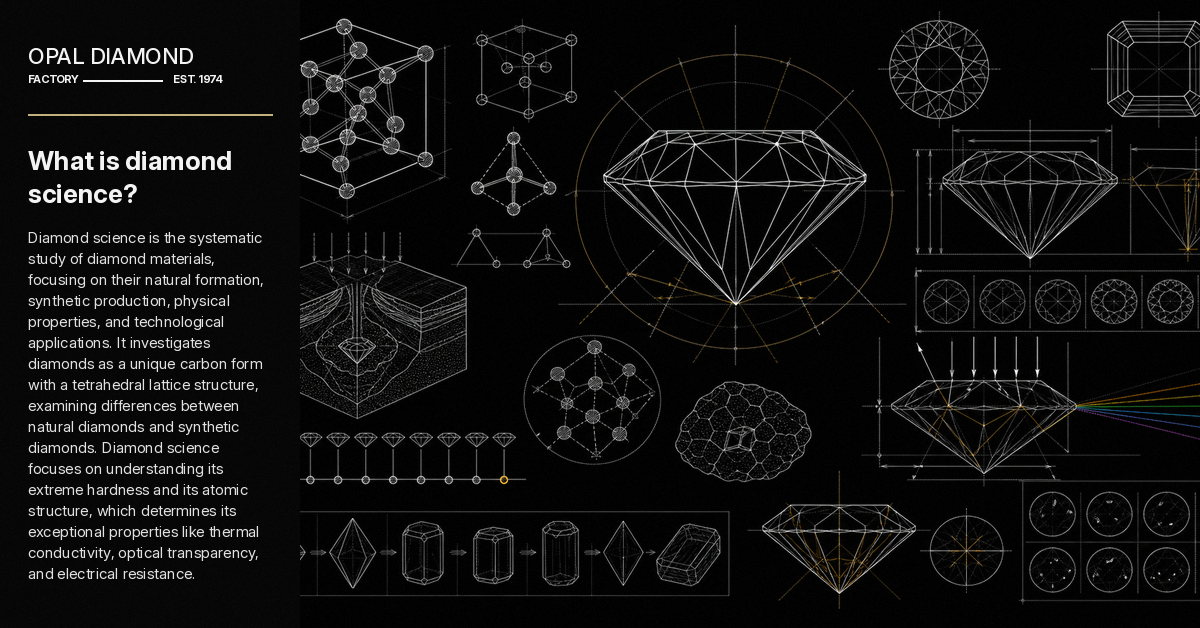
Diamond science is the systematic study of diamond materials, focusing on their natural formation, synthetic production, physical properties, and technological applications. It investigates diamonds as a unique carbon form with a tetrahedral lattice structure, examining differences between natural diamonds and synthetic diamonds. Diamond science focuses on understanding its extreme hardness and its atomic structure, which determines its exceptional properties like thermal conductivity, optical transparency, and electrical resistance.
What are the main properties of diamonds?
Diamonds are extraordinary materials known for their unique physical and chemical properties, which make them valuable in both luxury and industrial applications. Below are the main properties of diamonds that set them apart:
- Hardness: Diamonds are the hardest known natural material, due to their strong atomic lattice structure, making them highly resistant to scratching and wear.
- Optical Properties: Their ability to refract and reflect light gives diamonds their iconic brilliance, fire, and sparkle, making them highly prized as gemstones.
- Thermal Conductivity: Diamonds have exceptional thermal conductivity, which makes them useful in applications requiring efficient heat dissipation, such as electronics.
- Transparency: Gem-quality diamonds are typically transparent, allowing light to pass through with minimal distortion.
- Chemical Stability: Diamonds are chemically inert and resist reactions with most acids and bases.
- Common Crystal Structure: Diamonds have a cubic crystal structure, known as a face-centered cubic or diamond cubic lattice, which forms the foundation of their physical properties.
- Electrical Insulation: While thermally conductive, diamonds are electrical insulators due to the absence of free electrons in their structure.
- High Density: Diamonds have a high density compared to most materials, contributing to their weight and tactile feel in certain applications.
These properties make diamonds highly versatile, valuable, and enduring across a range of fields from jewellery to cutting-edge technologies.
How are diamonds formed?
Diamonds form deep in Earth’s mantle, where extreme conditions enable carbon atoms to crystallize into rigid lattice structures.
The natural formation process:
- Carbon Source: Carbon from organic materials or mantle rocks.
- High Pressure & Temperature:
- Depth: ~150-200 km below Earth’s surface.
- Conditions: 900-1,300°C temperature and pressures exceeding 725,000 PSI.
- Crystallization: Carbon atoms realign into a diamond cubic structure.
- Volcanic Eruption: Diamonds are transported upward through kimberlite pipes.
- Geologic Time: Formation spans millions to billions of years.
Visual summary:
- Pressure: >725,000 psi
- Temperature: >2,000°F
- Depth: ~140-200 km
What is geological crystallography?
Geological crystallography is the evidence-based science of studying how atoms arrange themselves in crystalline materials, with particular focus on the atomic lattice level structure of minerals and rocks. This basic science is crucial for understanding various Types of diamond and the properties of diamond, including their superior hardness and stable form. The field examines how the characteristic of gem diamonds and other minerals arise from their unique crystal structures, leading to discoveries that impact everything from descriptors of diamonds in jewellery to applications in cancer therapy.
Modern crystallography, supported by organisations like ABC Science, has revealed how different forms of carbon known in nature can create varied structures, from the layer of diamond in detonation diamond synthesis to the rare diamond blue specimens. This understanding helps explain diamonds value diamonds not just for their beauty, but also for their industrial applications. The field continues to evolve, using advanced technology to study crystalline structures, providing insights that bridge the gap between theoretical crystallography and practical applications, from gem identification to materials science, all while maintaining a foundation in evidence-based scientific principles.
What is tectonic gemogenesis?
Tectonic gemogenesis is the process by which Earth’s geological forces create diamonds, occurring deep within the mantle. This occurs under extreme pressure and temperature, transforming carbon into crystalline diamond formations. Natural diamonds ascend via kimberlites, rare volcanic rock formations, which serve as transportation channels. Most commercial diamond deposits originated 1-3 billion years ago, making them ancient artifacts of Earth’s tectonic history. Diamond studies continue to explore the relationship between gemstones and Earth’s evolutionary processes.
What is the origin of diamonds in the mantle?
Carbon synthesis in Earth’s mantle occurs through complex geochemical processes under extreme pressure and temperature conditions.
Various carbon sources, including subducted crustal materials and primordial carbon trapped during Earth’s formation, contribute to the mantle carbon reservoir. These carbon compounds undergo transformation into diamond crystal structures when specific thermodynamic conditions are met within the mantle’s reducing environment.
What is mantle carbon synthesis?
Diamonds are primarily found in Earth’s mantle, where extreme pressure and temperature conditions transform carbon into crystalline structures. Carbon dioxide and carbonate rocks descend through subduction zones, converting to high-purity carbon under pressures exceeding 45,000 atmospheres and temperatures above 1000°C. This process occurs primarily at depths of 150-200 kilometers, providing the perfect laboratory for diamond creation over geological timescales.
What is the atomic structure of a diamond?
The atomic structure of a diamond is unique and is the key to its exceptional properties. It is based on a specific arrangement of carbon atoms, which forms the foundation of its strength and durability. Below are the main features of the atomic structure of a diamond:
- Composed of Carbon Atoms: Diamonds are a solid form of carbon, where all atoms are carbon and chemically pure in their ideal state.
- Covalent Bonds: Each carbon atom in a diamond is bonded to four neighboring carbon atoms through strong covalent bonds, creating a highly stable structure.
- Tetrahedral Arrangement: The carbon atoms in a diamond are arranged in a tetrahedral geometry, with each atom forming a pyramid-like structure with its neighbors.
- Diamond Cubic Crystal Structure: Diamonds have a face-centered cubic (FCC) crystal structure, often referred to as the diamond cubic structure, which contributes to their hardness and other unique properties.
- Atomic Lattice: The repeating pattern of carbon atoms forms a three-dimensional atomic lattice, giving diamonds their distinct strength and symmetry.
- Dense Packing: The atoms in a diamond are closely packed, ensuring maximum structural integrity and contributing to its high density.
- Electron Sharing: The covalent bonds involve the sharing of electrons between atoms, ensuring stability and a lack of free electrons, which is why diamonds are electrical insulators.
This precise and uniform atomic structure makes diamonds not only the hardest natural material but also a marvel of nature’s engineering.
What is crystalline bonding geometry?
Diamonds’ unique properties are due to their unique crystalline structure, which consists of eight carbon atoms in a face-centered cubic lattice called the diamond cubic crystal structure. These atoms form strong covalent bonds with four neighboring atoms in a tetrahedral configuration. The most common structure is cubic diamond, while hexagonal diamond (lonsdaleite) is a rare variant. Diamonds can be formed naturally or artificially through chemical vapor deposition, resulting in controlled properties.
What is refractive atomic morphology?
Diamonds possess a unique atomic structure called “refractive atomic morphology” due to their ability to manipulate light. This structure consists of carbon atoms arranged in a tetrahedral lattice, each bonded to four others. This configuration creates exceptional hardness and optical properties, and materials science has developed diamond identification tests. Under extreme pressure, carbon forms a crystalline network with quantum defects, influencing diamonds’ value.
What is facet structural quantum design?
Facet structural quantum design examines how atoms in diamond and their unit cells can be manipulated at the quantum level, building upon our understanding of how the element carbon arranges itself in crystalline structures. This sophisticated process, studied by institutions like the Carbon Observatory, focuses on controlling the placement of atomic defects within diamond’s crystalline lattice, where specific arrangements of atoms per unit cell create quantum bits essential for advanced applications.
Unlike typical igneous rock formation, this engineered approach allows scientists to precisely design diamond structures with predetermined quantum properties. By manipulating nanocrystalline diamond growth and controlling the arrangement of carbon atoms within the crystal structure, researchers can create specialized diamonds that maintain their exceptional mechanical properties while enabling breakthrough applications in quantum computing, sensing, and communications technologies. This marriage of traditional crystallography with quantum engineering represents a significant advancement in our ability to harness diamond’s unique properties for technological innovation.
Why are diamonds so hard?
Diamonds are the hardest natural material due to their unique atomic structure. Below are the key reasons for their exceptional hardness:
- Strong Covalent Bonds: Each carbon atom is bonded to four others through extremely strong covalent bonds, creating a highly robust network.
- Tetrahedral Structure: The atoms are arranged in a rigid tetrahedral configuration, which resists deformation.
- Diamond Cubic Crystal Structure: The repeating cubic atomic lattice ensures a highly stable and tightly packed atomic arrangement.
- Lack of Weak Planes: The uniform structure of diamonds lacks cleavage planes where the lattice can easily break, greatly enhancing hardness.
This tightly bonded and uniform atomic framework makes diamonds capable of enduring extreme forces without scratching or breaking.
What is Mohs scale apex analysis?
While many gemstones exhibit remarkable hardness, diamonds stand atop the Mohs scale at a perfect 10, representing Earth’s hardest naturally occurring substance. Mohs scale apex analysis involves specialized hardness tests that precisely measure a diamond’s resistance to scratching relative to other minerals.
In gemological science international (GSI) evaluations, diamantology experts employ this analysis to verify authenticity and quality of polished diamonds. The diamond industry relies on these measurements as key characteristic descriptors of gem diamonds.
Unlike lower-rated gemstones, diamonds resist virtually all abrasion attempts, making hardness a fundamental parameter in gemstone science classification systems and commercial valuation protocols.
What is carboniferous compression strength?
Carbon atoms form the foundation of diamond’s extraordinary hardness through carboniferous compression strength-the material’s ability to withstand immense pressure without deforming.
This exceptional property develops during diamond formation within Earth’s mantle, where carbon undergoes geological transformation at pressures exceeding 725,000 times atmospheric pressure. The extreme conditions in Earth’s interior force carbon atoms into a rigid tetrahedral diamond crystal structure, creating unparalleled compression strength in the resulting rough diamonds.
Unlike other carbon-based materials, diamonds maintain structural integrity under massive compressive forces. This characteristic makes polycrystalline diamond indispensable for industrial applications requiring materials that can endure extreme mechanical stress without yielding.
What are crystalline abrasive metrics?
Crystalline abrasive metrics provide quantifiable measurements of a material’s resistance to scratching, wear, and deformation-properties that explain diamond’s unrivaled hardness. Diamond scores 10 on the Mohs scale, setting industry standards for both rough diamond evaluation and synthetic diamonds production.
Key metrics include abrasion resistance, fracture toughness, and thermal stability. While fake diamonds may visually resemble genuine stones used in a diamond ring, their crystalline metrics reveal fundamental differences. The unique bonding structure of carbon atoms in diamonds-whether formed naturally in Earth’s core, created through laboratory processes, or produced via detonation methods-enables their exceptional performance as electrode materials and industrial abrasives.
How do diamonds form in nature?
Diamonds form in nature under extreme conditions deep within the Earth’s mantle. Below are the key factors involved in their natural formation:
- High Pressure and Temperature: Diamonds form at depths of about 140-200 kilometers below Earth’s surface, where temperatures range from 900-1,300°C and pressures exceed 45,000 times atmospheric pressure.
- Carbon Source: The process begins with carbon, often from organic materials or carbonate rocks, subjected to extreme mantle conditions.
- Crystal Growth: Under sustained pressure and temperature, carbon atoms bond in a tetrahedral arrangement, forming a diamond’s characteristic structure.
- Volcanic Eruption Transport: Diamonds are brought closer to the Earth’s surface through volcanic eruptions, carried by magma in pipes called kimberlites or lamproites.
- Time: The entire process takes millions, or even billions, of years to complete.
These unique geological conditions make diamonds rare and one of the most remarkable forms of carbon found in nature.
Where are diamonds found?
Deep beneath Earth’s surface, diamonds form under extreme pressure and temperature conditions, typically at depths of 140 to 190 kilometers in the Earth’s mantle. These precious gems reach the surface through volcanic eruptions, carried by magma through kimberlite and lamproite pipes.
Primary diamond sources include mines in Russia, Botswana, Canada, Australia, and South Africa. Alluvial deposits in riverbeds contain gem-quality diamonds eroded from their original geologic settings. Rare blue diamonds emerge from earth’s interior under specific conditions exceeding 50,000 ATM pressure. Fibrous diamonds form through slightly different processes.
Scientists have also discovered extraterrestrial diamonds in meteorites, indicating their formation beyond our planet.
Which minerals help form diamonds?
While diamonds themselves are composed of pure carbon, certain minerals play a role in their formation, either by coexisting with diamonds or by creating the geological conditions necessary for their formation. Below are the key minerals associated with diamond formation:
- Peridotite and Eclogite: These mantle-derived rocks often host diamonds as they are rich in carbon-bearing material and form at the depths and conditions required for diamond crystallization.
- Carbonate Minerals: Minerals such as calcite, magnesite, and dolomite provide a source of carbon for diamond formation under extreme pressure and temperature in the mantle.
- Garnet: Specific garnet varieties, such as pyrope garnet, are common diamond indicators in kimberlite and lamproite pipes and often coexist with diamonds in these geological formations.
- Olivine: This green mineral is often found alongside diamonds in peridotite, helping indicate diamond-rich areas.
- Chromite and Ilmenite: These minerals are often present in kimberlite pipes and serve as indicators of potential diamond presence.
- Graphite: Though not directly involved, graphite-a softer form of carbon under lower pressure-can transform into diamond when subjected to sufficient pressure and heat in the Earth’s mantle.
These minerals, either as carbon sources or geological indicators, contribute to the formation and identification of diamonds in nature.
What is synthetic diamond production?
Synthetic diamond production is the technological process of creating lab-grown diamonds that are chemically, physically, and optically identical to natural diamonds. Here are the key aspects:
- Main Production Methods:
- High-Pressure, High-Temperature (HPHT): Mimics natural diamond formation conditions
- Chemical Vapor Deposition (CVD): Creates diamonds layer by layer in a controlled chamber
- Key Features:
- Production costs have decreased from 4,000to300-500 per carat
- China leads global production with approximately 20 million carats annually
- Quality control is superior to natural diamond mining
- Advanced technology allows for customized properties
- Applications:
- Jewellery industry as a sustainable alternative
- Industrial tools and cutting equipment
- Electronic components
- Scientific research instruments
- Optical devices
- Advantages:
- Environmentally sustainable
- Conflict-free production
- Consistent quality
- Lower cost than natural diamonds
- Controllable properties
The synthetic diamond industry continues to evolve with technological advances, making these diamonds increasingly accessible for both commercial and industrial applications.
What is lab-grown facet precision?
Lab-grown facet precision refers to the exceptional accuracy achieved when cutting synthetic diamonds into specific geometric shapes. This precision is facilitated by the controlled environment of artificial diamonds chemistry, allowing predictable crystal structures unlike natural specimens.
Modern diamondology employs mathematical sciences to calculate exact angles for maximum light refraction. The new method using chemical vapor deposition enables unprecedented control over facet creation, particularly valuable when producing fancy diamonds with unusual geometries.
This precision extends beyond aesthetics to functional applications. Precisely faceted lab-grown diamonds optimize performance in betavoltaic devices and biomedical applications where exact specifications are indispensable for operational success.
What is artificial gemogenesis?
Precisely how do scientists transform mundane carbon into brilliant diamonds? Artificial gemogenesis replicates conditions found in Earth’s mantle through controlled laboratory processes.
The primary method, Chemical Vapor Deposition (CVD), suspends carbon atoms in gas that crystallize onto substrate materials, forming precise carbon lattice structures. High Pressure High Temperature (HPHT) techniques use liquid metals as catalysts while applying extreme pressure to carbon.
Scientific variations in these processes produce lab-created diamonds with customizable properties for both gems and science applications. These techniques yield industrial diamonds for manufacturing and perfect specimens for jewellery-indistinguishable from mined diamonds yet produced through diamond science rather than geological processes.
What are carbon vapour deposition dynamics?
Carbon vapor deposition dynamics represent the cornerstone of modern synthetic diamond production, manipulating carbon atoms at the molecular level. Unlike Earth’s interior conditions where diamonds form naturally, CVD creates tiny diamonds in laboratory settings by decomposing gases by chemical vapor processes. This precisely controlled environment allows carbon lattice atoms to build upon substrates, replicating diamond’s crystalline structure.
The technique harnesses the exceptional potential of diamond as an electrical insulator while minimizing defects. Atmospheric science principles guide temperature and pressure calibration during synthesis, yielding diamonds with tailored properties for industrial applications – a technological achievement that complements natural formation processes.
What are the main uses of diamonds in industry?
Diamonds are highly valued in industry due to their exceptional hardness, thermal conductivity, and durability. Below are the main industrial uses of diamonds:
- Cutting and Drilling: Diamonds are used in cutting tools, saw blades, and drill bits for hard materials such as metal, stone, concrete, and ceramics.
- Polishing and Grinding: Diamond abrasives are essential for polishing and grinding applications, particularly in precision industries.
- Thermal Management: Due to their excellent thermal conductivity, diamonds are used in electronics to dissipate heat in high-performance devices like semiconductors and lasers.
- Optics: Diamonds are utilized in optical applications, such as lenses, windows, and coatings, where high durability and transparency are required.
- Medical Equipment: Diamonds are used in surgical instruments, such as scalpels and dental drills, due to their precision and sharpness.
- Scientific Applications: Diamonds are used in high-pressure experiments, such as in diamond anvil cells, to study material properties under extreme conditions.
- Engraving and Etching: Diamonds enable fine, precise engraving on hard surfaces like glass, metal, and ceramics.
These industrial uses highlight how diamonds’ properties extend far beyond their value as gemstones, making them vital to technological and manufacturing advancements.
Gem-grade vs. industrial diamonds: what’s the difference?
The fundamental distinction between gem-grade and industrial diamonds lies in their structural integrity and optical properties. Gem-grade diamonds, exemplified by specimens like the Hope Diamond or rare red diamonds and pink diamonds, exhibit exceptional clarity, colour, and brilliance, making them sought-after gemstones for jewellery science.
Industrial diamonds, conversely, contain flaws, inclusions, and impurities that compromise their aesthetic value but maintain their mechanical hardness. Both varieties originate in Earth’s mantle under extreme pressure, but undergo different quality assessments.
While gem-grade specimens command astronomical prices, industrial diamonds serve practical applications. Neither type easily succumbs to the destruction of diamond or conversion from diamond to graphite under normal conditions.
What standards measure diamond quality?
Diamond fluorescence refers to the emission of visible light by a diamond when exposed to ultraviolet radiation. The Gemological Institute of America (GIA) grades fluorescence on a scale from None to Very Strong, with most diamonds exhibiting blue fluorescence.
While fluorescence can affect a diamond’s appearance under certain lighting conditions, it is not necessarily a quality defect and may even enhance the stone’s perceived colour in some cases.
What is diamond fluorescence?
Gemstones sometimes reveal hidden traits under specialized lighting conditions, and fluorescence represents one such phenomenon in diamonds. When exposed to ultraviolet light, approximately 30% of diamonds emit a visible glow, most commonly blue. This property originates during formation in the earth’s mantle at temperatures exceeding 1,000 degrees Celsius, where trace elements interact with organic matter.
Diamond fluorescence has fascinated humans for centuries. Gemologists grade it from None to Very Strong, affecting both appearance and value. While some collectors prize this characteristic, others avoid it. Recent research from university press publications suggests fluorescence impacts light performance in ways not fully understood, warranting supplementary video analysis in each chapter diamond examination.
How is diamond authenticity tested?
Several reliable methods exist for verifying diamond authenticity, each examining different physical and optical properties. Gemological testing employs spectroscopy to analyse light absorption patterns unique to natural diamonds. Thermal conductivity tests leverage diamonds’ exceptional heat conductivity compared to simulants.
Refractive Index measurements identify how light bends through the stone, while fluorescence observations detect characteristic responses to ultraviolet light. Specific gravity testing measures density, and inclusion analysis examines internal features visible under magnification. Professional certification laboratories combine these techniques with advanced equipment to distinguish natural diamonds from synthetic stones or other gemstones. These thorough approaches effectively identify diamond simulants marketed as authentic stones.
What are diamond simulants and how are they different?
Diamond simulants are materials, either natural or synthetic, that closely resemble diamonds in appearance but differ in chemical composition and physical properties. Below is an overview of diamond simulants and how they differ from real diamonds:
- Chemical Composition: Unlike diamonds, which are made of pure carbon with a cubic crystal structure, simulants are composed of other materials, such as zirconium dioxide (cubic zirconia), silicon carbide (moissanite), or glass.
- Hardness: While diamonds are the hardest natural material (10 on the Mohs scale), most simulants-like cubic zirconia (8-8.5) or moissanite (9.25)-are slightly softer, making them more prone to scratching.
- Optical Properties: Simulants often differ in brilliance, fire, and luster. For example, cubic zirconia has higher dispersion (fire) than diamond, while moissanite produces a distinctive rainbow-like brilliance.
- Density: Simulants usually have different densities from diamonds. Cubic zirconia, for instance, is denser, making a stone of the same size heavier than a diamond.
- Thermal Conductivity: Diamonds are excellent thermal conductors, a property that is often tested to distinguish them from simulants. Most simulants, except moissanite, are poor thermal conductors.
- Cost: Simulants are significantly less expensive than natural or lab-grown diamonds, making them a popular alternative for budget-conscious consumers.
- Durability: Simulants generally lack the same level of durability as diamonds, making them more prone to wear over time.
While diamond simulants mimic the visual appeal of diamonds, their differing physical and chemical properties make them distinguishable through specialized testing or closer inspection.
What are new scientific findings in diamond research?
The landscape of scientific research on diamonds has evolved dramatically in recent years, yielding breakthroughs that extend far beyond traditional gemology.
Studies of earth’s interior reveal conditions creating diamond rain on gas giants. Researchers from Cambridge University Press and Macquarie University have discovered how diamonds form in earth’s mantle and identified new applications using gallium in biological sciences, potentially revolutionizing how the biggest diamonds are synthesized.