
Diamond mining is the extraction of rough diamonds from primary deposits in kimberlite pipes and secondary sources like alluvial diamonds found in riverbeds and offshore gravel layers. Major producers like Rio Tinto’s Argyle Diamond Mine and the Diavik Diamond Mine supply three types of diamonds: gem-quality, industrial, and rare coloured varieties like pink diamonds. Mining operations use three main processes: primary and secondary crushers, cyclonic separation plants, and dense media separation with ferrosilicon solutions.
Advanced mechanical systems ensure efficient recovery while managing excess material and environmental impact. The industry transforms recovered rough diamonds into polished gemstones known for their hardness and ability to emit brilliant flashes of light.
The diamond gemstone guide helps place this detail in context.
Challenges such as carbon emissions and toxic chemicals persist, but advancements in renewable energy and ethical trade have improved sustainability in regions like the Northwest Territories and the Orange River.
What is the history of diamond mining?
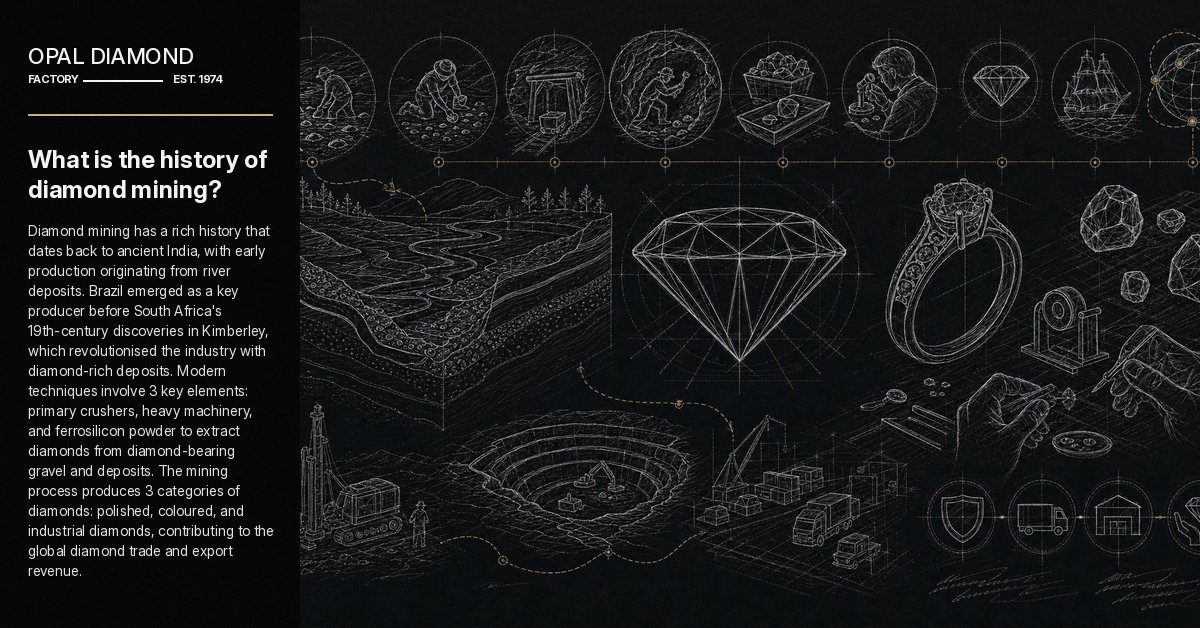
Diamond mining has a rich history that dates back to ancient India, with early production originating from river deposits. Brazil emerged as a key producer before South Africa’s 19th-century discoveries in Kimberley, which revolutionised the industry with diamond-rich deposits. Modern techniques involve 3 key elements: primary crushers, heavy machinery, and ferrosilicon powder to extract diamonds from diamond-bearing gravel and deposits. The mining process produces 3 categories of diamonds: polished, coloured, and industrial diamonds, contributing to the global diamond trade and export revenue.
Today, 2 factors shape the industry: offshore operations and sustainable practices, with producers in 3 countries, Canada, Australia, and Africa, focusing on reducing carbon footprint and harnessing advanced recovery processes. Diamonds possess 2 key properties, hardness and light-reflecting brilliance, that make them essential for 2 markets: luxury markets and industrial uses. Innovations in mining ensure a steady supply of pink diamonds and support rich global exploration.
Which countries mine the most diamonds?
Several countries dominate global diamond production, contributing significantly to both gem-quality and industrial diamonds. These nations host some of the largest diamond deposits and mining operations in the world.
|
Country |
Key Characteristics |
|---|---|
|
Russia |
The largest producer of diamonds by volume, Russia extracts vast quantities from kimberlite and alluvial deposits, with ALROSA leading production. |
|
Botswana |
Known for high-quality diamonds, Botswana produces substantial carats annually from 2 major mines: Jwaneng and Orapa. |
|
Canada |
A significant source of gem-quality diamonds, Canada operates 2 advanced and sustainable mines: Diavik and Ekati. |
|
Democratic Republic of Congo (DRC) |
Specialising in industrial diamonds, the DRC has abundant diamond-rich alluvial deposits. |
|
Australia |
Famous for coloured diamonds, including pink diamonds from the Argyle Diamond Mine, Australia remains a key producer. |
|
South Africa |
A historic diamond hub, South Africa continues to mine notable quantities from kimberlite and alluvial sources. |
|
Namibia |
Renowned for offshore diamond mining, Namibia recovers high-value diamonds from marine deposits along its coastline. |
What is subterranean gem retrieval?
Subterranean gem retrieval is a process that extracts diamonds from deep beneath the Earth’s surface using advanced mining techniques. This process involves accessing diamond sources through tunnels and shafts and uses 3 main components: heavy-density materials, rotating drums, and ferrosilicon powder to separate the diamond-rich concentrate. The process involves 3 additional elements: flexible pipes, magnetic susceptibility, and acid solutions to isolate diamonds and ensure tamper-resistant collection.
The process uncovers 2 types of diamonds: polished diamonds and industrial diamond powder, which are valuable as domestic products and represent a vital mineral resource to the diamond market. Subterranean operations contribute to the mining industry’s production of real diamonds, including 2 specific kinds: antique diamonds and rare Argyle Pink Diamonds. Despite 2 challenges, energy consumption and lab-grown diamond alternatives, real diamonds remain a precious legacy in 2 areas: industries like jewel bearings and the global diamond trade.
What are the geological facets of extraction?
The geological facets of extraction focus on identifying and targeting 2 diamond-bearing formations: kimberlite pipes and alluvial deposits formed by volcanic activity. Diamonds, created from carbon atoms under intense heat and pressure, are found in layers of diamond-rich material. Two processes, magnetic susceptibility and dense media separation, using a solution of ferrosilicon powder, isolate diamonds from heavy density materials.
Mining operations employ 2 methods: crushers and recovery techniques to extract a rich concentrate, yielding 3 types of diamonds: gem-quality stones, coloured diamonds, and industrial diamonds. These geological features shape the complex process of retrieving diamonds from 2 types of deposits: terrestrial and offshore deposits.
How is carbon crystalline harvesting done?
Carbon crystalline harvesting creates diamonds by converting carbon atoms into a crystal lattice using 1 of 2 methods: High-Pressure High-Temperature (HPHT) or Chemical Vapour Deposition (CVD). HPHT replicates the Earth’s mantle conditions, if precise temperature and pressure are applied. CVD uses carbon-rich gases to deposit layers of carbon onto a diamond seed, if a controlled environment is maintained. These processes, controlled for 2 properties, purity and hardness, produce lab-grown diamonds identical to natural ones, serving 2 purposes: gem and industrial purposes.
What is refractive resource mapping?
Refractive resource mapping is the analysis of how light refracts through geological materials to identify resource-rich deposits, such as diamonds. It uses 2 optical properties, refractive index and density contrasts, to detect diamonds within host materials. Advanced technologies, including 2 specific tools, laser scanning and imaging, help pinpoint diamond-bearing formations, aiding efficient exploration and extraction.
Where are diamonds mined?
Diamonds are mined in regions rich in 2 types of diamond-bearing deposits: kimberlite pipes and alluvial sources. Key countries include 7 major producers: Russia, the largest diamond producer by volume; Botswana, known for high-quality gems; Canada, with advanced sustainable mines; South Africa, a historic producer; Namibia, excelling in offshore diamond mining; Australia, producing coloured diamonds such as pink diamonds; and the Democratic Republic of Congo, focusing on industrial diamonds. Other sources include 3 additional locations: Angola, Zimbabwe, and emerging producers in regions like India and Brazil.
What is gemological geography?
Gemological geography is the study of the geographic distribution and formation of gemstones, including diamonds, in relation to geological processes. It examines how 3 factors, volcanic activity, plate tectonics, and erosion, create gemstone deposits in specific regions. This field identifies locations of 2 primary sources, such as kimberlite pipes, and secondary sources, such as alluvial deposits, while exploring 3 environmental and mineralogical conditions that influence gemstone quality, occurrence, and accessibility.
What is global crystalline distribution?
Global crystalline distribution refers to the worldwide occurrence and arrangement of naturally formed crystalline materials, including diamonds, based on geological processes. These materials are concentrated in specific regions due to 3 geological events: tectonic activity, volcanic eruptions, and sedimentary processes.
Diamonds, for example, are found in 2 types of deposits: primary deposits like kimberlite pipes in regions such as Russia, Botswana, and Canada, and in secondary alluvial deposits in river systems like the Orange River. The distribution reflects Earth’s historical geodynamics, influencing 2 aspects: mining activities and access to crystalline resources.
How is diamond mining done?
Diamond mining is the extraction of diamonds from Earth’s crust, primarily in 2 types of deposits: primary deposits like kimberlite pipes and secondary deposits in riverbeds or marine environments. There are 3 main methods: open-pit mining, underground mining, and offshore extraction using tools such as shark cages and shore diving. Diamonds are separated during recovery using 3 tools: density sinks, crushers, and advanced processing plants. Water sources, such as lake water and rivers, also play a role in alluvial mining.
Offshore diamond mining focuses on marine deposits, while pit diamond mines are key for accessing Earth’s largest diamond reserves. The mining process uncovers natural minerals, which possess 2 notable characteristics: unmatched hardness on the Mohs scale and flashes of light emitted after polishing. These diamonds are often processed in joint ventures and exported as 2 categories: luxury exports or industrial diamond dust. Modern practices address 2 concerns: ethical concerns and preserving the legacy of diamond formation over a human time scale.
What tools mine diamonds?
Various specialised tools are used to mine diamonds, aiding in the extraction, processing, and recovery of these gemstones. These tools are designed to efficiently target diamond-bearing materials in 3 different mining environments: open-pit, underground, and alluvial/marine.
|
Tool |
Description |
|---|---|
|
Excavators |
Heavy machinery used to remove overburden and access diamond-bearing material in 2 types of mines: open-pit and alluvial mines. |
|
Primary Crushers |
Machines that break down large rocks containing diamond deposits for easier processing. |
|
Secondary Crushers |
Further process broken ore into smaller pieces to isolate diamond-bearing gravel. |
|
Dense Media Separation Equipment |
Utilises a solution of ferrosilicon powder to separate diamonds from heavy-density materials based on their density sink. |
|
X-ray Sorting Machines |
Detect and recover diamonds using their ability to fluoresce under X-rays. |
|
Laser Scanners |
Precisely sort gem-quality diamonds based on 2 factors: size and shape. |
|
Flexible Pipes |
Used in offshore diamond mining to transport diamond-bearing gravel from marine environments. |
|
Rotating Drums |
Separate diamonds by size through mechanical sieving during the recovery process. |
|
Collection Boxes |
Tamper-resistant containers used to securely store recovered diamonds. |
|
Blast Drills |
Create holes for controlled explosions to release diamond ore in underground mining. |
|
Suction Dredgers |
Extract diamond-bearing material from the ocean floor in offshore operations. |
|
Handheld Tools |
Simple mining implements, such as picks and shovels, used historically and in small-scale operations. |
What is open-pit mining?
Open-pit mining is a surface mining method used to extract diamonds from near-surface deposits, such as kimberlite pipes. Heavy machinery removes rock and soil in large pits to access diamond-bearing ore, which is processed using 3 main techniques: crushing, dense media separation, and sorting technologies. Common in 2 diamond-rich regions, Botswana and Canada, open-pit mining efficiently retrieves diamonds while requiring environmental management.
How does underground mining work?
Underground mining extracts diamonds from deep deposits, such as kimberlite pipes, that are unreachable by surface mining. Tunnels and shafts are constructed to access diamond-rich ore beneath the surface. Techniques, such as block caving, use controlled blasts to break ore, while gravity aids its collection. Diamond-bearing material is transported to the surface using 1 of 2 methods: conveyor belts or haul trucks.
At processing plants, the ore undergoes 2 stages: crushing and dense media separation with ferrosilicon solutions to isolate diamonds. Advanced sorting methods, including 2 technologies, X-ray and laser technology, are used to recover gem-quality diamonds. Underground mining allows access to deeper reserves while requiring extensive safety measures to maintain 2 critical aspects: structural stability and minimize the environmental impact of diamonds.
What is artisanal mining?
Artisanal mining is a small-scale mining practice where individuals or small groups manually extract minerals, including diamonds, using 3 simple tools: shovels, pans, and sieves. It often targets 2 types of deposits: alluvial deposits in riverbeds or shallow layers of diamond-bearing gravel. Artisanal mining delivers raw diamonds with minimal machinery or advanced technology, emphasising 2 things: physical labour and traditional methods.
While it provides livelihoods for many, it is often informal and associated with 3 negative outcomes: environmental degradation, unsafe working conditions, and the presence of blood diamonds. However, artisanal mining remains a significant source of diamonds in 2 regions, Africa and South America, contributing to local economies. Efforts to formalize and regulate artisanal mining continue to reduce its 2 main challenges: social and environmental challenges.
What types of diamond mines exist?
Diamond mines are classified based on 2 factors: the geological nature of the deposits and the methods used to access them. These types of mines are designed to recover diamonds efficiently from various environments.
|
Type of Mine |
Description |
|---|---|
|
Open-Pit Mines |
Large surface mines that remove layers of rock and soil to access diamonds in kimberlite pipes close to the surface. |
|
Underground Mines |
Deep mines that use tunnels and shafts to extract diamonds from deposits located far beneath the Earth’s surface. |
|
Alluvial Mines |
Operate in riverbeds and floodplains to recover diamonds transported by natural erosion, often using 2 simple methods: sieving or dredging. |
|
Marine Mines |
Extract diamonds from the seabed by vacuuming or dredging diamond-bearing gravel in offshore operations. |
|
Artisanal Mines |
Small-scale, often manual mining operations targeting shallow deposits, such as riverbeds, with hand tools. |
|
Secondary Deposits |
Mines focusing on diamonds relocated from their original kimberlite source into sedimentary environments, including shorelines. |
These types of mines target the unique distribution of diamond deposits and adapt to 2 kinds of conditions: environmental and geological conditions.
What is the carboniferous disruption index?
The Carboniferous Disruption Index refers to a theoretical measure or concept used to evaluate the extent of geological or environmental changes during the Carboniferous Period. This geologic interval, spanning approximately 358.9 to 298.9 million years ago, saw 3 significant shifts: the assembly of the supercontinent Pangaea, widespread glaciations, and the development of extensive coal-forming tropical forests.
The index could hypothetically quantify 3 types of changes: shifts in biodiversity, alterations in carbon cycles, and the impact of tectonic and climatic events on ecosystems and sedimentary environments during this period.
What are the externalities of gem extraction?
The externalities of gem extraction refer to the unintended environmental, social, and economic consequences arising from mining practices.
These include 5 main categories:
- Environmental Impact: Deforestation, habitat destruction, water pollution from mining runoff, and soil erosion disrupt ecosystems. Two types of mining, open-pit and alluvial mining, can also degrade water sources and increase carbon emissions.
- Social Issues: Two types of mining, artisanal and unregulated mining, can lead to 3 problems: unsafe working conditions, child labor, and the exploitation of local communities in mining regions.
- Economic Inequities: While gem exports generate revenue, the benefits often fail to reach local populations, resulting in 2 outcomes: uneven wealth distribution and reliance on volatile markets.
- Conflict Diamonds: The mining and trade of blood diamonds have fueled violence and civil wars in certain regions, creating 2 long-lasting issues: social and political instability.
- Resource Depletion: Over-mining can exhaust finite diamond and gemstone deposits, threatening long-term availability.
Efforts to address these externalities include 3 approaches: ethical regulations, certification schemes such as the Kimberley Process, and sustainable mining practices.
What is the impact of diamond mining?
Diamond mining impacts the environment through 4 main ways: deforestation, ecosystem disruption, water pollution, and greenhouse gas emissions. Socially, it can involve 3 negative aspects: worker exploitation, community displacement, and the trade of blood diamonds. Economically, it supports 3 positive outcomes: global trade, generates revenue, and provides jobs, though benefits are often unevenly distributed. Three measures, sustainable practices, ethical certifications such as the Kimberley Process, and lab-grown diamonds, aim to reduce these negative effects.
How is diamond mining controlled?
Diamond mining is controlled through 3 main mechanisms: regulations, ethical certifications, and industry oversight to ensure responsible practices. Governments enforce laws on 3 areas: mining licenses, environmental protection, and labor standards, if compliance is monitored. Certifications, such as the Kimberley Process, prevent the trade of conflict diamonds. Two entities, diamond bourses and international organizations, monitor the diamond trade, ensuring 2 key elements: transparency and ethical sourcing. Technological advancements, such as blockchain tracking, further improve traceability of diamonds from mines to markets.
What are lapidary ecological dynamics?
Lapidary ecological dynamics involve the environmental impact of cutting and polishing gemstones, including 3 factors: water use, energy consumption, and diamond dust waste. Two key concerns are pollution from polishing agents and the carbon footprint of operations. Two sustainable practices, renewable energy and proper waste management, reduce these effects.
What are the environmental effects?
The environmental effects of mining and gemstone processing are varied, with significant impacts on ecosystems and resources.
There are 6 key effects:
- Habitat Destruction: Two actions, deforestation and land clearing, disrupt ecosystems and biodiversity.
- Soil Erosion: Mining activities remove topsoil, leading to land degradation.
- Water Pollution: Runoff containing 2 substances, chemicals and heavy metals, contaminates water sources.
- Excessive Water Use: Two processes, mining and polishing, deplete local water sources, affecting availability for 2 groups: communities and ecosystems.
- Greenhouse Gas Emissions: Energy consumption during 2 activities, mining and processing, contributes to increased carbon footprints.
- Waste byproducts: Improper disposal of 2 mining residues, such as diamond dust and chemical agents, pollutes the surrounding environment.
Efforts to combat these effects include 3 methods: sustainable mining methods, proper waste management, and renewable energy adoption to reduce overall environmental impact.
How does mining affect wildlife?
Mining affects wildlife by disrupting ecosystems, damaging habitats, and altering natural processes essential for species survival.
There are 6 key effects:
- Habitat Destruction: Land clearing for mining operations removes vegetation and displaces wildlife.
- Fragmentation: Mining infrastructure, such as 2 structures, roads and pits, divides habitats, restricting 2 wildlife activities: movement and breeding.
- Water Contamination: Mining runoff pollutes water sources, harming 2 things: aquatic ecosystems and the animals that rely on them.
- Noise and Light Disturbance: Two elements, heavy machinery and artificial lighting, disrupt 3 animal behaviors: hunting, mating, and migration.
- Toxic Exposure: Chemicals and heavy metals from mining contaminate 2 areas, soil and food chains, leading to 2 outcomes: poisoning and population declines.
- Invasive Species: Mining operations can introduce non-native species that outcompete local wildlife.
How do communities gain from mining?
Mining can benefit communities through 3 main avenues: job creation, economic growth, and infrastructure development. It boosts local businesses, generates government revenue through 2 sources, taxes and royalties, and funds 2 community programs: education and healthcare. Responsible mining can also provide 3 additional benefits: skills training, promote technology transfer, and restore land post-mining for long-term use.
What risks does diamond mining pose?
Diamond mining poses various risks to the environment, communities, and workers, if not conducted responsibly. Below are 10 key risks associated with diamond mining:
|
Risk Category |
Specific Risks |
|---|---|
|
Environmental Damage |
Destruction of ecosystems, deforestation, and water pollution from mining operations. |
|
Soil Erosion |
Open-pit mining can lead to soil erosion and loss of arable land. |
|
Water Depletion |
Excessive water use can reduce local water availability for communities. |
|
Loss of Biodiversity |
Mining may disrupt habitats, threatening local flora and fauna. |
|
Health and Safety |
Miners face risks such as injuries, accidents, and exposure to harmful dust and chemicals. |
|
Labor Exploitation |
Unethical mining practices may involve child labor or unfair wages. |
|
Conflict Financing |
Illegal trade of diamonds may fund armed conflicts. |
|
Community Displacement |
Mining projects can displace populations, leading to loss of homes and livelihoods. |
|
Economic Inequality |
Benefits often go to corporations or elites, leaving local communities with minimal gains. |
|
Cultural Disruption |
Mining projects can harm indigenous cultures and traditions. |
What happens to diamonds after mining?
After mining, diamonds go through 7 steps before reaching consumers. Below is an overview of the process:
- Sorting and Grading: Newly mined diamonds are sorted and graded based on 4 characteristics: size, colour, clarity, and quality.
- Cutting and Polishing: Rough diamonds are sent to specialised facilities where they are cut and polished into desired shapes (e.g., round, princess, oval) to maximise 2 aspects: brilliance and value.
- Certification: High-quality diamonds are certified by organisations, such as the Gemological Institute of America (GIA), to verify their 2 attributes: quality and authenticity.
- Trading: Diamonds are traded in global markets and exchanges, such as Antwerp, Dubai, or Mumbai, where they are sold to 2 types of buyers: manufacturers or retailers.
- Jewellery Manufacturing: Cut and polished diamonds are used to create jewellery, such as 3 items: engagement rings, necklaces, and earrings.
- Retail Sales: Finished diamond jewellery is sold to consumers through 2 channels: retail stores or online platforms.
- Recycling and Resale: Some diamonds are resold or repurposed, contributing to the secondary market.
Throughout this 7-step process, 3 elements, ethical sourcing, certification, and traceability, are essential to ensure the diamonds meet international standards and avoid funding 2 negative outcomes: conflict or exploitation.
How are diamonds processed?
After mining, diamonds are sorted by quality, with gem-quality stones sent for 2 processes: cutting and polishing to maximise brilliance and value. They are then graded and certified by gemological labs to verify their 4 key attributes: carat, colour, clarity, and cut. Finally, certified diamonds are traded globally or sold for use in jewellery, with a focus on 2 important aspects: ethical sourcing and traceability.
How do diamonds reach the market?
Diamonds reach the market through a 5-step process. After mining, they are sorted and graded based on quality. Gem-quality diamonds undergo 2 actions: cutting and polishing to maximise brilliance and value. These polished diamonds are then certified by gemological labs to verify 4 key attributes: carat, colour, clarity, and cut. Certified diamonds are sold to 2 types of entities: traders or wholesalers, who distribute them to retailers. Retailers then sell them to consumers through 2 main channels, brick-and-mortar stores or online platforms, completing the journey from mine to market.
How do buyers avoid conflict diamonds?
Buyers can avoid conflict diamonds by purchasing from reputable jewellers, verifying certifications such as the Kimberley Process, and ensuring ethical sourcing through documentation. Two additional methods, researching supply chains or choosing lab-grown diamonds, are also effective ways to support responsible and conflict-free practices.
What new technologies help mining?
New technologies transforming mining include 3 main categories: automation, artificial intelligence (AI), and data analytics, which enhance 2 aspects: operational efficiency and safety. Autonomous trucks and drones reduce human involvement in hazardous areas, if conditions are suitable. AI optimises 2 things: drilling patterns and resource extraction.
Data analytics enables 3 functions: real-time monitoring, predictive maintenance, and better planning. Green technologies, such as 2 examples, energy-efficient equipment and water recycling systems, support sustainability efforts. Four innovations, digital twins, geometallurgy, blockchain, and advanced sensors, further improve 3 areas: decision-making, waste management, and supply chain transparency, shaping the future of mining.
What is the future of diamond mining?
The future of diamond mining is shaped by 3 key factors: advancements in technology, increased focus on sustainability, and shifting consumer preferences toward ethical sourcing. Emerging technologies, such as AI, automation, and advanced geological tools, are improving 2 aspects: efficiency and accuracy in resource extraction. The industry is prioritising sustainability through 3 practices: reducing environmental impact, enhancing water and energy management, and adopting renewable energy in mining operations.
Ethical considerations, including 2 specific areas, responsible sourcing and supply chain transparency, are becoming essential as consumers increasingly demand 2 types of diamonds: conflict-free and environmentally responsible diamonds. These trends, along with innovations in lab-grown diamonds, are transforming 2 things: the diamond mining industry’s practices and long-term outlook.