
Diamonds have a geological history spanning billions of years, beginning with their crystallization in the Earth’s mantle and being transported to the surface via volcanic pipes. By the 13th century, they became symbols of wealth and authority, particularly impacting European aristocracy. Key figures like Alexander the Great and Sir Thomas Cullinan are associated with pivotal moments in diamond history, particularly in the 18th century when significant diamond deposits, including Indian diamonds, increased the global supply of gem-quality diamonds.
The demand for diamonds presents ethical challenges, such as the blood diamond conflict, which highlights human rights violations linked to diamond rough mining. Understanding the atomic structure of diamonds, identification tests, and grading methods is essential.
This detail is part of the wider diamond quality guide.
The diamond industry’s relationship between luxury and ethics is complex, involving aspects such as diamond recovery, the use of diamond anvil cells, and gem diamond characteristics.
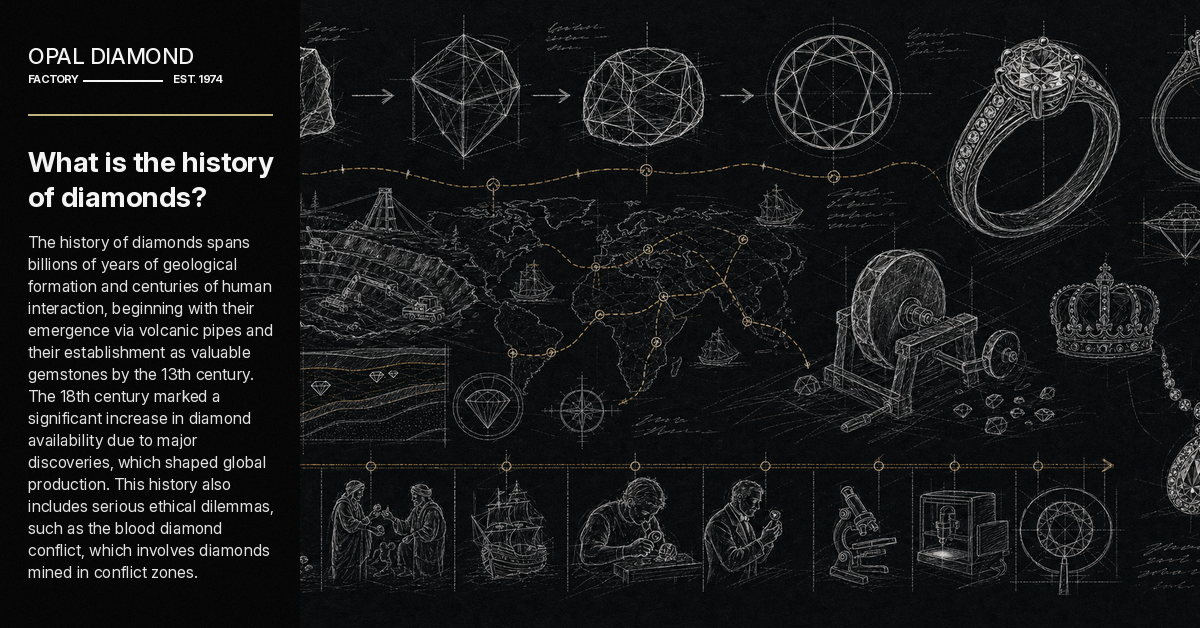
What is the history of diamonds?
The history of diamonds spans billions of years of geological formation and centuries of human interaction, beginning with their emergence via volcanic pipes and their establishment as valuable gemstones by the 13th century. The 18th century marked a significant increase in diamond availability due to major discoveries, which shaped global production. This history also includes serious ethical dilemmas, such as the blood diamond conflict, which involves diamonds mined in conflict zones. Understanding diamonds requires exploring their atomic structure, their specific grading methods, and these important ethical considerations, as they represent both natural beauty and complex societal implications in the modern world.
Where were diamonds first found?
Diamonds were first found in three primary ancient locations: India, Brazil, and South Africa, with these discoveries shaping their historical and economic significance.
| Region | Approximate Discovery Period | Key Details | Notable Entities/Locations |
|---|---|---|---|
| India | 4th Century BC | First recorded discovery; diamonds found in riverbeds, particularly along the Krishna River. | Golconda region |
| Brazil | Early 18th Century | Became the second major global source of diamonds after India’s deposits began to deplete. | Minas Gerais |
| South Africa | Late 19th Century (c. 1866) | Discovery by 15-year-old Erasmus Jacobs near the Orange River led to major mining operations and diamond rushes. | Kimberley, Orange River |
How are diamonds formed?
Diamonds are formed deep within the Earth’s upper mantle under conditions of extreme high pressure and high temperature acting on carbon-containing materials over geological timescales. This natural formation process involves 4 main stages:
- Extreme Conditions: Diamonds crystallise at depths of approximately 150 to 200 kilometers (93 to 124 miles), where pressures exceed 725,000 pounds per square inch and temperatures range from 1,300 to 2,200 degrees Fahrenheit (700 to 1,200 degrees Celsius).
- Carbon Source: The essential element for diamond formation is carbon, derived from pre-existing carbon-rich fluids or rocks, which under these conditions arranges into a strong covalent network solid with a diamond lattice structure.
- Geological Timescales: This metamorphic transformation process from carbon source to crystal typically requires millions to billions of years.
- Volcanic Transport: Diamonds are transported to the Earth’s surface rapidly through deep-source volcanic eruptions, emplaced in igneous rocks known as kimberlite pipes and lamproite pipes.
- Synthetic Replication: Humans replicate these conditions using 2 main methods, High Pressure High Temperature (HPHT) and Chemical Vapor Deposition (CVD), to produce synthetic diamonds.
What is the carbonaceous chronology of diamonds?
The carbonaceous chronology of diamonds outlines the geological history of their carbon sources and the multi-billion-year timeframe required for their crystallization within the Earth’s mantle. Carbon, naturally present in the Earth’s mantle and sometimes originating from subducted organic materials or ancient carbonate rocks, transforms into diamonds under intense pressure and temperature over periods ranging from 1 billion to over 3.3 billion years.
During their formation, diamonds can incorporate mineral inclusions, such as olivine, garnet, and pyroxene, which provide geochemists with valuable data about the conditions and composition of the Earth’s mantle at the time of diamond genesis. Understanding this chronology assists in tracing the specific origins of diamonds and their journey from deep Earth environments to their eventual surface discovery, offering insights into the Earth’s carbon cycle and its long-term geological evolution.
When did people first use diamonds?
People first used diamonds around 2500 BCE during the Sumerian period in Mesopotamia, where they were primarily valued as potent talismans. Initially, these hard stones were not employed for jewelry but were believed to offer protection and signify power. The use of diamonds in jewelry began approximately 3,000 years ago after early diamonds were mined in India. A notable early incorporation of diamonds into European jewelry is exemplified by the Hungarian queen’s crown, dating to 1074. The tradition of using diamonds in engagement rings commenced in the 15th century, specifically in 1477, when Archduke Maximilian of Austria presented a diamond ring to Mary of Burgundy.
What are the oldest diamonds?
The oldest diamonds, some estimated to be approximately 4 billion years old, offer invaluable insights into Earth’s early geological conditions. These ancient gemstones have been discovered in a few key global locations.
| Diamond Name/Location | Estimated Age | Significance |
|---|---|---|
| Jack Hills Zircon Diamonds | Up to 4.25 billion years old | Found within zircon crystals in Western Australia; provide clues about early Earth conditions. |
| Diavik & Ekati Mine Diamonds | 3.3 to 3.5 billion years old | Sourced from mines in Canada’s Northwest Territories; pre-date atmospheric oxygen rise. |
| Other Ancient Diamonds | Approximately 2.6 billion years | Found in various locations, including South Africa and Australia, marking significant geological events. |
While famous historical diamonds, such as the Koh-I-Noor and the Hope Diamond, possess significant cultural and historical value dating back several centuries, their geological ages are considerably younger than these primordial specimens.
How were diamonds mined in ancient times?
Diamonds were mined in ancient times primarily through 2 main methods: surface collection in alluvial deposits within riverbeds and shallow open-pit digging into weathered primary deposits. In India, the first significant source, miners manually sifted through river gravel and sand to find rough diamonds. These recovered diamonds, often measured in carats, were regarded as valuable gemstones. The extraction process involved basic tools, such as shovels and baskets, and depended on considerable manual labor. Miners would dig shallow pits to access primary diamond deposits embedded in weathered igneous host rocks, like kimberlite.
How has lapidary evolved in diamond history?
Lapidary, the art of cutting and polishing diamonds, has evolved through 4 key stages of development, progressing from rudimentary shaping to precise, technologically assisted faceting.
- Early Rudimentary Shaping (Pre-14th Century): Initial methods in India involved basic rubbing or minimal faceting to slightly improve the natural brilliance of rough diamonds.
- Introduction of Simple Cuts (14th-17th Centuries): The point cut, which followed the diamond’s natural octahedral shape, and the table cut, which created a flat top surface, were among the first systematic cutting styles developed, primarily in Europe.
- Development of Complex Cuts (15th-18th Centuries): More sophisticated techniques emerged, including the rose cut in the 15th century, which featured a flat base and a domed crown with triangular facets to maximise sparkle. The brilliant cut was further developed in the 18th century by Vicenzo Peruzzi, optimising light performance through precise angles and an increased number of facets.
- Modern Precision Cutting (19th Century – Present): Technological advancements, including the invention of the bruting machine, diamond saws, and precision grinding tools, transformed lapidary. Today, modern techniques incorporate computer-aided design (CAD) and laser cutting, enabling highly intricate designs, consistent quality, and the creation of numerous standardised cuts, such as the princess cut, emerald cut, and oval cut.
Who first traded diamonds internationally?
The first known significant international diamond trader was Jean-Baptiste Tavernier, a 17th-century French gem merchant and traveler. Tavernier undertook six major journeys to Persia and India between 1630 and 1668, sourcing diamonds directly from mining areas, including the renowned Golconda region. His detailed accounts of these voyages and descriptions of large diamonds, such as the precursor to the Hope Diamond, significantly influenced European understanding and desire for these precious stones, laying critical groundwork for the subsequent expansion of global diamond commerce.
What is the alluvial provenance of diamonds?
The alluvial provenance of diamonds describes their secondary geological origin, where diamonds are naturally transported from their primary kimberlitic or lamproitic host rocks by water systems and subsequently deposited in riverbeds, floodplains, or coastal sediments. Diamonds initially formed deep within the Earth are brought to the surface by volcanic eruptions. Over geological time, weathering and erosion of these primary deposits release the diamonds.
Rivers and streams then carry these durable gemstones, often over considerable distances, eventually concentrating them in alluvial deposits. Understanding the specific alluvial provenance is crucial for effective diamond exploration, as it allows geologists and miners to trace these deposits back to potential primary sources, assess the quality and quantity of diamonds, and implement mining practices that consider the environmental context of these secondary deposits.
What is primordial gemogenesis in diamonds?
Primordial gemogenesis in diamonds is the original formation process of these gemstones from ancient carbon sources deep within the Earth’s upper mantle, occurring under extreme geological conditions of high pressure and high temperature over billions of years. This process typically takes place at depths between 150 and 200 kilometers. The carbon atoms, originating from primordial materials present since the early Earth or from subducted crustal carbon, bond into the characteristic diamond crystal lattice structure.
Primordial diamonds formed through this genesis can contain minute inclusions of other mantle minerals, such as olivine, garnet, and chromite, which provide scientists with valuable insights into the Earth’s mantle composition and the specific historical geological processes active during the diamond’s formation.
What is geo-crystalline synthesis in diamond formation?
Geo-crystalline synthesis in diamond formation is the natural crystallization process where carbon-rich materials transform into diamonds under specific high-pressure and high-temperature geological conditions found deep within the Earth’s upper mantle. This synthesis typically occurs at depths of 150 to 200 kilometers. During this process, carbon atoms, subjected to intense pressure (often exceeding 5.5 gigapascals) and heat, arrange themselves into the highly ordered and stable diamond crystal lattice.
Factors such as the subduction of tectonic plates can introduce carbon-bearing materials into the mantle, facilitating this synthesis. These naturally synthesised diamonds are subsequently transported to the Earth’s surface via kimberlite and lamproite magmas during volcanic eruptions.
What are tectonic carboniferous dynamics in diamond history?
Tectonic carboniferous dynamics in diamond history explain how large-scale tectonic plate movements influence the formation and subsequent geological distribution of diamonds by subducting carbon-rich sediments and oceanic crust into the Earth’s mantle, leading to diamond crystallization and the eventual formation of kimberlite pipes that transport them to the surface. When tectonic plates converge, significant quantities of carbon-rich materials, such as marine sediments and altered oceanic basalt, can be carried deep into the mantle.
Within specific pressure-temperature windows in the mantle (the diamond stability field), this subducted carbon can crystallise into diamonds, forming the characteristic diamond cubic structure. These tectonic dynamics are also intrinsically linked to the generation of magmas that form kimberlite and lamproite pipes, the primary conduits for diamond transport to the Earth’s crust. This process is particularly evident in the formation of major diamond deposits within cratonic regions, such as those in the African diamond industry, which yields both primary (kimberlitic) and secondary (alluvial) diamonds, including famous large diamonds which contribute significantly to annual world diamond production.
What was india’s role in diamond history?
India’s role in diamond history was foundational, serving as the world’s primary and virtually sole source of diamonds for over 3,000 years, from antiquity until the 18th century, and pioneering early diamond cutting and polishing techniques. The country was home to ancient and famous diamond mines, particularly in the Golconda region, which yielded numerous legendary and iconic stones, such as the Koh-I-Noor, the Hope Diamond, and the Regent Diamond.
For many centuries, India dominated the global diamond trade, with its gems reaching Persia, the Arab world, and eventually Europe. Indian artisans also developed the earliest known techniques for cutting and polishing diamonds, knowledge that was influential for subsequent lapidary developments. Even in the 21st century, India remains an important global center for the diamond industry, with a vast majority of the world’s diamonds being cut and polished in major cities, such as Surat.
How did diamond trade routes change?
Diamond trade routes changed significantly over several centuries, evolving from ancient overland paths, such as the Silk Road and routes through the Middle East, to complex global maritime and eventually aerial networks, driven by new diamond discoveries in different continents and advancements in transportation technology.
- Ancient Routes (Pre-18th Century): Initially, diamonds sourced almost exclusively from India were traded westward along caravan routes, reaching Persia, the Ottoman Empire, and European trading centers like Venice and Bruges.
- Shift to Brazil (18th Century): The discovery of significant diamond deposits in Brazil in the early 1700s shifted the primary flow of diamonds, with Portuguese ships transporting them directly to Lisbon and then to other European capitals, such as Amsterdam and London.
- Dominance of South Africa (Late 19th Century Onwards): The discovery of vast diamond fields in Kimberley, South Africa, around 1870, dramatically altered trade routes again. British colonial interests and companies like De Beers Consolidated Mines established control, channeling rough diamonds primarily to London for sorting and subsequent distribution to cutting centers.
- Modern Globalized Routes (20th Century – Present): Advancements in transportation and communication technologies facilitated a more dispersed and efficient global trade. Rough diamonds are now sourced from various mining regions, including Africa (e.g., Botswana, Angola), Russia, Canada, and Australia. These are then typically sent to major cutting and polishing centers, such as Surat in India, Antwerp in Belgium, and Tel Aviv in Israel, before being distributed to retail markets worldwide, increasingly through sophisticated logistics and e-commerce platforms.
When did diamonds arrive in europe?
Diamonds first arrived in Europe in limited quantities around the 1st century CE via overland trade routes from India, as documented by Roman naturalist Pliny the Elder, though their significant presence and appreciation began later, around the 13th and 14th centuries. These early diamonds were primarily curiosities or used uncut as talismans. A more consistent influx occurred as trade links with India strengthened, with Italian city-states, such as Venice and Genoa, becoming key trading hubs by the late Medieval period.
The story of Alexander the Great bringing diamonds from India in 326 BC is a popular legend but lacks definitive historical proof for widespread European distribution at that early date. By the 1400s, diamonds started to be incorporated into the jewelry of European royalty and nobility, marking their ascent as symbols of wealth and power in European culture.
How were diamonds used by royalty?
Royalty used diamonds in 7 principal ways to symbolize and project power, wealth, divine favor, and dynastic continuity:
- Incorporated into Jewelry Adornments: Monarchs and royal family members wore diamonds set in necklaces, earrings, bracelets, rings, and brooches to display their status and magnificence, with famous pieces like Queen Elizabeth II’s extensive collection of diamond jewellery.
- Embedded in Royal Regalia: Diamonds were prominently featured in ceremonial objects, including crowns (e.g., the British Imperial State Crown containing the Cullinan II diamond), scepters, orbs, and swords, enhancing the opulence and symbolic authority of these items.
- Featured in Engagement and Wedding Rings: The tradition, starting with Archduke Maximilian in 1477, saw diamonds become favoured gemstones for royal betrothal rings, representing enduring love and commitment, as seen in numerous royal marriages.
- Exchanged as Gifts and Diplomatic Tokens: Diamonds were frequently presented as prestigious gifts between royal courts or used as diplomatic tokens to signify alliances, curry favour, or commemorate significant events.
- Utilised in Decorative Arts and Attire: Some royal houses adorned their palaces with elaborate diamond-encrusted artworks, objets d’art, and even incorporated diamonds into ceremonial clothing and military decorations.
- Functioned as Status Symbols: The possession and prominent display of large or numerous diamonds served as an unambiguous communication of a monarch’s immense wealth, power, and social preeminence within the European aristocracy and beyond.
- Designated as Crowning Jewels: Famous diamonds, such as the Koh-I-Noor in the British Crown Jewels or the Orlov Diamond in the Russian Imperial Sceptre, were designated as paramount state jewels, embodying the sovereignty and heritage of the nation.
What was the first diamond cutting method?
The first recognized systematic diamond cutting method was the point cut, which emerged in Europe, likely in Germany or Italy, during the late 14th to early 15th centuries. This rudimentary technique involved grinding four additional facets onto the natural octahedral (8-sided) points of a rough diamond, following its existing crystal structure to create a more regular, polished point.
This method aimed to enhance the stone’s natural form and provide a slight improvement in light reflection compared to entirely uncut stones. Subsequently, as craftsmanship advanced, the table cut, which involved truncating the top point to create a flat “table” facet and a small culet at the bottom, was developed, offering improved brilliance and marking a further step in the evolution of diamond faceting.
Who created diamond cutting?
Diamond cutting was not created by a single individual; rather, it evolved gradually over several centuries, with key contributions from artisans in different regions, beginning with rudimentary techniques in India and significantly advancing in Europe from the 14th century onwards. Early Indian lapidaries practiced minimal polishing. More systematic faceting began in Europe, with early centers in Nuremberg, Venice, and Bruges.
While it is challenging to credit one person, Lodewyk (Louis) van Berken, a Flemish jeweller from Bruges, is often cited for significant innovations around 1476, including the invention of the scaif (a diamond-dust infused polishing wheel) and the development of absolute symmetry in faceting, which enabled more complex cuts like the pear shape and the pendeloque. His work greatly improved the brilliance of diamonds and set the stage for subsequent cutting advancements, such as the development of the rose cut and later the brilliant cut.
How did diamond cutting change?
Diamond cutting changed through 4 major phases of technological and stylistic evolution, progressing from minimal alteration to highly precise and scientifically informed faceting designed to maximise brilliance and fire:
- Rudimentary Shaping (Antiquity – 14th Century): Early methods, primarily in India, involved basic polishing of natural crystal faces or cleaving to remove imperfections, with little systematic faceting.
- Early Faceting (14th – 17th Century): European cutters developed the first systematic cuts, such as the point cut (enhancing the natural octahedron) and the table cut (a flat top facet). The rose cut, with its domed crown of triangular facets, appeared in the 16th century, offering improved sparkle.
- Development of the Brilliant Cut (18th – Early 20th Century): The 18th century saw the emergence of early versions of the brilliant cut (e.g., the “Old Mine Cut” or “Peruzzi Cut” attributed to Vicenzo Peruzzi around 1700), characterised by more facets and an attempt to optimise light return. This evolved into the “Old European Cut” with the advent of bruting machines in the late 19th century.
- Modern Precision Cutting (Early 20th Century – Present): Marcel Tolkowsky’s 1919 mathematical calculations for the round brilliant cut revolutionised diamond cutting by establishing ideal proportions for maximising light performance. Subsequent advancements include the development of sophisticated machinery, laser cutting technology, and computer-aided design (CAD), enabling extreme precision, the creation of numerous new fancy cuts (e.g., princess, radiant, cushion), and consistent adherence to grading standards.
When did diamonds become symbols of wealth?
Diamonds, once considered a symbol of wealth, gained popularity in Europe during the 14th and 15th centuries due to their rarity and difficulty of acquisition. The tradition of diamond engagement rings, popularized by Archduke Maximilian of Austria’s gift to Mary of Burgundy in 1477, further enhanced their status. The discovery of major diamond mines in South Africa in the late 19th century increased the supply of diamonds, including the famous Cullinan Diamond.
De Beers’ marketing campaigns in the mid-20th century further solidified diamonds as symbols of love, luxury, and enduring value. Today, demand for fancy cut diamonds, including pink and other colored ones, continues to grow. The physics of carbon and innovative diamond cutting techniques continue to make diamonds one of the most sought-after gemstones, reflecting their deep-rooted value across cultures and time.
What is the history of diamond engagement rings?
The history of diamond engagement rings began in 1477 when Archduke Maximilian of Austria commissioned a ring set with diamonds in the shape of an “M” for his betrothal to Mary of Burgundy, marking one of the first documented instances of a diamond ring being used specifically for engagement.
This royal precedent initiated a tradition that grew significantly through 3 subsequent historical periods:
- 19th Century Growth: The popularity of diamond engagement rings expanded considerably during the Victorian era, fueled by Queen Victoria’s own affinity for jewelry and, more critically, by the discovery of extensive diamond mines in South Africa in the late 1860s. This increased availability made diamonds more accessible beyond the highest nobility.
- Early 20th Century Refinement: The introduction and perfection of the modern round brilliant cut, following Marcel Tolkowsky’s calculations in 1919, greatly enhanced the sparkle and visual appeal of diamonds, making them even more desirable for engagement rings.
- Mid-20th Century Solidification: The tradition was firmly cemented in Western culture by De Beers’ highly influential marketing campaigns, most notably the “A Diamond is Forever” slogan launched in 1947. This campaign successfully linked diamonds with everlasting love and marriage, establishing the diamond engagement ring as a quintessential symbol of commitment.
How did de beers influence diamond history?
De Beers influenced diamond history profoundly through 2 major strategic actions: first, by establishing and maintaining a near-monopoly over global diamond production and supply for much of the 20th century after its founding by Cecil Rhodes in 1888, and second, by launching unprecedentedly successful marketing campaigns that fundamentally shaped consumer perceptions of diamonds. By controlling the supply from major South African mines and other sources, De Beers could regulate prices and cultivate an image of rarity and exclusivity.
The company’s “A Diamond is Forever” slogan, introduced in 1947 by the N.W. Ayer advertising agency, transformed diamonds into essential symbols of love, engagement, and enduring value in popular culture, particularly in the United States and subsequently other global markets. De Beers also faced significant criticism and scrutiny for its historical practices, including its role concerning conflict diamonds, which later contributed to industry-wide reforms and discussions on ethical sourcing.
What was the diamond rush?
A diamond rush is a rapid and often frenetic migration of large numbers of people to a newly discovered diamond field in pursuit of fortune, with the most notable historical example being the Kimberley Diamond Rush in South Africa, which began in 1871. This specific rush was triggered by discoveries of diamonds on the farm Vooruitzigt, owned by the De Beers brothers, and nearby areas. Thousands of prospectors, known as “diggers,” from South Africa and around the world converged on the region, leading to the chaotic establishment of mining camps and eventually the city of Kimberley.
The Kimberley Diamond Rush resulted in the extraction of vast quantities of diamonds, the development of large-scale industrial mining techniques, and the consolidation of claims that ultimately led to the formation of De Beers Consolidated Mines Ltd. Other, smaller diamond rushes have occurred in various locations, such as Brazil and Australia, when new alluvial or primary deposits were found.
Where are modern diamond mines?
Modern diamond mines are predominantly located in 7 key countries recognised for their substantial kimberlite and lamproite deposits, as well as significant alluvial diamond fields.
| Country | Notable Mines/Regions | Significance |
|---|---|---|
| Russia | Udachny, Mirny, Aikhal, Verkhne-Munskoye (Siberian Platform) | One of the world’s largest producers by volume, primarily through Alrosa. |
| Botswana | Jwaneng, Orapa, Letlhakane, Karowe | A leading producer by value; mines known for high-quality, large diamonds. |
| Canada | Diavik, Ekati, Gahcho Kué (Northwest Territories) | Significant producer of high-quality, ethically sourced diamonds. |
| Australia | Formerly Argyle (closed 2020), Ellendale | Argyle was famous for its pink, red, and blue diamonds; Ellendale for yellow. |
| South Africa | Cullinan (formerly Premier), Venetia, Finsch | Historically significant; still a major producer of diverse diamond types. |
| Angola | Catoca, Lulo | Growing production, known for both kimberlite and alluvial deposits. |
| Democratic Republic of Congo (DRC) | Kasai region (numerous artisanal and small-scale mines) | Major producer by volume, largely from alluvial and informal mining sectors. |
These countries collectively account for the vast majority of global rough diamond production.
What is the blood diamond conflict?
The blood diamond conflict refers to diamonds that are mined in war-torn regions, primarily in several African countries during the late 20th and early 21st centuries, and sold illicitly to finance armed rebel movements or insurgencies attempting to overthrow legitimate governments. These “conflict diamonds” became notorious for fueling brutal civil wars, characterized by widespread human rights abuses, civilian casualties, and community destruction in countries such as Sierra Leone, Angola, Liberia, and the Democratic Republic of Congo. The international outcry over this issue led to the establishment of the Kimberley Process Certification Scheme in 2003, an initiative aimed at preventing conflict diamonds from entering the mainstream rough diamond market.
How did the kimberley process begin?
The Kimberley Process began in May 2000, when Southern African diamond-producing states met in Kimberley, South Africa, to discuss solutions to halt the trade in conflict diamonds; this initiative culminated in the formal launch of the Kimberley Process Certification Scheme (KPCS) on January 1, 2003. The primary impetus was growing international concern, highlighted by NGOs like Global Witness, over how illicit diamond sales were financing devastating civil wars in parts of Africa.
The KPCS was designed as a joint government, industry, and civil society initiative to implement an international certification system for rough diamonds, requiring participating countries to establish internal controls and ensure that all rough diamond exports are accompanied by a forgery-resistant Kimberley Process certificate, vouching for their conflict-free origin.
What is the modern diamond supply chain?
The modern diamond supply chain encompasses 7 primary stages, a complex global network transforming rough diamonds from deep within the earth into polished gems available to consumers:
- Mining and Extraction: This initial stage involves locating and extracting rough diamonds from primary sources (kimberlite or lamproite pipes via open-pit or underground mining) or secondary sources (alluvial deposits). Major mining operations are conducted by large corporations, such as De Beers, Alrosa, and Rio Tinto, in countries like Botswana, Russia, and Canada.
- Sorting and Valuation: Extracted rough diamonds are cleaned, sorted into thousands of categories based on size, shape, clarity, and color (the “4Cs”), and valued. This often occurs at central selling organisations or government diamond offices in producing countries or major trading hubs.
- Cutting and Polishing: Sorted rough diamonds are sent to manufacturing centers, with India (particularly Surat) processing approximately 90% of the world’s rough diamonds by volume. Other centers include Belgium (Antwerp), Israel (Ramat Gan), China, and Thailand. Skilled artisans use precise techniques and advanced technology, including lasers and automated cutting machines, to transform rough stones into faceted, polished gemstones.
- Trading of Polished Diamonds: Once cut and polished, diamonds are traded through a network of dealers, brokers, and bourses (diamond exchanges) located in major trading hubs like Antwerp, New York, Hong Kong, and Dubai. Prices are influenced by market demand, rarity, and quality characteristics.
- Jewelry Manufacturing and Design: Polished diamonds are sold to jewellery manufacturers who design and create finished pieces, such as rings, necklaces, and earrings. This involves setting diamonds into various precious metals.
- Retailing: Finished diamond jewellery reaches consumers through a diverse range of retail channels, including independent jewellers, chain stores, department stores, luxury brand boutiques (e.g., Tiffany & Co., Cartier), and increasingly, online e-commerce platforms.
- Certification and Ethical Considerations: Throughout the supply chain, particularly for larger or higher-value diamonds, independent gemological laboratories, such as the Gemological Institute of America (GIA) or the International Gemological Institute (IGI), provide grading reports. Ethical sourcing is addressed through initiatives like the Kimberley Process Certification Scheme for rough diamonds and various industry and company-specific protocols aimed at ensuring traceability and responsible practices.
How did diamond marketing change views?
Diamond marketing, particularly by De Beers starting in the mid-20th century, changed public views by transforming diamonds from relatively niche luxury items into powerful and widely accepted symbols of love, commitment, status, and enduring value, primarily through 3 strategic approaches:
- Linking Diamonds with Romance and Marriage: The “A Diamond is Forever” slogan, launched in 1947, and associated advertising campaigns created a profound emotional connection between diamonds and eternal love, successfully establishing the diamond engagement ring as an indispensable tradition in many Western cultures and later globally. Marketing emphasised the size and quality of the diamond as a measure of the giver’s affection and commitment.
- Cultivating Aspirational Value and Status: Diamonds were consistently positioned as indicators of wealth, success, and sophisticated taste. Advertisements featured glamorous settings, celebrities, and depictions of affluent lifestyles, encouraging consumers to see diamonds as essential accessories for important life milestones and symbols of personal achievement.
- Educating Consumers and Creating Perceived Scarcity: While controlling supply, marketing efforts also educated consumers on the “4Cs” (Cut, Color, Clarity, Carat weight), fostering an appreciation for diamond quality and justifying their high price. The inherent rarity of natural diamonds was emphasised, enhancing their mystique and desirability. These strategies collectively shifted diamonds from being just one type of gemstone to being the preeminent symbol of lasting emotional and financial value.
How did synthetic diamond history begin?
Synthetic diamond history began in 1954 when a team of scientists at General Electric (GE) – specifically Francis Bundy, H. Tracy Hall, Herbert M. Strong, and Robert Wentorf – first verifiably and reproducibly synthesized diamonds using a high-pressure, high-temperature (HPHT) method. This breakthrough involved subjecting graphite to pressures of around 5.5 gigapascals (approximately 55,000 atmospheres) and temperatures above 1500°C (2732°F) in the presence of a metallic catalyst. While earlier claims of diamond synthesis existed, notably by James Ballantyne Hannay in 1879 and Henri Moissan in 1893, these were not conclusively proven or reproducible at the time. The GE success marked the true beginning of viable synthetic diamond production, initially for industrial applications due to their hardness and thermal conductivity.
What are the key events in lab-grown diamond history?
Lab-grown diamond history is marked by 7 key developmental events, progressing from initial scientific synthesis to widespread mainstream market acceptance:
| Year(s) | Event | Description | Key Entities Involved |
|---|---|---|---|
| 1954 | First Verifiable Synthetic Diamond | General Electric
scientists successfully produced diamonds using the high-pressure, high-temperature (HPHT) method, a major scientific breakthrough. |
General Electric (GE) |
| 1970 | First Gem-Quality Synthetic Diamonds | GE researchers, led by Robert Wentorf Jr., grew the first gem-quality synthetic diamond crystals large enough for jewelry, though not yet commercially viable. | General Electric (GE) |
| 1980s | Chemical Vapor Deposition (CVD) Development | The
Chemical Vapor Deposition (CVD) method emerged as an alternative, allowing diamond growth at lower pressures and moderate temperatures, expanding production possibilities. |
Various research institutions |
| 2000s | Increased Commercial Availability | Companies began producing gem-quality lab-grown diamonds for the jewelry market in larger quantities, offering consumers an alternative to mined diamonds. | Gemesis, Apollo Diamond |
| 2012-2015 | Improved Quality and Size | Significant advancements in both HPHT and CVD technologies led to the consistent production of larger, higher-quality lab-grown diamonds. | IIa Technologies, Pure Grown Diamonds |
| 2018 | FTC Recognition and GIA Grading | The U.S.
Federal Trade Commission (FTC) revised its Jewelry Guides, formally recognizing lab-grown diamonds as real diamonds. The Gemological Institute of America (GIA) began providing full grading reports for lab-grown diamonds. |
FTC, GIA |
| 2020s | Mainstream Acceptance and Market Growth | Lab-grown diamonds achieved significant popularity and market share, increasingly recognized for their value, ethical sourcing advantages, and lower environmental impact compared to many mined diamonds. | Numerous global producers and retailers |
How has diamond history influenced fashion?
Diamond history has significantly influenced fashion by establishing diamonds as premier symbols of luxury, status, and personal style, primarily through 4 historical impacts that embedded them deeply into jewellery aesthetics and broader fashion trends:
- Royal Popularisation and Aristocratic Emulation: From the Renaissance onwards, diamonds worn by European royalty and nobility set powerful fashion precedents, making diamond adornments highly aspirational symbols of power and refinement.
- Setting Bridal and Formal Wear Trends: The tradition of diamond engagement rings, starting in the 15th century, profoundly impacted bridal fashion. Diamonds also became de rigueur for formal occasions, dictating styles for necklaces, tiaras, earrings, and bracelets.
- Iconic Marketing and Cultural Integration: Mid-20th-century marketing campaigns, such as De Beers’ “A Diamond is Forever,” cemented diamonds as essential elements of elegance and enduring love, making them staples in high-end jewellery collections and influencing mainstream fashion to incorporate diamond accents.
- Introduction of Ethical and Accessible Alternatives: More recently, the rise of high-quality lab-grown diamonds has redefined modern diamond fashion, offering consumers ethical and often more accessible choices without compromising on style or brilliance, thus broadening their appeal and integration into everyday and couture fashion.
What is the future of diamond history?
The future of diamond history is predicted to be influenced by three key factors: technological advancements in synthetic production and detection, evolving ethical standards, and shifting consumer preferences towards sustainability and personalization. Lab-grown diamonds are expected to gain market share, while innovations in diamond cutting, material science applications, and jewelry design will introduce new styles and functional uses. Increased demand for transparency, ethical sourcing, and verifiable provenance will drive industry practices and enhance consumer trust, ensuring diamonds balance their legacy of luxury with modern values of responsibility and technological innovation.