
Ethical diamonds represent a significant development in the global jewellery industry, integrating traditional practices with modern environmental and social responsibilities. The diamond industry has historically faced at least 3 critical challenges, such as unsafe mining conditions for artisanal miners, severe environmental devastation from practices including large-scale operations and alluvial mining, and widespread concerns over labour rights and equitable community development. These operational challenges frequently result in substantial environmental damage, including issues such as widespread habitat destruction, significant land erosion, and adverse impacts on clean water resources.
The diamond practical guide helps place this detail in context.
In response to these 3 primary challenges, the market has evolved to embrace ethical alternatives, including options such as laboratory-grown diamonds, recycled-antique diamonds, and GIA-certified stones that ensure responsible sourcing. These ethical options address at least 3 major concerns: high carbon emissions, inadequate land reclamation, and negative social impact, while maintaining the expected beauty and quality. The industry’s increasing focus on 3 key areas-verifiable environmental stewardship, indigenous communities’ welfare, and certifiable carbon-neutral practices-reflects a growing consumer awareness and demand for diamonds that not only symbolise love but also represent sound ethical choices in the mainstream market.
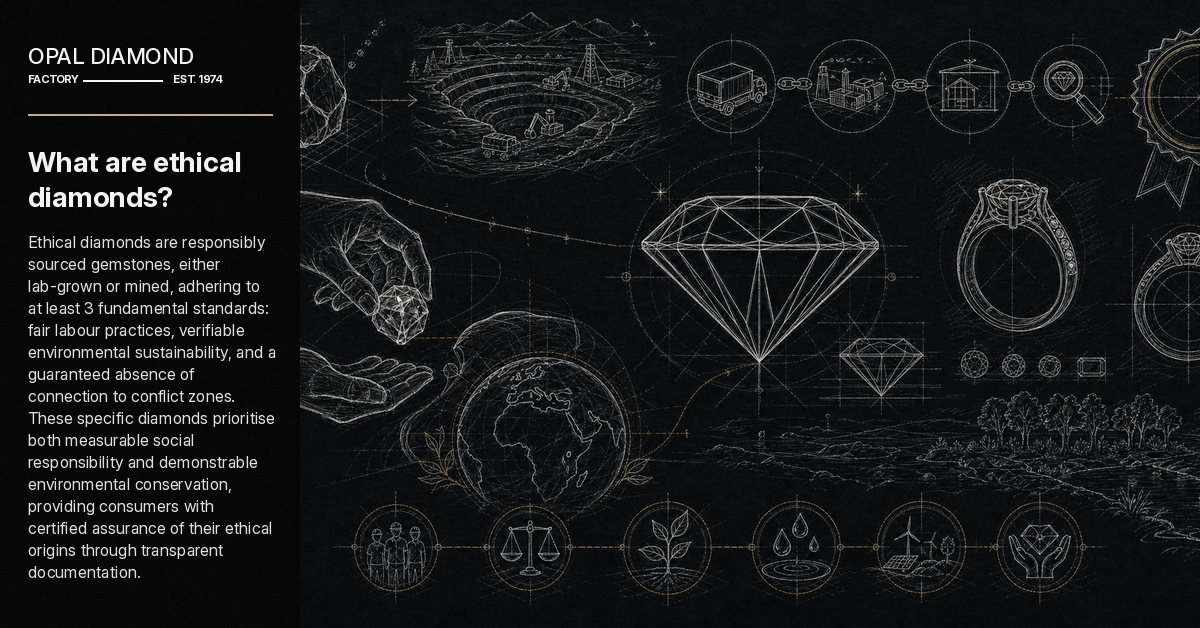
What are ethical diamonds?
Ethical diamonds are responsibly sourced gemstones, either lab-grown or mined, adhering to at least 3 fundamental standards: fair labour practices, verifiable environmental sustainability, and a guaranteed absence of connection to conflict zones. These specific diamonds prioritise both measurable social responsibility and demonstrable environmental conservation, providing consumers with certified assurance of their ethical origins through transparent documentation.
What makes diamonds ethical?
Diamonds are considered ethical when their sourcing and production processes meet at least 4 specific, rigorous standards from their point of origin to the final market:
- Ensuring complete conflict-free sourcing, meaning production does not contribute to funding military actions or civil unrest.
- Upholding verifiable human rights, ensuring no human rights violations occur during extraction or processing.
- Minimising demonstrable environmental degradation, ensuring mining or creation processes have minimal negative environmental impact.
- Maintaining transparent supply chains, providing complete documentation that traces the diamond’s journey. Ethical diamonds, whether lab-grown or traditionally mined, demonstrate these responsible sourcing practices and aim to provide tangible economic benefits to local communities while maintaining strict environmental stewardship protocols.
What types of ethical diamonds exist?
There are 6 primary types of ethical diamonds available in the current market, each offering distinct environmental and social advantages:
| Type | Description | Key Ethical Benefit |
|---|---|---|
| Lab-Grown Diamonds | Diamonds created in controlled laboratory settings using one of two advanced technological processes: HPHT or CVD. | Eliminates direct mining impacts such as habitat destruction, reduces water usage, and ensures conflict-free origins. |
| Canadian Diamonds | Natural diamonds mined in Canada under some of the world’s strictest national environmental and labour regulations. | Ensures complete traceability from specific Canadian mines and adherence to high ethical mining standards. |
| Recycled/Vintage Diamonds | Diamonds repurposed from existing jewellery pieces, often antique or pre-owned. | Reduces demand for new mining activities, thereby promoting resource conservation and minimising further environmental impact. |
| Blockchain-Tracked Diamonds | Natural diamonds whose ethical sourcing and chain of custody are documented and verified via blockchain technology. | Provides an immutable and transparent record of the diamond’s ethical journey, enhancing consumer trust. |
| Fairtrade Diamonds | Natural diamonds sourced from artisanal and small-scale mining organisations (ASMOs) certified for fair labour practices and community benefits. | Supports small-scale miners with fair wages, improved working conditions, and community development premiums. |
| Alliance for Responsible Mining (ARM) Certified Diamonds | Natural diamonds sourced from artisanal mines that follow ARM’s strict ethical and environmental guidelines for “Fairmined” certification. | Promotes responsible environmental practices, safe working conditions, and social development in artisanal mining areas. |
What are conflict-free diamonds?
Conflict-free diamonds are gemstones verified through at least 1 crucial certification process, such as the Kimberley Process Certification Scheme, to ensure they have not financed military actions, terrorism, or human rights abuses. These gems, including both GIA-certified natural diamonds and lab-grown diamonds, are tracked from their rough state through international markets to promote sound practices, such as fair labour rights and comprehensive environmental preservation, while addressing troubling issues like blood diamond mining.
Consumers aware of these 3 environmental and social issues can choose between natural diamonds and lab-grown alternatives. Lab-grown diamond brands utilise specific components, such as small diamond seed crystals and pure carbon-rich gas (e.g., methane for CVD), under controlled temperatures (e.g., 900-1200 degrees Celsius for CVD synthesis), while eco-friendly diamond mining operations focus on minimising damage to nature by protecting forested land and maintaining high labour standards.
Are lab-grown diamonds ethical?
Lab-grown diamonds are generally considered an ethical choice within the diamond industry because their creation in controlled laboratory environments mitigates at least 3 significant social and environmental concerns associated with traditional mining, such as habitat destruction, unsafe working conditions, and potential funding of conflict. These diamonds typically have a demonstrably reduced environmental footprint compared to many traditionally mined diamonds, especially regarding land use and waste generation.
The production of lab-grown diamonds requires substantial electrical energy; consumers should research specific manufacturers to ensure responsible production practices are followed and renewable energy sources are utilised, if they want to maximise the sustainability of their purchase.
How can I identify ethical diamonds?
You can identify ethical diamonds by looking for at least 3 key indicators: recognised certifications from reputable organisations, comprehensive documentation detailing the diamond’s provenance, and transparent seller policies regarding ethical sourcing.
Reputable sellers willingly provide detailed information. Important verification steps include these 6 actions:
- Request comprehensive documentation showing the diamond’s complete, verified chain of custody.
- Look for third-party certifications from respected organisations, such as the Gemological Institute of America (GIA), SCS Global Services (for sustainability), or Fairtrade International.
- Research the retailer’s published ethical sourcing policies and supplier codes of conduct.
- Check for specific origin documentation, particularly for diamonds marketed with specific, verifiable origins like Canadian diamonds from the Canadamark™ program.
- Verify if the seller or their suppliers participate in responsible sourcing initiatives, such as the Responsible Jewellery Council (RJC).
- Ask direct questions about their transparency regarding all sourcing and manufacturing processes for their diamonds. Consider working with jewellers who specialise in ethical diamonds and can provide comprehensive, verifiable documentation of their sourcing practices for all their precious stones, such as diamonds, sapphires, and emeralds.
How are diamond origins verified?
Diamond origins are verified through 3 main rigorous methods: the Kimberley Process Certification Scheme specifically for natural rough diamonds, emerging blockchain technologies for enhanced supply chain transparency, and specific industry initiatives promoting accountability and traceability. Ethical diamond sourcing involves these robust methods to eliminate “blood diamonds” linked to the conflict diamond trade. Consumers should look for verified diamonds adhering to responsible mining practices and stringent environmental standards, ensuring no human rights violations occurred during their extraction.
Blockchain technologies, such as De Beers’ Tracr platform or Everledger, offer transparent, immutable tracking of diamond origins. Additionally, initiatives like the Diamond Development Initiative and the Responsible Jewellery Council further promote accountability and ethical practices throughout the complex, multi-stage diamond supply chain.
How are ethical diamonds made?
Ethical diamonds are produced through 2 principal methods: ethical traditional mining for natural diamonds and advanced laboratory creation for lab-grown diamonds, each with distinct processes and ethical considerations.
| Method | Process Description | Key Ethical Practices Involved |
|---|---|---|
| Ethical Traditional Mining
(Natural Diamonds) |
Natural diamonds are extracted from the Earth following at least 3 strict environmental and social standards. These mining operations typically occur in regulated countries, such as Canada, Botswana, Namibia, and Australia. | Includes implementation of safe working conditions, payment of fair wages, minimisation of environmental impact through responsible water and waste management, undertaking land reclamation practices, protection of local ecosystems, and ensuring tangible economic benefits flow to local communities. |
| Laboratory Creation
(Lab-Grown Diamonds) |
Lab-grown diamonds are created using one of two advanced technological processes, such as HPHT (High Pressure/High Temperature) or CVD (Chemical Vapor Deposition), which replicate the natural diamond formation conditions within a controlled laboratory environment. | Eliminates most direct mining-related environmental and social concerns, such as land disruption and worker exploitation in unregulated mines, though significant energy consumption requires careful scrutiny for overall sustainability. |
In both cases, ethical diamonds must maintain transparent, verifiable documentation detailing their journey from the specific source (mine or laboratory) to the market, ensuring consistent compliance with numerous environmental and social responsibility standards.
Where are ethical diamonds from?
Ethical diamonds originate from 3 primary categories of carefully regulated sources: specific countries known for responsible natural diamond mining, technologically advanced nations with facilities for lab-grown diamonds, and the global pool of existing jewellery for recycled diamonds.
| Source Category | Specific Origins | Key Characteristics of Source |
|---|---|---|
| Natural Ethical Diamonds | At least 4 key countries: Canada (notably the Northwest Territories with mines like Ekati and Diavik), Botswana, Namibia, and Australia (formerly Argyle mine). | Rigorous national environmental and labour standards, strong governance structures, well-established community reinvestment programs, and often traceability initiatives. |
| Lab-Grown Diamonds | Technologically advanced nations, such as the United States (with numerous production facilities), various European countries (e.g., Netherlands, Germany, United Kingdom), Singapore, and India. | High-tech laboratory facilities, often with a growing focus on using renewable energy sources and implementing strict environmental controls for production. |
| Recycled/Vintage Diamonds | Sourced globally from existing jewellery pieces, including heirlooms, antique items, and post-consumer markets. | Bypasses all new mining concerns entirely; the specific origin of the diamond itself varies by the original piece and its history. |
Each source type must meet specific, verifiable criteria for environmental responsibility, adherence to labour rights, and transparency in their entire production and supply process, which defines ethical diamond sourcing.
What is the origin of ethical diamonds?
The origin of ethical diamonds traces to 2 main source types: responsibly managed natural mines located in strictly regulated countries, such as Canada (e.g., Northwest Territories), Botswana (e.g., Jwaneng mine), and Namibia, where robust environmental protection protocols and fair labour practices are stringently enforced; and modern, certified laboratories situated in developed nations, such as the United States and specific European countries, where diamonds are created using advanced technology under precisely controlled and audited conditions. Both distinct source types maintain rigorous, documented standards for transparency and ethical production throughout their entire supply chains.
What is mine-to-market tracking in ethical diamonds?
Mine-to-market tracking in ethical diamonds is a comprehensive documentation and verification system utilising at least 3 types of technologies-such as secure blockchain platforms (e.g., Tracr, Everledger), laser inscriptions of unique serial numbers on the diamond’s girdle, and digital certificates of authenticity and origin-to trace a diamond’s complete, auditable journey from its specific source (either a particular mine or laboratory) to the final consumer.
This system creates an unbroken, verifiable chain of custody. This meticulous tracking process documents the diamond’s transformation through all key stages, including rough diamond sorting, detailed cutting and polishing, and final jewellery setting, while concurrently confirming consistent compliance with numerous environmental and social standards at each step. It enables consumers to verify their diamond’s ethical sourcing with a high degree of certainty and confidence.
What is a conflict-free diamond supply chain?
A conflict-free diamond supply chain is a strictly monitored and regulated system designed to ensure diamonds are sourced, processed, and sold exclusively through legitimate, transparent channels, thereby preventing the funding of at least 3 key negative outcomes: armed violence by rebel movements, prolonged civil wars, or systemic human rights violations. This complex process begins at approved, audited mining sites or certified laboratories and meticulously follows the diamond through each stage of production-from rough stone to polished gem to finished jewellery product-with detailed, verifiable documentation and third-party verification at every point of transfer.
The system operates primarily under international agreements, most notably the Kimberley Process Certification Scheme for rough diamonds, and additional, often more stringent, industry protocols from organisations like the Responsible Jewellery Council, requiring multiple checkpoints, certificates of origin, and transparent documentation to prove diamonds have not passed through conflict zones or contributed to unethical practices. Every participant, from large mining companies and diamond manufacturers to wholesale distributors and retail jewellers, must adhere to these stringent standards and maintain detailed, auditable records to ensure the ongoing integrity of the conflict-free certification.
What is the humanitarian mining index?
While a specific, universally recognised “Humanitarian Mining Index” is not widely documented under that exact name in mainstream diamond industry literature, various comprehensive assessment frameworks and at least 2 types of independent certification programs evaluate diamond mining operations based on their measurable social and environmental impact, assessing at least 7 key performance factors.
These frameworks, often managed by non-governmental organisations (NGOs) or multi-stakeholder industry bodies like the Initiative for Responsible Mining Assurance (IRMA) or Fairtrade International, assess important aspects including these 7 areas:
- Evaluating worker safety protocols and ensuring fair, documented compensation.
- Assessing local community development initiatives and benefit-sharing mechanisms.
- Monitoring environmental protection measures, including detailed water and biodiversity management plans.
- Respecting and upholding the rights of Indigenous peoples in mining areas.
- Ensuring equitable distribution of economic benefits to host countries and local communities.
- Verifying operational transparency in all dealings and reporting.
- Confirming consistent compliance with relevant international labour conventions and human rights standards.
What are origin certification standards for ethical diamonds?
Origin certification standards for ethical diamonds are comprehensive, multi-faceted verification systems, often validated by at least 2 types of recognized, independent third-party bodies like the Gemological Institute of America (GIA) for diamond grading and origin reports or SCS Global Services for sustainability certifications, that authenticate a diamond’s specific source and its full ethical compliance through at least 9 specific types of documentation, audits, and processes.
The rigorous certification process typically includes these 9 elements:
- Detailed documentation of specific source (e.g., particular mine location, laboratory identification).
- Independent verification of compliance with stringent national and international environmental regulations.
- Audited confirmation of fair labour practices throughout the entire supply chain.
- Comprehensive supply chain tracking documentation, often utilising secure digital platforms.
- Mandatory Kimberley Process certification for all shipments of natural rough diamonds.
- Accessible third-party auditing reports on social and environmental performance.
- Unbroken, documented chain of custody records from source to retail.
- Demonstrable compliance with numerous relevant international standards (e.g., ISO 14001 for environmental management, SA8000 for social accountability).
- Registration in secure, often proprietary, tracking databases, where applicable for specific certification schemes. These robust standards ensure a high level of transparency and provide consumers with substantial confidence in their diamond’s ethical origins and journey.
Who sets origin standards for ethical diamonds?
Origin standards for ethical diamonds are established and enforced by a combination of at least 3 types of entities: international governmental organizations, specific influential industry bodies, and national government regulators in both producing and consuming countries.
The Kimberley Process Certification Scheme, an international governmental initiative, provides the foundational framework aimed at preventing the trade in conflict diamonds. Industry bodies, such as the World Diamond Council which interfaces with the Kimberley Process, the Responsible Jewellery Council (RJC) which offers a comprehensive Code of Practices, and CIBJO (The World Jewellery Confederation) which promotes responsible practices through its Blue Books, establish additional, often more detailed, requirements and codes of practice.
Independent gemological certification bodies, such as the GIA and the American Gem Society (AGS), develop specific grading and authentication protocols that increasingly include verifiable origin information. These various organisations collaborate, sometimes formally and sometimes informally, to create comprehensive, evolving standards addressing environmental protection, labour rights, supply chain transparency, and conflict prevention.
What is kimberley process compliance?
Kimberley Process compliance involves strict adherence to a mandatory international certification system for rough diamonds, which currently includes over 80 participating countries and various industry representative bodies, designed with 1 primary objective: to prevent diamonds from conflict zones, often termed “blood diamonds,” from entering the legitimate international diamond market. Compliance requires participating countries and their respective industry members to implement a series of stringent controls, such as meticulous documentation of all rough diamond shipments, standardised certification processes for export and import, and robust internal audits and controls, to certify that their rough diamonds are verifiably conflict-free.
Each international shipment of rough diamonds must be accompanied by a valid, government-issued Kimberley Process certificate. Member countries must also maintain rigorous import/export procedures, collect and share statistical data on rough diamond trade, and participate in reciprocal peer review missions to ensure consistent adherence to these established minimum standards.
What is sustainability verification for ethical diamonds?
Sustainability verification for ethical diamonds is a comprehensive, independent assessment system that evaluates at least 2 key areas of corporate responsibility-measurable environmental stewardship and demonstrable social accountability-throughout a diamond’s entire lifecycle, from initial extraction or laboratory creation to final retail. For traditionally mined diamonds, this verification process monitors specific environmental protection measures, detailed mining practices, and tangible community impact.
For lab-grown diamonds, it focuses on factors such as energy efficiency of production, the source of that energy (renewable versus non-renewable), chemical usage, and overall production methods. Independent, accredited auditors verify compliance with established, recognised sustainability standards (e.g., SCS-007 Jewellery Sustainability Standard, RJC Code of Practices), examining at least 5 specific factors, such as quantifiable carbon emissions, detailed water usage and recycling, land reclamation and biodiversity conservation efforts, adherence to fair labour practices, and evidence of positive community impact and engagement.
Why choose ethical diamonds?
Individuals choose ethical diamonds for at least 3 principal reasons: to actively support responsible and transparent practices within the global diamond industry, to ensure their significant financial and emotional purchase does not inadvertently contribute to negative global outcomes such as severe environmental degradation, egregious human rights violations, or the funding of armed conflict, and to gain genuine peace of mind knowing their investment aligns with their personal ethical values.
Ethical diamonds, by definition, offer complete, verifiable transparency in their sourcing and production processes, whether they are lab-grown or responsibly mined. By consciously choosing ethical diamonds, consumers actively support specific companies and entire communities committed to at least 3 positive outcomes: the implementation of sustainable operational practices, the enhancement of worker safety and well-being, and the promotion of equitable local economic development.
How ethical are diamond sellers?
The ethical commitment of individual diamond sellers varies significantly across the industry; reputable sellers typically demonstrate their dedication to ethical practices through 3 key verifiable actions: strict adherence to established, comprehensive industry standards, such as the Responsible Jewellery Council (RJC) Code of Practices or Fairtrade
Gold standards for associated materials; provision of complete, unambiguous sourcing transparency for their diamonds and other precious materials used in their jewelry; and consistent maintenance of proper, verifiable certification from recognized, independent gemological and ethical standards bodies. Consumers should research potential sellers thoroughly and diligently verify all ethical claims through official documentation and third-party certifications, if they want to ensure an ethical purchase from a reliable and responsible jeweller.
What is the impact of ethical diamonds?
Ethical diamonds create at least 4 significant positive environmental and social changes on a global scale by actively promoting certifiably responsible mining practices, ensuring verifiably fair labour conditions for all workers, and fostering genuinely sustainable production methods throughout the supply chain.
These tangible positive changes include measurably improved worker safety and overall well-being, demonstrably reduced environmental damage from mining and processing activities, direct financial and developmental support for local communities through mechanisms such as fair trade premiums or equitable revenue sharing agreements, and a significant decrease in the availability of funding for conflict zones that historically relied on illicit diamond sales.
By choosing ethical diamonds, consumers directly contribute to driving industry-wide improvements toward more sustainable and socially responsible operational practices while maintaining access to high-quality diamond products.
What is the future of ethical diamonds?
The future of ethical diamonds indicates clear progression towards 2 main interconnected trends: significantly greater sustainability in both the sourcing of raw materials and the methods of production, and markedly increased transparency throughout the entire complex, global supply chain. This evolution is being driven by at least 3 key influential factors: rapidly advancing technologies for tracking and verification (e.g., blockchain), growing and more vocal consumer demand for verifiably responsible and ethically sourced products, and the implementation of stricter international industry standards and regulations.
Lab-grown diamonds are steadily gaining market share as a visible alternative. Traditional diamond mining operations are increasingly adopting more stringent, independently audited environmental and social protocols. Emerging technologies, such as enhanced, immutable blockchain tracking systems, improved energy-efficient production methods for lab-grown diamonds utilising renewable energy, and more comprehensive, widely adopted certification processes from entities like the Responsible Jewellery Council and SCS Global Services, are collectively working to make fully ethical practices the expected industry norm rather than a niche exception.