
Diamonds exhibit a complex array of characteristics that determine their value and appeal, from their fundamental cubic structure where atoms form tetrahedra to their visible properties. Natural stones formed through volcanic eruptions compete with modern Lab diamonds in today’s market, while diamond cutters carefully consider factors like cut grades, clarity, and colour variations – from yellow and brown tints to rare blue hues. The 4Cs diamond chart serves as the primary benchmark for grading, helping navigate the often-complex diamond buying process.
These gems’ distinct properties, including superior hardness and unique electronic properties, are influenced by nitrogen and boron impurities, while heat treatment can modify their characteristics.
This detail is part of the wider diamond selection guide.
Whether choosing center stones for engagement rings or evaluating enhanced diamonds, understanding these essential quality factors – along with advice from industry veterans – helps consumers make informed decisions in an increasingly ethics-conscious market. The interplay of these attributes, from structural composition to visible features, continues to shape buyer preferences and market trends.
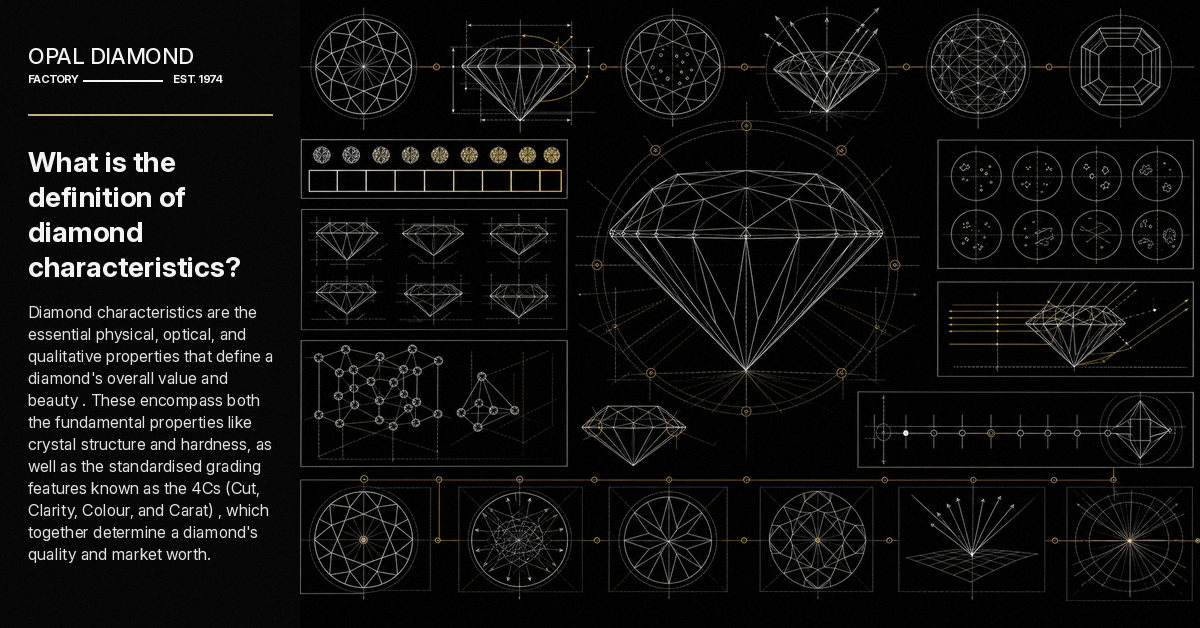
What is the definition of diamond characteristics?
Diamond characteristics are the essential physical, optical, and qualitative properties that define a diamond’s overall value and beauty. These encompass both the fundamental properties like crystal structure and hardness, as well as the standardised grading features known as the 4Cs (Cut, Clarity, Colour, and Carat), which together determine a diamond’s quality and market worth.
What are the main types of diamond characteristics?
Diamond characteristics are divided into three key categories: Physical, Optical, and Quality (4Cs). These categories represent the fundamental properties and qualities that define a diamond’s appearance, value, and identity.
- Physical Characteristics – The natural structural properties of a diamond including its crystal formation, hardness, and overall durability.
- Optical Characteristics – The way a diamond interacts with light, including its brilliance, fire (dispersion of light), and sparkle.
- Quality Characteristics (4Cs) – The standardised grading system used to evaluate diamonds, consisting of Cut, Clarity, Colour, and Carat weight.
These characteristics serve as universal standards for evaluating and comparing diamonds in the marketplace, helping both professionals and consumers make informed decisions about diamond quality and value.
What are the physical characteristics of a diamond?
The key physical characteristics of a diamond, referring to its inherent natural properties that define its structure and durability, are:
- Crystal Structure – The atomic arrangement of carbon atoms in a cubic (isometric) system forming a highly organised lattice pattern.
- Hardness – The resistance to scratching, measuring 10 on the Mohs scale, making diamonds the hardest natural substance known.
- Durability – The ability to withstand pressure and resist breaking, though diamonds can be brittle along cleavage planes.
- Density – The specific gravity of diamond, measuring approximately 3.52, which determines its weight relative to water.
- Thermal Conductivity – The exceptional ability to conduct heat, making diamonds feel cold to the touch.
- Electrical Properties – Natural diamonds typically ACT as electrical insulators, though some varieties can conduct electricity based on their impurities.
What is the isotropic hardness index of a diamond?
The isotropic hardness index of a diamond varies based on the crystal face being measured. Despite diamonds being the hardest natural substance with a Mohs hardness of 10, on the more precise Knoop hardness scale, diamonds show different hardness values ranging from approximately 5700 to 7000 KHN (Knoop Hardness Number), depending on the crystallographic direction being tested. This variation in hardness across different crystal faces is particularly important for diamond cutters, as it affects how the stone can be cut and polished. The octahedral face {111} shows the highest resistance to abrasion, while the cube face {100} is relatively softer, demonstrating that diamond’s legendary hardness is not uniform in all directions.
What are the four c’s of diamond characteristics?
The Four C’s of diamond characteristics are the globally recognised standards used to evaluate and grade diamonds, consisting of Cut, Clarity, Colour, and Carat weight.
- Cut refers to how well a diamond is fashioned from its rough state, affecting its brilliance and overall appearance.
- Clarity measures the presence or absence of inclusions and blemishes within and on the diamond.
- Colour grades the absence of colour in white diamonds, with completely colourless being most valuable.
- Carat represents the diamond’s weight, where one carat equals 0.2 grams.
These four characteristics work together to determine a diamond’s overall quality and value in the marketplace.
What is diamond carat weight?
Carat represents the diamond’s weight, where one carat equals 0.2 grams. Carat weight serves as an important factor in determining a diamond’s value and desirability. The weight carat directly correlates with diamond size, influencing the perception of larger diamonds as more valuable. A one-carat diamond is often seen as a benchmark in the market, greatly affecting diamond prices. While polished diamonds of various weights can be gem-quality, larger diamonds tend to command higher prices due to their rarity.
What is diamond cut quality?
Cut refers to how well a diamond is fashioned from its rough state, affecting its brilliance and overall appearance. Cut quality greatly impacts a diamond’s overall appearance and brilliance. It is one of the Four C’s of diamond characteristics, influencing how light interacts with the stone. A well-cut diamond maximises its brilliance and fire, showcasing its cut clarity and cut colour. Diamonds graded with excellent cut quality reflect light beautifully, enhancing the diamond’s appearance. The diamond will exhibit optimal light performance and visual appeal, when these measurements fall within ideal ranges.
What is diamond colour grading?
Colour grading uses a standardised colour scale that ranges from D (colourless diamonds) to Z (light yellow or brown). Colour grading is a crucial aspect of evaluating diamonds, influencing their overall beauty and value. This scale determines a diamond’s appearance, affecting its desirability and price. Colour diamonds, which exhibit hues beyond the colourless range, are also assessed but follow different criteria.
What is diamond clarity rating?
Diamond clarity assesses the presence or absence of inclusions and blemishes within and on the diamond. Clarity rating is an essential component of the Four C’s that define diamond characteristics, alongside colour, cut, and carat weight. The Gemological Institute of America (GIA) clarity scale ranges from Flawless (no inclusions visible under 10x magnification) to Included (inclusions visible to the naked eye). A flawless diamond offers the highest clarity, while slightly included stones may have minor imperfections. High clarity diamonds are prized for their visual appeal, ensuring that the stone’s colour and cut are showcased without distraction from clarity issues.
What are common diamond inclusions?
Common diamond inclusions are internal features or imperfections found within diamonds.
Here are the most common types:
- Crystals – Small mineral deposits trapped inside the diamond during formation, appearing as white or dark spots.
- Feathers – Small fractures within the diamond that resemble feather-like patterns.
- Clouds – Clusters of tiny crystals grouped together creating a hazy or cloudy appearance.
- Needles – Thin, elongated inclusions that appear as pin-like lines within the stone.
- Pinpoints – Tiny dots that appear as miniature crystals within the diamond.
- Twinning Wisps – Internal distortions caused during crystal growth, appearing as twisted patterns.
- Knots – Surface-reaching crystal inclusions that create visible irregularities.
- Cavities – Small indentations or hollow areas within the diamond’s structure.
What are common diamond blemishes?
Common diamond blemishes are external imperfections found on the surface of diamonds.
Here are the most common types:
- Polish Lines – Fine parallel lines on the diamond’s surface created during the polishing process.
- Scratches – Surface markings caused by contact with harder objects or during handling.
- Nicks – Small notches or chips along the diamond’s edges or facet junctions.
- Naturals – Remnants of the original rough diamond’s surface left unpolished.
- Extra Facets – Additional unplanned facets created to remove surface imperfections.
- Abrasions – Damaged areas showing wear along facet junctions or edges.
- Surface Graining – Visible lines or streaks on the diamond’s surface due to irregular crystal growth.
- Burn Marks – Dark spots caused by excessive heat during cutting or polishing.
What is diamond shape versus diamond cut?
Shape refers to the geometric outline (like round, oval, or princess), while cut describes the technical precision of facet arrangement that affects how light interacts with the stone. Diamond shape and cut are distinct characteristics that determine a diamond’s appearance and performance. While shape is largely a matter of personal preference, cut quality directly influences a diamond’s brilliance, fire, and overall value in the marketplace.
What are the best diamond shapes?
The concept of “best” diamond shapes is subjective, but the round brilliant shape is widely considered the most desirable. The round brilliant’s 57-58 facet pattern maximises brilliance and fire while hiding inclusions effectively. The concept of “best” diamond shapes is largely dependent on personal preference, though certain shapes have proven more popular and advantageous.
Popular fancy shapes include oval, princess, cushion, emerald, pear, and marquise, each offering unique advantages. For example, oval and marquise shapes can create an illusion of larger size, while emerald cuts showcase clarity and colour. The choice of shape often depends on factors like hand size, finger length, lifestyle, and intended setting style.
What are ideal diamond proportions?
Ideal diamond proportions are important measurements that determine how well a diamond performs optically, including:
- Table Percentage – 54-59% ratio of the table width to the total diamond width.
- Crown Angle – 34-35 degrees for optimal light reflection and dispersion.
- Pavilion Angle – 40.6-41 degrees to ensure proper light return.
- Depth Percentage – 59-62.6% ratio of total depth to total width.
- Girdle Thickness – Thin to medium, providing durability without excess weight.
- Culet Size – None to very small, ideally pointed or minimal.
These proportions work together to create maximum brilliance, fire, and scintillation. When these measurements fall within ideal ranges, the diamond will exhibit optimal light performance and visual appeal.
What are diamond symmetry characteristics?
Diamond symmetry characteristics refer to the precision and alignment of a diamond’s facets and proportions.
Here are the key elements:
- Facet Alignment – The proper matching of corresponding facets on opposite sides of the diamond.
- Table Centering – The positioning of the table facet exactly in the center of the stone.
- Girdle Uniformity – The consistency of the girdle thickness around the diamond’s circumference.
- Crown Height – The evenness of the crown height and angle around the stone.
- Pavilion Depth – The consistency of pavilion facets and their meeting points.
- Points and Edges – The proper alignment of the culet, keel line, and all points where facets meet.
- Shape Outline – The overall evenness and regularity of the diamond’s outline from all views.
These symmetry characteristics are graded as Excellent, Very Good, Good, Fair, or Poor, directly affecting diamond brilliance, overall appearance, and how it handles light performance.
What is diamond polish quality?
Diamond polish quality is the smoothness and condition of a diamond’s surface after the cutting and polishing process. It is important in how brilliant diamonds interact with light and display their essential quality factors. Polish quality is graded on a scale from Excellent to Poor, considering surface characteristics like polish lines, abrasions, and imperfections. Diamond experts evaluate polish based on light performance in colourless and coloured diamonds.
Poor polish can diminish a stone’s brilliance and clarity grade, while excellent polish enhances natural properties, including visible inclusions. This, along with other quality factors like diamond cut grades and clarity grading scale, helps consumers find their dream diamond that balances both quality and value. The presence of polish marks can affect light interaction with diamond surfaces, potentially impacting spectral colours and overall brilliance.
What is diamond fluorescence?
Diamond fluorescence is a natural phenomenon where diamonds emit a blue glow when exposed to ultraviolet light. The degree of fluorescence can affect the appearance of gem diamonds in daylight and their value. Some quality diamonds benefit from fluorescence, while others may appear hazy.
Fluorescence, along with other diamond characteristics like clarity grade, internal inclusions, and structure, helps buyers make informed decisions when evaluating diamonds for engagement rings. This natural property, influenced by nitrogen impurities and the crystal structure, serves as a unique identifier and factor in determining a diamond’s overall quality and value.
What is the ultraviolet luminescence scale for diamond fluorescence?
The ultraviolet luminescence scale categorises diamonds based on their reaction to UV light, affecting their perceived cut, colour, and clarity. This phenomenon, known as fluorescence, can greatly impact a diamond’s appearance under white light. Higher clarity diamonds may exhibit minimal fluorescence, enhancing their brilliance, while some synthetic diamonds or lab-grown varieties may fluoresce more intensely. Knowledge of these diamond characteristics helps consumers make informed decisions when selecting their perfect gem.
What are the activating wavelength thresholds for diamond fluorescence?
Activating wavelength thresholds for diamond fluorescence determine the intensity and colour of a diamond’s fluorescence. Understanding these thresholds is fundamental to grasping how diamonds respond to ultraviolet light. These thresholds can greatly affect a diamond’s overall appearance.
Fluorescence is influenced by diamond characteristics, such as cut, colour, and clarity, as well as the crystal structure inherent to diamond cubic formation. High-temperature treatments and processes like chemical vapor deposition can also modify fluorescence behaviour. These factors combine to create unique visual effects, enhancing a diamond’s allure and value in the eyes of consumers and gemologists alike.
What is fluorophore spectral emission in diamonds?
Fluorophore spectral emission in diamonds arises from the atomic structure, where certain fluorophores absorb ultraviolet light and re-emit it as visible colour. This effect contributes to the phenomenon of diamond fluorescence. The spectral emission varies, impacting the diamond’s characteristics, such as colour and clarity. When exposed to specific lighting conditions, these diamonds may exhibit a unique glow, enhancing their overall appearance. The interaction of light with carbon atoms within the diamond plays a vital role in this process.
What is the optical transparency spectrum of a diamond?
The optical transparency spectrum of a diamond indicates how light passes through the stone, playing a vital role in its visual appeal and performance. The optical transparency spectrum of a diamond plays a vital role in its visual appeal and performance. Understanding the dispersion coefficient ratio is essential, as it indicates how light is refracted within the stone. This characteristic contributes to the diamond’s brilliance and fire, elements that are highly valued in gemology.
What is the dispersion coefficient ratio of a diamond?
The dispersion coefficient ratio of a diamond is a measure of how light separates into its constituent colours. This measure considerably influences a diamond’s appearance. With a high dispersion ratio, diamonds exhibit brilliant fire, enhancing their cut, clarity, and colour. The arrangement of atoms in diamond’s crystal lattice allows for exceptional hardness and thermal conductivity, further elevating its desirability in jewellery. This interplay of optical characteristics guarantees that each diamond reflects light uniquely, enchanting observers and adding to its charm as a timeless symbol of beauty and luxury.
What is diamond light performance?
Diamond light performance encompasses the concepts of fire, brilliance, sparkle, and scintillation. Diamond light performance encompasses the concepts of fire, brilliance, sparkle, and scintillation.
- Fire refers to the dispersion of light into various colours.
- Brilliance represents the overall brightness a diamond emits.
- Sparkle and scintillation capture the dynamic play of light as the stone moves.
These concepts contribute to its enchanting visual appeal.
What are diamond fire and brilliance?
Diamond fire and brilliance are the two primary optical properties that determine a diamond’s visual performance:
• Brilliance – The intensity of internal and external white light reflection in a diamond, creating the bright, white flashes that give the stone its sparkle. This effect is produced when light enters through the crown, reflects off the pavilion facets, and returns through the crown to the viewer’s eye. The quality of brilliance depends heavily on the precision of the diamond’s cut proportions.
• Fire (Dispersion) – The separation of white light into its spectral colours (like a prism effect) as it passes through the diamond, creating flashes of colour ranging from red to violet. This phenomenon occurs when light is bent and split as it travels through the diamond’s facets at different angles. The degree of fire is influenced by the diamond’s cut quality, with well-proportioned stones displaying more vivid and noticeable colour dispersion.
What are diamond sparkle and scintillation?
Diamond sparkle and scintillation are essential optical characteristics that contribute to a diamond’s visual performance:
• Sparkle – The dynamic flashes of light that occur when either the diamond moves, the light source changes, or the viewer moves. This visual effect is created by the interplay of light with the diamond’s facets, producing quick, bright flashes that attract the eye. The intensity and quality of sparkle directly relates to how well the diamond is cut and polished.
• Scintillation – The pattern and contrast of bright and dark areas that appear as the diamond, light source, or observer moves. This effect creates the diamond’s “life” or visual drama through the alternating pattern of bright flashes against darker areas. Proper scintillation depends on the precise alignment and positioning of facets, with well-cut diamonds displaying an even, balanced pattern of light and dark areas.
What are fancy colour diamond characteristics?
Fancy colour diamonds are distinguished by their vibrant hues, which range from deep blues and fiery oranges to soft pinks and vivid yellows. Their unique colours greatly enhance the diamond’s appearance and value. Characteristics such as cut and clarity influence how light interacts with these stones, affecting their brilliance. Yellow diamonds, blue diamonds, and green diamonds exhibit varying specific gravity and hardness, similar to traditional diamonds. The ring size also plays a role in showcasing these colours, with larger stones typically commanding higher prices.
What are lab-grown diamond characteristics?
Lab-grown diamonds possess characteristics that are virtually identical to those of their natural counterparts. This makes them an attractive alternative for consumers. Their appearance is virtually identical, as both types are formed from the solid form of the element carbon. Through the application of extreme heat and pressure, carbon atoms create covalent bonds, resulting in a crystal structure. Lab-grown diamonds exhibit the same hardness, cut, clarity, and colour as natural diamonds, ensuring they meet high standards of quality. This similarity in characteristics allows consumers to enjoy the beauty and brilliance of diamonds while often benefiting from a more ethical and sustainable choice.
What are diamond certification standards?
Diamond certification standards are essential for evaluating a diamond’s quality and authenticity. Popular grading labs, such as the Gemological Institute of America (GIA) and the American Gem Society (AGS), set industry benchmarks. Understanding these standards guarantees consumers make informed purchasing decisions.
What are popular diamond grading labs?
Popular diamond grading labs provide the necessary certification to confirm quality, including renowned institutions like the Gemological Institute of America (GIA), American Gem Society (AGS), and International Gemological Institute (IGI). These labs are trusted sources for accurate assessments. These labs evaluate diamonds rigorously, adhering to ethical standards and providing objective reports.
What are conflict-free diamond characteristics?
Conflict-free diamond characteristics refer to diamonds that are ethically sourced and traded.
Here are their key features:
• Certification – Must have Kimberley Process certification and documentation proving ethical sourcing
• Traceability – Complete tracking of the diamond’s journey from mine to market with verifiable documentation
• Ethical Mining – Sourced from mines that follow fair labour practices and safe working conditions
• Legal Trade – Traded through legitimate channels that comply with international regulations and standards
• Social Impact – Benefits local communities through fair wages, development programs, and economic growth
• Documentation – Includes certificates of origin and authentication from recognised international authorities
• Retailer Verification – Sold by authorised retailers who maintain strict compliance with conflict-free standards
• Supply Chain – Maintained within a transparent and monitored supply chain network
What are sustainable diamond characteristics?
Sustainable diamonds are those that meet rigorous standards beyond traditional grades and clarity, ensuring they meet ethical practices in both lab-grown and naturally mined stones. Skilled graders evaluate not only the perfect qualities but also the responsible sourcing and production methods.
Consumers are increasingly considering sustainability alongside essential diamond quality factors, understanding how industrial diamonds and gem diamonds impact communities and environments from their formation to retail distribution. This approach ensures that diamond engagement choices support ethical practices while maintaining the purity and quality expected from retailers, preserving the natural environment and the integrity of the diamond education and distribution process.
What are heirloom diamond characteristics?
Heirloom diamond characteristics refer to the distinctive qualities of vintage and antique diamonds that have been passed down through generations.
Here are their defining features:
• Age and History – Diamonds typically 50+ years old with documented family provenance or historical significance
• Cut Style – Often features older cutting techniques like Old Mine Cut, Old European Cut, or Rose Cut, distinct from modern cuts
• Manufacturing Marks – Shows hand-crafted elements and cutting marks characteristic of earlier diamond cutting techniques
• Metal Work – Usually set in period-specific settings with distinctive vintage metalwork and design elements
• Natural Imperfections – May contain more natural characteristics due to older cutting techniques and standards
• Colour Range – Often displays warmer colour grades, including slight yellow or brownish tints common in antique stones
• Documentation – May include original certificates, family records, or historical documentation of ownership
What defines an heirloom diamond?
An heirloom diamond is defined by its historical significance and generational legacy, typically being at least 50 years old with documented family provenance. These stones often feature period-specific cutting styles like Old Mine Cut or Old European Cut, along with vintage craftsmanship techniques and settings that reflect their era of origin. Beyond their physical characteristics, heirloom diamonds carry significant sentimental value and family history, making them uniquely valuable beyond their technical specifications or market worth. Their authenticity is often supported by family documentation, historical records, or vintage certificates that help tell their story through generations.
What are common features of antique diamonds?
Antique diamonds typically feature distinctive characteristics from their historical cutting and manufacturing methods. They often display larger facets, higher crowns, and smaller tables compared to modern cuts, resulting in a softer, more romantic appearance. These stones frequently exhibit warmer color tints and may contain natural inclusions that were considered acceptable during their era.
Hand-crafted elements are common, including irregular facet patterns and asymmetrical shapes, reflecting the limitations of early cutting technology. The most common antique cuts include Old Mine Cut, Old European Cut, and Rose Cut, each displaying unique proportions that create different light patterns compared to contemporary diamonds. These characteristics combine to give antique diamonds their distinctive vintage charm and historical significance.
What are modern diamond characteristics?
Modern diamond characteristics have evolved to prioritise both aesthetic appeal and ethical considerations. While the allure of diamonds remains timeless, modern diamond characteristics have evolved markedly to prioritise both aesthetic appeal and ethical considerations. The formation of these gems involves extreme temperature and pressure, where carbon dioxide can melt and transform into graphite before crystallising into larger diamonds. The size of a diamond often serves as the biggest indicator of its value in contemporary markets.
What are unique diamond characteristics?
Unique diamond characteristics, often found in heirloom and antique diamonds, include unique cuts (such as old mine or cushion shapes), inclusions that tell a story of their age, and colour ranging from warm hues to rare shades. These unique characteristics often set heirloom and antique diamonds apart from their modern counterparts. Their colour can range from warm, rich hues to rare shades, while the craftsmanship reflects historical techniques, adding to their allure and sentimental value.