
Affordable diamond alternatives have emerged as a captivating choice for couples looking for ethical and stunning engagement ring designs. These alternatives, including lab-made stones like moissanite (made from silicon carbide), and colorful gemstones such as morganite, sapphires, and peridot, offer a wide variety of colors, larger stone sizes, and remarkable durability. Many closely match the appearance to diamonds, especially in terms of brilliance, symmetry, and a colorless look. With a high rating on the scale of hardness, they are suitable for daily wear and special occasions, offering a perfect balance of beauty and value.
The growing demand for diamond alternatives is driven by concerns over traditional diamond mining, including conflict diamonds and habitat destruction.
This detail is part of the wider diamond education guide.
Ethical production and sustainable sourcing make these stones a thoughtful choice for consumers. Whether opting for white diamonds, black sapphires, or Pink Argyle Diamonds, these versatile gems suit both vintage-inspired and modern intricate designs. In terms of quality, durability, and aesthetics, they are an excellent choice for perfect engagement or wedding jewellery.
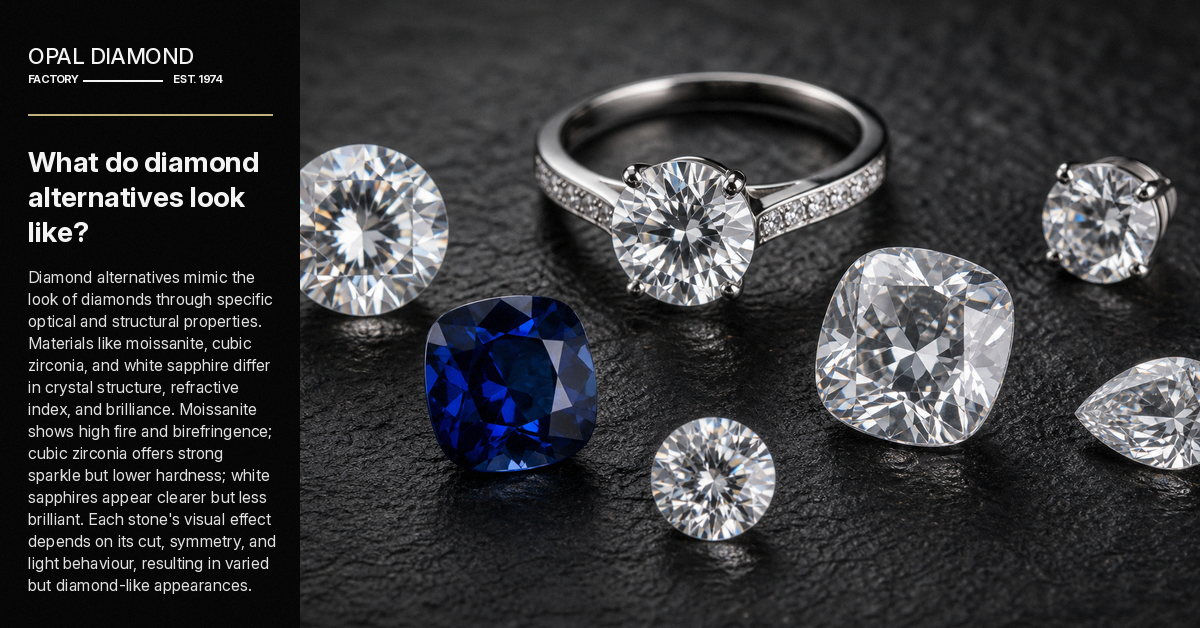
What do diamond alternatives look like?
Diamond alternatives mimic the look of diamonds through specific optical and structural properties. Materials like moissanite, cubic zirconia, and white sapphire differ in crystal structure, refractive index, and brilliance. Moissanite shows high fire and birefringence; cubic zirconia offers strong sparkle but lower hardness; white sapphires appear clearer but less brilliant. Each stone’s visual effect depends on its cut, symmetry, and light behaviour, resulting in varied but diamond-like appearances.
How hard are diamond alternatives?
Diamond alternatives vary in hardness, with diamond ranking 10 on the Mohs scale. Moissanite (9.25), white sapphire (9), and cubic zirconia (8-8.5) are common options, while spinel and quartz are softer. Hardness affects durability, making it a critical factor for engagement rings and daily-wear jewellery.
These alternatives offer a range of colors, clarity grades, and visual appearances. Choices include colourless stones, coloured diamonds, pepper diamonds, and green-coloured natural diamonds. From lab diamond jewellery to vintage-inspired coloured gemstones, each alternative stone suits different personal preferences. Whether for a wedding band, statement piece, or diamond engagement, consumers can find affordable options with stunning beauty, crafted by skilled artisans and shaped for versatility in jewellery designs.
What colours do diamond alternatives have?
Diamond alternatives offer a diverse palette of hues that expand beyond the classic colorless look. Their colours are influenced by mineral composition, impurities, and treatment methods.
Diamond alternatives come in a wide range of colours, including:
- Colourless – Mimics genuine diamond clarity and brilliance
- White – Subtle, glass-like transparency
- Yellow – Warm tones similar to natural fancy diamonds
- Pink – Soft to vibrant hues, often found in morganite
- Blue – Deep or icy shades, common in sapphire gemstone
- Green – Earthy to vivid, like green-coloured natural diamonds
- Black – Opaque and bold, used as a black stone or black centre stone
- Red – Rare, intense tones in synthetic or treated stones
- Peach/Champagne – Neutral tones popular in statement pieces
- Pepper (Salt and Pepper) – Included stones with speckled black and white patterns
How do diamond alternatives reflect light?
Diamond alternatives reflect light based on refractive index, dispersion, and cut. Moissanite has higher fire than diamond, showing intense colored flashes. Cubic zirconia reflects brightly but with softer brilliance. White sapphire and similar stones have lower sparkle due to lower refractive indices. Doubly refractive stones like moissanite split light, increasing sparkle but sometimes blurring details. Cut quality and symmetry are key to maximising light return.
What are natural diamond alternatives?
Natural diamond alternatives are gemstones formed in the earth, valued for their durability and appearance. They offer unique colors and characteristics distinct from synthetic options. Common natural alternatives include:
- White Sapphire – Clear corundum with a glassy brilliance
- Spinel – Durable and often mistaken for ruby or diamond
- Topaz – Found in clear and colored forms, with good hardness
- Zircon – Natural mineral with high brilliance and fire
- Quartz – Abundant, lower hardness, used for its clarity
- Garnet – Red and rare colourless varieties used in vintage pieces
- Peridot – Green gemstone with distinct internal glow
What are lab-created diamond alternatives?
Lab-created diamond alternatives are man-made stones engineered to mimic the optical and physical properties of natural diamonds. Moissanite, composed of silicon carbide, is the most well-known, offering high brilliance and fire due to its elevated refractive index. Cubic zirconia, a synthetic crystalline form of zirconium dioxide, is another popular alternative, valued for its affordability and diamond-like appearance, though it is softer and less durable. Other options include synthetic spinel, synthetic rutile, and yttria-stabilized zirconia, each varying in hardness, clarity, and light performance. These materials are produced in controlled environments, allowing for consistent quality, fewer impurities, and a wide range of color and cut variations.
What are the different types of diamond alternatives?
Various diamond alternatives offer unique characteristics and aesthetics, appealing to different tastes and budgets.
Moissanite, cubic zirconia, white sapphire, white topaz, and zircon each present distinct qualities that set them apart from traditional diamonds.
What is moissanite?
Moissanite is a popular, durable gemstone with exceptional brilliance and fire, offering a striking diamond-like appearance at an affordable price. It is often created in labs and has a lower environmental footprint than mined diamonds. Moissanite is classified as a simulated diamond, making it an excellent choice for those seeking quality and aesthetics without sacrificing quality. Its mesmerising sparkle makes it a great diamond alternative for engagement rings and other jewellery.
What is cubic zirconia?
Cubic zirconia (CZ) is a popular diamond substitute due to its brilliance and affordability. Its flawless appearance and excellent brilliance make it a popular choice among gem substitutes. CZ is durable and closely mimics natural diamonds in clarity and fire, making it a reliable choice for those seeking beauty without high cost. Available in various cuts and styles, CZ remains a popular choice for engagement rings and fine jewellery pieces.
What is white sapphire?
White sapphire is a natural gemstone with a high clarity and durability, offering a stunning alternative to diamonds. With a Mohs hardness of 9, it’s suitable for everyday jewelry and is a popular choice for ethical sourcing. Whether set in rings or necklaces, white sapphire’s alluring appeal complements any style, making it a popular choice for ethical jewelry alternatives.
What is white topaz?
White topaz is a popular semi-precious gemstone due to its brilliance and versatility, making it a popular choice for eco-friendly engagement rings. Its excellent clarity and dazzling appearance mimic the look of diamonds without the high price tag. White topaz’s durable nature makes it suitable for everyday wear, making it a compelling choice for those seeking a balance between beauty, affordability, and ethical considerations in jewellery selection.
What is zircon?
Zircon, a brilliant diamond alternative, is a semi-precious gemstone with a high refractive index and durability rating of 6-7.5 on the Mohs scale. It comes in various colors, with white zircon being the most sought-after due to its diamond-like appearance. Zircon offers beauty and quality without the high price tag associated with traditional diamonds, making it an appealing option for everyday wear.
What is a synthetic diamond?
Synthetic diamonds, also known as lab-grown diamonds, are artificially created to mimic the physical and chemical properties of natural diamonds. They are popular diamond substitutes for engagement rings, offering high quality at a lower price. These diamonds combine beauty and ethical considerations, and their growing acceptance signifies a shift towards sustainable options in the jewellery market.
What are the most popular diamond alternatives?
The most popular diamond alternatives are moissanite, cubic zirconia, and white sapphires. Moissanite is prized for its brilliance and durability, closely resembling a diamond. Cubic zirconia offers an affordable, diamond-like appearance but is less durable. White sapphires provide a natural, durable option at a lower cost, with a clear, glassy look. Each caters to different preferences for appearance, cost, and durability.
What are the rarest diamond alternatives?
Diamond alternatives are popular for their beauty and affordability, but rare gems like sapphires, rubies, and Morganite offer unique options. Morganite and aquamarine are popular choices for engagement rings, while Moissanite rings remain rare. Coloured gemstones, particularly rare ones, add elegance and individuality to diamond alternatives, making them a popular choice for fine jewellery collectors.
What is the Gemological Substitute Index?
The Gemological Substitute Index (GSI) is a grading system used to compare the optical properties, durability, and overall performance of diamond simulants to real diamonds.
This index helps consumers evaluate various diamond alternatives based on their chemical composition, hardness rating, and brilliance. Popular diamond simulants, like moissanite stones, are often assessed for their exceptional sparkle and ability to resemble a well-cut diamond. While moissanite offers a brilliant sparkle and captivating beauty, other alternatives such as blue sapphires, colored diamonds, and colorless stones each present their own unique qualities in terms of appearance, durability, and color spectrum.
The GSI also highlights how lab vs mined diamonds compare with ethical alternatives, making it easier for consumers to find an affordable diamond alternative that suits their personal style. From stunning, larger stones to vintage-inspired looks, the GSI helps determine which gemstones, including peridot stones and green-colored natural diamonds, are the perfect choice for gemstone engagement rings or elaborate pieces of jewelry. For those seeking ethical choices or gemstone alternatives, this index offers endless possibilities for stunning options that reflect both beauty and durability.
What is refractive dispersion analysis?
Refractive dispersion analysis is the process of measuring how a gemstone splits light into its component colors, known as its “fire.” This is determined by a stone’s refractive index (RI), which indicates how light bends as it enters the gemstone, and its dispersion, which describes how the light is separated into different wavelengths or colours. Stones with higher dispersion, like moissanite, exhibit more intense flashes of color, giving them a brilliant sparkle. This analysis helps gemologists assess the visual performance of a stone, with a focus on its ability to reflect and refract light, which contributes to the overall brilliance and attractiveness of diamond alternatives.
What is synthetic crystallography?
Synthetic crystallography is the study of the crystal structure and formation of synthetic (man-made) materials, including gemstones. It involves analyzing how atoms and molecules are arranged in a crystal lattice, which determines the physical properties, such as hardness, light dispersion, and overall appearance. For synthetic diamonds and diamond simulants like moissanite, synthetic crystallography helps understand their growth patterns, symmetry, and how they mimic or differ from natural crystals.
How durable are diamond alternatives?
The durability of diamond alternatives varies depending on their hardness, chemical composition, and structure. Moissanite, one of the most durable alternatives, ranks 9.25 on the Mohs scale, making it highly resistant to scratches and ideal for daily wear. White sapphires, with a Mohs hardness of 9, are also durable but can show scratches over time. Cubic zirconia, at 8-8.5, is softer and more prone to wear and tear, requiring extra care to maintain its appearance. Other alternatives like spinel and quartz are less durable, with hardness ratings of 8 and 7, respectively.
How brilliant are diamond alternatives?
Popular diamond alternatives, such as cubic zirconia and moissanite, offer stunning alternatives to diamonds with impressive brilliance. These white stones exhibit excellent fire and sparkle, rivaling the quality of natural diamonds.
While diamonds score a perfect 10 on the Mohs scale, zirconia and other alternatives generally range from 8 to 9, making them ideal for everyday jewellery. Responsible sourcing enhances their appeal, ensuring ethical options without sacrificing aesthetic appeal.
How much are diamond alternatives worth?
Brilliance and durability often influence the perceived worth of diamond alternatives. Among the best alternatives to diamonds, options like sapphire engagement rings and zirconium oxide stand out due to their impressive hardness and aesthetic appeal.
While natural diamonds and mined diamonds command high prices, fake diamonds and other alternatives can offer stunning looks at a fraction of the cost. Popular options in the diamond alternative market provide diverse choices for engagement rings and wedding rings.
How heavy are diamond alternatives?
The weight of diamond alternatives can vary based on their density, which differs from that of a real diamond. A carat, the standard unit of weight for gemstones, is consistent across all stones, but their actual weight can differ.
- Moissanite – Moissanite is slightly less dense than diamond, so a 1-carat moissanite will appear slightly larger than a 1-carat diamond but will weigh about 0.8 times as much.
- Cubic Zirconia – Cubic zirconia is more dense than diamond, meaning a 1-carat cubic zirconia stone will actually weigh more than a 1-carat diamond.
- White Sapphire – White sapphires have a similar density to diamonds, so their weight is almost identical for the same carat size.
- Spinel and Quartz – Spinel is denser than diamond, while quartz is much lighter, so both will weigh differently at the same carat size.
What is the cheapest diamond alternative?
The cheapest diamond alternative is cubic zirconia. It is a synthetic material made from zirconium dioxide and is significantly more affordable than natural diamonds and other alternatives like moissanite or white sapphires. Cubic zirconia offers a diamond-like appearance, making it an attractive option for those seeking a budget-friendly gemstone.
Are diamond alternatives eco-friendly?
Many diamond alternatives, like moissanite and cubic zirconia, are more eco-friendly than mined diamonds, as they are lab-created and avoid the environmental impact of mining. Responsible sourcing of colored gemstones like sapphires can also reduce ecological harm. The eco-friendliness of a gemstone depends on production practices, making ethical sourcing important for minimising environmental impact.
Are diamond alternatives conflict-free?
Yes, most diamond alternatives are conflict-free, as they are either lab-created or ethically sourced. Lab-grown stones, such as moissanite and cubic zirconia, do not involve mining, eliminating concerns related to conflict diamonds. When it comes to natural alternatives like sapphires or other colored gemstones, they can also be conflict-free if sourced responsibly from certified, ethical suppliers.
Choosing gemstone alternatives with verified ethical production and sourcing ensures they are free from exploitation or human rights abuses associated with traditional diamond mining.
Do diamond alternatives need mining?
Diamond alternatives do not typically require mining, especially lab-grown options. Stones like moissanite, cubic zirconia, and synthetic diamonds are created in controlled laboratory environments, eliminating the need for mining and its associated environmental and ethical concerns. Although, some natural alternatives, like sapphires or spinels, do require mining. Responsible sourcing and ethical practices can reduce the environmental impact of mining for these natural stones.
Where can you buy diamond alternatives?
Diamond alternatives can be purchased from various sources, including:
- Online Jewelers – Websites offering a wide range of moissanite, cubic zirconia, and other alternatives.
- Specialty Stores – Shops focused on ethical jewelry or gemstone engagement rings, including lab-created stones.
- Online Marketplaces – Independent sellers offering custom or vintage-inspired diamond alternatives, such as colored gemstones and moissanite.
- Local Jewelry Stores – Many jewelers now carry a selection of moissanite, sapphires, and other diamond alternatives.
- Big-Box Retailers – Large stores offering affordable diamond simulants like cubic zirconia.
How do you pick the best diamond alternative?
To pick the best diamond alternative, consider your budget, desired appearance, and durability. Moissanite offers brilliant sparkle and high durability, while cubic zirconia is more affordable but softer. Sapphires provide a natural, durable option with a range of colors. Focus on hardness and longevity, especially for everyday wear. Choose the alternative that fits your personal style, lifestyle, and ethical preferences.
Do diamond alternatives scratch easily?
Some diamond alternatives scratch more easily than others, depending on their hardness. Moissanite is highly scratch-resistant with a Mohs hardness of 9.25, making it suitable for daily wear. White sapphires, rated at 9, are also durable but can show wear over time. Cubic zirconia, with a hardness of 8-8.5, is more prone to scratches and clouding. Softer stones like quartz or fluorite scratch easily and require extra care. Durability varies, so it’s important to choose based on how often the piece will be worn.
How do you clean diamond alternatives?
Keeping diamond alternatives clean helps maintain their brilliance and appearance. Here’s how to care for them safely and effectively:
- Warm Soapy Water – Soak the stone in mild dish soap and warm water, then gently scrub with a soft toothbrush.
- Rinse and Dry – Rinse thoroughly with clean water and dry with a lint-free cloth.
- Avoid Harsh Chemicals – Do not use bleach or ammonia, as they can damage certain stones.
- Ultrasonic Cleaner (if safe) – Use only for durable stones like moissanite; avoid with softer or treated stones.
Are diamond alternatives getting more popular?
Yes, diamond alternatives are becoming increasingly popular. Lab-grown diamonds have seen a surge in interest due to their ethical production and affordability. Gemstones like moissanite, white sapphire, and morganite are also gaining traction as unique and meaningful choices for engagement rings. This shift reflects a growing consumer preference for sustainable and personalised jewellery options.
Do celebrities wear diamond alternatives?
Yes, many celebrities now wear diamond alternatives as part of a growing trend toward sustainability and ethical fashion. Public figures known for environmental and social consciousness often choose lab-created stones like moissanite or unconventional gems such as black diamonds. These alternatives align with values such as avoiding traditional mining and embracing unique, personalized style. The shift reflects a broader cultural move toward responsible luxury and distinctive jewellery choices.
Are diamond alternatives used in engagement rings?
Yes, diamond alternatives are increasingly popular in engagement rings. Many people choose these stones for their affordability, ethical sourcing, and unique appeal. Lab-grown diamonds, moissanite, white sapphires, and colored gemstones like emeralds or rubies offer stunning alternatives to traditional diamonds. These options allow for a wider variety of designs and colors, while also providing durability and brilliance similar to or exceeding that of natural diamonds. With growing awareness of sustainability and ethical concerns, diamond alternatives have become a favoured choice for couples looking for meaningful and eco-friendly engagement rings.